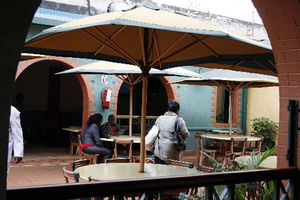
Renowned restaurant owner William Osewe, known for his K'Osewe or Ranalo Foods brand, has lost the battle to stop a lender from auctioning his hotel in the lakeside city of Kisumu over a debt of Sh240 million.
Mr Osewe and Stella Mutheu had offered Blue Waters Hotels Limited in Kisumu’s Milimani area and a five-storey apartment in Nairobi’s South C as collateral for a loan borrowed from Guaranty Trust Bank (Kenya) Limited (GT Bank).
The Court of Appeal upheld a High Court decision and dismissed Mr Osewe’s persuasion that the establishment had a unique value, saying the sentimental value could not override commercial obligations.
Justices Asike Makhandia, Hellen Omondi and Aggrey Muchelule said since the hotel directors had provided the properties as security for commercial loans, they assumed the risk of sale upon default.
“There is no doubt the amount owed to the bank continues to accumulate interest and may get to a level that it may not be recoverable to the detriment of the lender,” said the judges.
And because the hotel owners did not claim that the bank would not be in a position to pay the damages, the judges concurred that the balance of convenience tilted in favour of the respondent (GT Bank).
Mr Osewe and Ms Mutheu, who are directors of Blue Waters Hotel, moved to court to stop the financial institution from exercising its statutory power of sale over the properties.
Mr Osewe has for decades built his food business from a small establishment in Nairobi’s Kaloleni estate to an empire with various outlets, with the city centre’s Kimathi Street branch as a flagship.
On the Kisumu dispute, evidence in court showed that the loan agreement was entered into by the parties on May 12, 2014, when the businessman first took a loan facility of Sh220 million, including Sh10 million overdraft to finance the construction of the hotel.
There were additional conditions for the loan facility, including a debenture over all assets belonging to the hotel, fresh valuation reports from the bank's approved valuers, personal guarantees from the two directors and a corporate guarantee from Ranalo Foods with a board resolution.
The charges over the Kisumu and South C properties were registered on August 6, 2014, to secure the loan.
On October 2, 2017, the directors again requested a six-month moratorium, after which monthly payments, including principal sum and interest, were to resume.
Subsequently, on October 31, 2017, the bank restructured the loan facility once more at the request of the hotel owners to Sh228.45 million under the same conditions and a deposit of Sh1 million.
The lender argued that despite the arrangements, the directors defaulted on the agreed repayment schedules, prompting issuance of a statutory notice on February 7, 2018, seeking to auction the assets to recover Sh239.6 million.
Mr Osewe challenged the notices as defective, saying they did not specify the exact amount required to remedy the default.
He also claimed that the hotel had secured an additional loan facility of Sh100 million from Tourism Finance Corporation in a bid to satisfy the outstanding arrears, but the release of the facility was conditional upon GT Bank lifting its charge over the South C property, which the lender allegedly declined.
The directors also contended that certain supplementary loan terms imposed by the bank were unfair, created under economic duress, and lacked proper consideration.
They also accused the bank of deliberately scheming to frustrate their redemption rights and seeking to dispose of their properties without justification.
High Court Judge Thipsisa Cherere had, during the trial, dismissed the application to stop the sale in 2018, forcing the directors to move to the appellate court.
To buttress their case, the directors emphasised the uniqueness and value of the Kisumu property, highlighting that it was strategically located in a prime waterfront area near the Central Business District of Kisumu City.