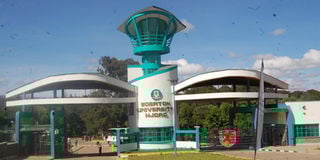
At the heart of Egerton University’s Njoro campus, a quiet scientific revolution is taking root—one that promises to transform Africa’s agricultural resilience amid climate uncertainty.
The GENES II project (2024–2027), funded by the INTRA-AFRICA Academic Mobility Scheme, is equipping a new generation of African scientists with cutting-edge skills in plant genomics, biotechnology, and digital agriculture.
Its mission is both ambitious and urgent: to boost food security and strengthen climate adaptation across sub-Saharan Africa.
Project coordinator Dr Pascal Ojwang, a lecturer in Egerton’s Faculty of Agriculture, describes GENES II as a “continental classroom,” bringing together researchers and universities from Kenya, Nigeria, Benin, Ethiopia, Zimbabwe, South Africa, and the Netherlands.
Other team members Dr Bernard Karanja (publicity and dissemination), Dr Oscar Donde (monitoring, evaluation and quality assurance) and Geoffrey Maina (research assistant)
Through academic exchanges, advanced research, and hands-on experimentation, the initiative is nurturing expertise that the continent critically needs.
Central to the project is crop genetic improvement, using genomic tools to make staple foods more resilient. Two international PhD students are already translating this vision into reality.
One, from Benin, is working to enhance green gram varieties suited for Kenya’s semi-arid regions, where farmers increasingly battle scorching temperatures and unpredictable rainfall.
The second, from Ethiopia, is collaborating with the International Institute of Tropical Agriculture (IITA) and the International Livestock Research Institute (ILRI) in Nairobi to edit the finger millet genome, improving its resistance to devastating diseases.
The project is also fostering African scholars eager to deepen their expertise. Two MSc students—from Jimma University, Ethiopia, and the University of Zimbabwe—completed research at Egerton during the 2024/2025 academic year, focusing on finger millet and green gram.
Their findings are expected to support region-wide breeding programs. Another cohort of MSc students will arrive in 2025/2026, ensuring the momentum continues.
GENES II goes beyond student training. In 2025/2026, Egerton University will send two academic staff members to partner universities for professional exchange while hosting two visiting scholars from Africa. This will strengthen collaboration, enrich teaching, and promote cross-border innovation.
The programme also integrates agribusiness training, preparing graduates not only in laboratory techniques but also in the market dynamics shaping Africa’s food systems.
One Egerton MSc student will pursue agribusiness studies at the University of Zimbabwe, while the Njoro campus will host two graduate trainees from partner institutions. Dr Ojwang emphasises the importance of this integrated approach.
“We are building a skilled workforce that can deploy climate-smart technologies and improve crop productivity across the continent,” he says. “The future of Africa’s food security depends on strong scientific partnerships and transformative research.”
As droughts intensify and pests evolve, Africa’s agricultural landscape faces unprecedented threats. Yet at Egerton University, seeds of hope are being planted, rooted in knowledge, nourished by collaboration, and poised to grow into solutions that could ensure no African goes hungry.
The GENES II project demonstrates how academic mobility, hands-on research, and continental partnerships can deliver practical outcomes for Africa’s most pressing challenges. By blending cutting-edge genomics with agribusiness acumen, the programme aims to empower a generation of scientists to tackle both climate and food security crises.
“Science alone is not enough,” Dr Ojwang notes. “We need research that reaches farmers’ fields, informs policy, and drives sustainable practices. GENES II is designed to do all of this while training leaders who understand both the lab and the market.”
Beyond the classroom and laboratory, the initiative fosters cross-border mentorship and networking, encouraging students and staff to share knowledge and best practices with African institutions. By doing so, the programme builds resilience and cultivates collaboration that extends far beyond Kenya.
For the international PhD and MSc students, GENES II is not just academic enrichment; it is an opportunity to tackle real-world challenges, from enhancing crop resilience in semi-arid regions to protecting staple crops against evolving diseases.
Their work contributes directly to food security strategies across sub-Saharan Africa, laying the groundwork for more resilient agricultural systems.
The project’s long-term vision includes expanding research capacity across Africa, fostering innovation hubs in partner countries, and integrating new technologies to strengthen continental food systems. It also emphasises sustainability, ensuring that scientific advancements translate into measurable benefits for farmers and communities facing climate pressures.
At Egerton University, the fusion of research, collaboration, and practical application represents a blueprint for Africa’s agricultural future. The GENES II project exemplifies how targeted investment in science, technology, and education can yield transformative results, equipping young scientists to confront climate change and secure the continent’s food supply.
As Dr Ojwang concludes, “By combining knowledge, collaboration, and innovative research, we are planting the seeds not just for crops but for a food-secure Africa.”