When dawn breaks over Wahambla village in Homa Bay County, the day begins not with the quiet rustle of leaves or birdsong, but with the thrum of diesel-powered pumps as farmers set out to irrigate their crops.
For years, these machines have been the lifeline of smallholder farmers who depend on River Rang’wena to keep their farms productive in the scorching heat. Without them, the vegetables that sustain Homa Bay Town’s population — including more than 7,000 students at Tom Mboya University — would wither within days.
The village plays a crucial role in the region’s food security, supplying a steady stream of kales, spinach, coriander and other vegetables that keep households and campus cafeterias running.
The need for year-round production is unrelenting, and with erratic rainfall and rising temperatures, farmers have little choice but to turn to the river.
Yet, the very machines that feed the county bring with them noise, pollution, health risks and rising costs that weigh heavily on those who rely on them.
For farmers like Kennedy Okhuta, the early morning routine is familiar.
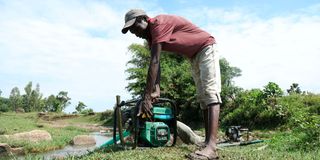
He has operated a diesel pump on his one-acre farm for eight years, and each dry day follows the same script: move the pipes from his homestead to the riverbank, wade into the water to fit the suction inlet, start the engine, then guide the water to his crops.
“All the work requires energy,” Mr Okhuta says. “I have to carry the pipes from home, connect them, irrigate, and then take everything back.”
Fuel alone costs him at least Sh2,000 per session — a steep price for a smallholder whose profits fluctuate with market demand and weather patterns.
Kennedy Okuta powers up a diesel water pump at his farm in Wahambla Village, Homa Bay County on October 27, 2025.
Photo credit: George Odiwuor | Nation Media Group
On top of that are maintenance expenses. A diesel pump, he says, “is like a car”; its moving parts wear out and must be serviced monthly.
Maintenance, parts replacements, and engine oil — which costs about Sh400 per month — can push his recurring expenses up to Sh3,500.
But cost is only one part of the burden. Wahambla farmers also endure the effects of noise pollution as dozens of pumps roar to life at the same time, turning the quiet riverside into an industrial zone. Some machines emit thick black smoke that hangs low over the fields, raising fears of long-term respiratory problems.
The river itself presents another danger that many farmers cannot avoid. To set up the pumps, farmers must step directly into the water, exposing them to Bilharzia — a parasitic disease spread by freshwater snails. Transmission occurs when larvae penetrate the skin and later develop into parasites, which can damage organs and cause chronic complications.
In September, researchers from the Kenya Medical Research Institute (Kemri), working with Israeli scientists, identified River Rang’wena as a high-risk area for Bilharzia transmission.
According to Dr Geoffrey Maina, a senior lab analyst at Kemri, people living along rivers and wetlands are particularly vulnerable, especially when wading in contaminated water.
He warns that donor funding for praziquantel — the primary drug used to treat Bilharzia — is declining, raising concerns about access to treatment for at-risk communities.
Mr Okhuta understands the risks but has little choice. “I have heard stories about the disease, but I have never contracted it,” he says. “Maybe others are affected, but because it is a neglected tropical disease, no one comes out to say they have it.”
Mr Evance Mboya, another farmer who relies on diesel pumps, echoes the frustration. Over the years, various companies and organisations have attempted to introduce cleaner, safer irrigation technologies, but farmers have been sceptical.
“Some of us are ready to change,” he says. “But then you hear stories about systems that failed elsewhere, and you lose confidence.”
Despite the reluctance, farmers agree that diesel irrigation is becoming increasingly unsustainable. Rising fuel prices, unpredictable weather and mounting health concerns are pushing many to consider alternatives — a shift that is already transforming farming practices in parts of the country.
A diesel-powered water pump in use at a farm in Wahambla Village, Homa Bay County on October 27, 2025.
Photo credit: George Odiwuor | Nation Media Group
More than 500 kilometres away, in Gachuriri village in Mbeere South, Embu County, farmers have taken a different route.
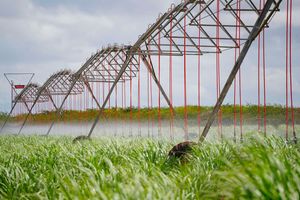
Here, solar-powered irrigation has taken root, helping farmers reduce fuel costs, boost yields and minimise exposure to waterborne diseases.
One of the farmers leading this transition is Mr Stephen Mutua. After five years working for an agricultural company, he returned home to farm full-time. At first, he used diesel pumps like his counterparts in Homa Bay, but rising fuel prices and frequent breakdowns pushed him to explore cleaner alternatives.
He switched to solar irrigation in 2024 — a move he says transformed his farming business. “I realised diesel was becoming too expensive,” he says. “Maintenance was also a burden, and I saw other farmers suffer from Bilharzia when using river water.”
With solar, his irrigation cost dropped to about Sh2,000 per acre during dry seasons, and his profits increased substantially. Many of his neighbours followed his example.
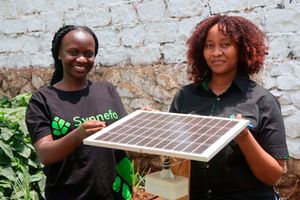
Mr Mutua and other farmers in Gachuriri have been supported by Saw Precise, a company founded by two entrepreneurs — Linda Kamau and Pius Musyoka. The firm operates mobile solar-powered irrigation units known as “sun riders”.
Their idea emerged after they noticed vast tracts of fertile land lying idle as farmers waited for rain. They realised that with access to a reliable water source — River Thiba — and clean energy, year-round production was possible.
“We pitched for funding and managed to set up the first units,” Linda says. Trials were conducted on several farms before the technology was rolled out commercially in 2024.
Today, the company has 15 bifacial solar panels per unit, each capable of producing up to 615 watts. Combined, they generate more than 9,000 watts — enough to run a 4,000-watt submersible pump that draws water from the river to the farms.
Farmers do not operate the systems themselves. The company handles installation, irrigation and maintenance. Customers pay Sh2,000 per acre irrigated, freeing their time for other activities.
“It gives farmers time to focus on more tasks,” Linda says. “Our goal is to reduce carbon emissions, protect farmers’ health and support sustainable agriculture.”
Saw Precise currently serves 150 farmers, with more than 500 others on the waiting list.
Experts say the shift to solar is not just an economic choice — it is an environmental imperative. Dr Erick Ronoh, a lecturer in Agricultural and Biosystems Engineering at Jomo Kenyatta University of Agriculture and Technology (JKUAT), says solar energy reduces greenhouse gases, boosts productivity and supports long-term food security.
“Rain-fed agriculture can no longer sustain farmers in the era of climate change,” he says. “We must adopt new technologies, and solar is top of that list.”
Solar energy can power irrigation, egg incubation, food processing, milling and drying. Foods dried using solar, Dr Ronoh adds, are more hygienic.
However, adoption remains low, with only about 4 per cent of Kenya’s farmland using solar technologies. Barriers include high initial costs, limited technical knowledge, maintenance concerns and lack of trusted suppliers.
Dr Ronoh warns that Africa has increasingly become a destination for substandard electronics, including ineffective solar panels that do not meet industry standards. He advises farmers to conduct thorough research before buying panels and to ensure correct installation, including maintaining the optimal panel angle of 10 to 15 degrees.
He emphasises the need for regular inspections, cleaning, protective barriers against theft and advanced coating to maximise efficiency.
Kenya Climate Change Working Group Chairperson John Kioli shares these concerns. He urges agencies like the Kenya Bureau of Standards (Kebs) to strengthen monitoring to prevent unscrupulous traders from importing defective panels.
“A lot of substandard goods enter the country,” he says. “If we don’t act, ineffective solar panels will flood the market and hurt farmers who are trying to embrace clean energy.”
Back in Wahambla, most farmers are still tied to diesel pumps, unable or unwilling to make the transition until they see tangible proof of long-term benefits. Yet with the health risks rising, fuel costs climbing, and climate variability increasing, the shift toward cleaner energy feels inevitable.
Farmers like Okhuta and Mboya acknowledge that change is needed. What they lack is support — financial, technical and educational — to make the transition possible.
For now, the river continues to sustain them, even as it exposes them to risks and costs they can scarcely afford.
But as examples from Embu show, with the right investment and trust, rural farmers can pivot to cleaner, safer and more sustainable ways of working.
Solar-powered irrigation may not yet be the norm, but it is fast becoming a necessity in a country where climate change is reshaping the future of farming — and where communities along rivers like Rang’wena must choose between tradition and transformation.