When Paul Maina, 29, returned to his rural home in Elburgon from Nairobi in 2023 after completing a casual job, he decided to revive a passion rooted in his childhood: dairy goat farming.
Inspired by his grandparents, who once reared goats, he invested Sh20,000 to construct a raised wooden goat shelter covered with iron sheets and ventilated with wire mesh.
“The environment here is ideal for goat rearing as long as housing is well constructed to protect them from cold, rain, and predators,” he said during a recent interview.
Mr Maina began with three female German Alpine goats purchased from an established farmer in Njoro sub County, each costing Sh10,000.
“The breed is disease-resistant, produces more milk, and can give birth twice a year. The chances of twins and triplets are high,” he said. After a month, he acquired a male goat to sire the does.
Within five months, all three females had twins.
While German Alpines are reliable milk producers, Mr Maina notes that Saanen goats have the highest yield compared to Toggenburgs and British Alpines.
Each goat consumes four to five kilos of feed daily. Goat farming appealed to him for several reasons.
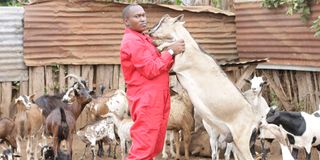
Paul Maina, 29 holds one of his dairy goats he keeps in Elburgon, Nakuru County on February 17, 2026. He makes good sales from milk and manure.
Photo credit: John Njoroge | Nation Media Group
“It requires a small land area and minimal time management. Unlike dairy cows, goats are less labour-intensive, cheaper to maintain, and feed is more affordable. The Sh30,000 I spent on three goats could only buy a single calf,” he explained.
To maintain a healthy herd, Mr Maina deworms the goats every two months and consults livestock officers for guidance.
By the end of the first year, his flock had increased significantly. “Ten goats can multiply to 50, especially if they bear twins or triplets,” he said confidently.
Mr Maina sells a litre at Sh200, compared to cow milk retailing at Sh60.
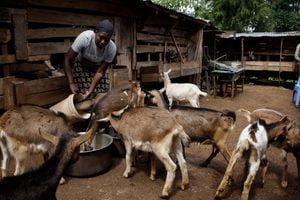
Production dips during the dry season due to feed scarcity. Nevertheless, he remains committed: the enterprise supports his personal needs and provides employment for a casual worker who cares for the goats.
Looking ahead, Mr Maina plans to expand his herd to 200 goats within two years.
His current flock of 40 includes German Alpine, Toggenburg, and other breeds.
He envisions scaling up operations, creating more jobs for local youth, and adding value through products such as yoghurt.
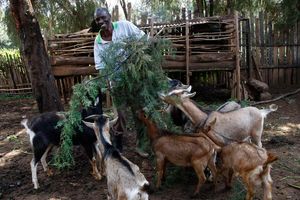
Paul Maina holds one of his bucks in Elburgon, Nakuru County on February 17, 2026.
Photo credit: John Njoroge | Nation Media Group
“Once mature, dairy goats sell for between Sh20,000 and Sh40,000 depending on size and milk production. Bucks fetch between Sh30,000 and Sh50,000. Some farmers hire my buck for breeding at Sh200 per session,” he said.
Mr Maina also participates in agricultural shows and seminars, collaborating closely with livestock officers to enhance his knowledge in feeding, disease control, and herd management.
In addition to milk, he sells manure to local farmers at Sh1,000 for a 90kg bag, while surplus fertilises his parents’ farm.
Goat meat fetches Sh900 per kilogramme at local butcheries. He urges fellow youth to embrace goat farming, which requires minimal capital and land.
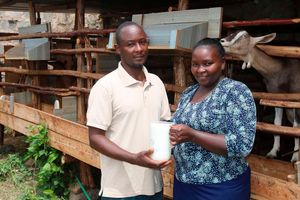
Paul Maina with some of his dairy goats in Elburgon, Nakuru County on February 17, 2026.
Photo credit: John Njoroge | Nation Media Group
Nutritionists highlight the benefits of goat milk. It is easier to digest than cow milk and richer in calcium, phosphorus, magnesium, and potassium, which support strong bones and cardiovascular health.
It also boosts immunity, promotes skin health, and provides vitamin A.
Kuresoi North Livestock Officer Antony Kariuki advises farmers to maintain clean shelters, adhere to regular deworming schedules, and engage with livestock officers to improve disease control and herd management.
Mr Maina’s story demonstrates how a small-scale venture, grounded in passion and good animal husbandry, can transform livelihoods and contribute to community development.