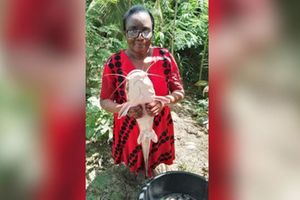
Whenever she speaks in public, Grace Mumo begins by stating that she left school after primary level. It’s not because she is proud of it. She does it to show that no one is limited. The 36-year-old has managed to establish a successful poultry enterprise in Makueni County.
In the Tutini region, at the heart of the Kibwezi West constituency, Mumo has become a household name. In a rural area where keeping chickens is seen as a cultural practice rather than a viable economic activity, she has embarked on a mission to transform poultry farming. She incubates one-day-old chicks and sells them to smallholder farmers at various stages of maturity. She started out with just 100 chicks. Now, she orders 1,000 chicks at a time, making her one of the biggest distributors of improved kienyeji chicks in Makueni County.
Individual smallholder farmers form the bulk of Mumo’s customers. She also sells chicks to organised groups of farmers supported by non-governmental organisations and government agencies. She says that the biggest impact lies in the growing number of smallholder farmers that she has helped to start and sustain commercially viable poultry ventures.
“So far, we have helped over 600 households across Makueni County to improve their chicken farming businesses by introducing them to improved kienyeji chickens and teaching them commercial chicken farming techniques,” Mumo told Seeds of Gold in an interview.
Grace Mumo displays improved kienyeji chicks at Tutini Village in Makueni County on May 1, 2026.
Photo credit: Pius Maundu | Nation Media Group
Mumo’s day starts with inspecting her chicks for diseases and signs of stress. She then visits individual farmers and organised groups to guide them in sustainable poultry farming.
Nothing in Mumo’s story suggests that she was once a lost cause until she reluctantly undertook a six-month poultry farming course at the Kwakathoka Agriculture Training Centre in Makueni County. She credits this training with giving her the conviction and skills to succeed. The poultry management programme plays a significant role in promoting commercial poultry ventures.
“Improved kienyeji chickens mature faster than indigenous chickens. This makes them ideal for commercial purposes,” says John Muthama, a lecturer who teaches poultry management at the college.
To raise improved kienyeji chickens commercially, Muthama advises farmers to reduce chick mortality, which is mainly caused by disease, feed and hygiene issues. According to Muthama, feed costs account for between 60 and 70 per cent of the cost of producing chicken.
“To reduce the cost of chicken feed, we encourage farmers to formulate feeds using locally available resources such as maize and cow peas,” he told Seeds of Gold .
Mumo urges smallholder farmers to start their improved kienyeji poultry ventures small, while Muthama urges caution as the campaign to switch from indigenous to improved kienyeji chicken gathers momentum.
He advises smallholder farmers to keep improved kienyeji chickens for commercial purposes, and indigenous chickens “as part of our heritage”.
“As we switch to improved kienyeji chicken, we should be careful not to lose the uniqueness of the indigenous breed,” he said.
A bid by farmers to keep diseases at bay through vaccination has offered Mumo a steady revenue stream.
“We have managed to overcome diseases such as the deadly Newcastle disease and fowl pox through regular vaccination. We start vaccinating chicks against Newcastle disease when they are two weeks old. We help farmers vaccinate their birds for a fee,” she said.
Mumo's journey towards empowerment began in 2024 with a six-month sponsored training course in poultry management at the Kwakathoka Agriculture Training Centre. This was one of 27 facilities established by the government across the country to address food security by training farmers.
Until 2024, the college offered farmer outreach programmes, but then Anglican Development Services Eastern, a non-governmental development organisation, started sponsoring students. Apart from poultry management, the college offers certificate courses in horticulture and milk production.
Mumo was part of the inaugural class, enjoying full sponsorship and leaving with startup capital including a dozen chicks.