In Mikindani, Mombasa, coconut farming is one of the most notable agricultural activities that greets first-time visitors. On arrival, visitors are welcomed by a canopy of coconut trees, which are a hallmark of Kenya’s Coastal region.
However, at Mzee Karisa’s home, alongside the botanically classified single-seeded drupe fruits, visitors are greeted by a different sight: several fish ponds teeming with different species of fish.
The person behind this transformation is Mzee Karisa’s wife, Eunice Kadzo, proprietor of Kadzo General Enterprise, a fish farming venture based in Mikindani.
“Initially, I used to buy fish from fishermen and sell it to women who roast it, as well as to restaurants and schools,” she says. It was the shortage of fish in the ocean in 2020 that compelled her to seek an alternative approach.
This shortage is largely attributed to changing weather patterns, the effects of climate change, and the ongoing pollution of the Indian Ocean. Ms Eunice notes that plastic bottles, polythene bags, children’s nappies and other waste materials severely affect marine ecosystems and breeding grounds.
She also says that the decline in fish stocks along the coast has been exacerbated by intensive deep-sea fishing that captures juvenile fish and eggs, the use of illegal and undersized nets such as mosquito nets, and ongoing environmental pollution, particularly from plastics, which damage breeding areas.
She adds that women, who depend largely on fish trading to provide food for their families, are often unable to venture into deeper fishing grounds where stocks may still be available.
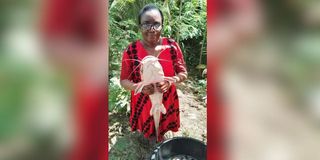
Eunice Kadzo, proprietor of Kadzo General Enterprise, displays harvested mudfish at her fish farm in Mikindani, Mombasa.
Photo credit: Pool
For those who are fortunate enough to access the fish, the opportunity often comes with demands, including sexual advances from fishermen. She believes that this practice can be eliminated if women are economically empowered and given stronger control over the value chain.
When the country was struck by the pandemic, she could only meet 40 to 50 per cent of daily customer demand, forcing her to turn away customers regularly. Income fluctuated depending on fish availability rather than market demand.
Determined to find a solution, Eunice underwent nine months of training at the Kenya Marine and Fisheries Research Institute (KMFRI) before transitioning into aquaculture in 2021.
“I started with one pond measuring 20 by 10 feet on a portion of my husband’s land, stocking between 700 and 1,000 fingerlings, before expanding my enterprise,” she reveals.
Today, she is closely linked to the Coastal Development Lobby Self-Help Group, a women’s group founded in 2011 with seven members, which has now grown to 24. She tells Seeds of Gold that the group manages six fish ponds, each with a capacity of 2,000 fingerlings, thereby strengthening the collective participation of women in aquaculture in Mikindani.
Eunice says that her journey has also had a strong impact on women in the area. The group has become a platform for training and income generation, as well as a space for sharing fish farming knowledge. This has enabled members to manage ponds, feeding schedules and sales more confidently. “I train them in good fish farming practices and help them to create market linkages.”
A mother of two and a grandmother, she says that fish farming alone cannot sustain her household because the fish take about six months to mature before they can be harvested. “During this period, I grow vegetables such as okra and aubergines, which are popularly referred to as bringanya at the Coast, as well as amaranth, to keep myself afloat between production cycles,” she says.
Kadzo Enterprises received key support to scale up production through the Investing in Women in the Blue Economy Kenya (IIWBEK) programme, which is implemented by the African Enterprise Challenge Fund (AECF) and funded by Global Affairs Canada. This included 1,000 tilapia and 7,000 mudfish fingerlings, solar lighting to illuminate and secure ponds at night, six surface nets, fencing materials, quality fish feed and training in financial literacy, marketing and business management.
“The training improved my business management skills, especially with regard to record keeping and customer relations,” she said in an exclusive interview, noting that without customers, there can be no business. Her target market includes women who cook and fry fish, as well as local households, hotels, schools, and other institutions. However, she says demand remains very high and she is still unable to fulfil all customer orders.
Currently, Kadzo General Enterprise has about 2,000 tilapia and a similar number of mudfish ready for harvesting, as well as about 8,000 catfish fingerlings. This brings her total stock to over 10,000 fish at various stages of growth. “We are actually working on expanding the business by increasing the number of fish ponds to meet the growing market demand,” she states. Catfish sell at around Sh600 per kilogramme, while tilapia sell at around Sh400 per kilogramme.
Despite this growth, Eunice highlights a significant challenge in coastal aquaculture: fish from the region tend to be lighter than those from the lake region, which affects yields and market competitiveness.
Nevertheless, improved management practices, training and structured group support have increased production and made harvests more consistent.
Kadzo Enterprises has already harvested some of its fish, while others continue to grow towards maturity.
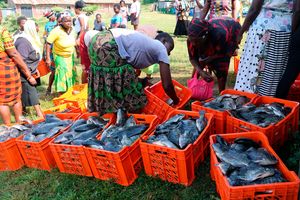
The business now serves around 60 customers a day, supports approximately 50 female fish traders known as 'Mama Karanga Samaki', and supplies fish to two school feeding programmes.
It has also created nine jobs for people from the local community. Of these, five are women and four are men, most of whom are young,
She says that she will continue to champion women’s leadership in aquaculture, urging more women to join groups, start enterprises, and participate actively in Kenya’s growing blue economy. Her husband, on the other hand, is involved in poultry and dairy farming.