An iron sheet gate leads to a compound containing five buildings: a brick house with a blue roof, a store, a kitchen, a chicken coop and an old house with soil-smeared walls that is used as a brooder.
Hidden behind these is a small dairy unit with seven cows, fenced in with iron sheets all around and with controlled single entry to block the animals' feed from prying public eyes.
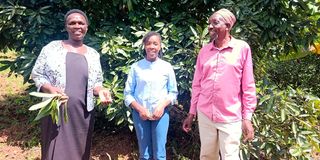
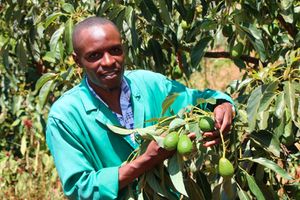
Next to the dairy unit and a banana plantation, Joseph Tonui, a retired teacher, his wife Stella Tonui, and their daughter Sandra Cherotich are applying manure and uprooting weeds at an avocado plantation.
Mr Joseph Tonui and his wife Stella Tonui at their avocado farm in Manyatta village, Bomet County on May 29, 2026.
Photo credit: Vitalis Kimutai | Nation Media Group
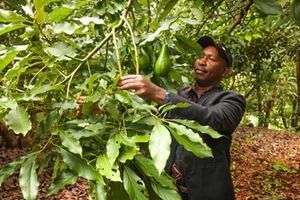
Fruit ready for harvest dangles from the 250 mature Hass avocado trees on the farm, creating a picturesque scene.
The family started avocado farming in November 2019 with 20 initial seedlings, obtained under a subsidy programme by the Bomet County Government, and the investment is paying off.
“I was among those trained in avocado farming at Manyatta village in Kapsimotwo, Bomet Central Constituency. I attended several agricultural meetings where we were taught about planting, spacing, and agronomic practices,” said Stella.
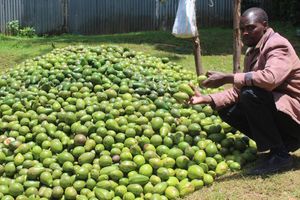
In the first harvest, two and a half years after planting, the family got 25 kilograms of fruit, which they sold for 80 shillings per kilogram, earning them 2,000 shillings.
The second harvest yielded 56 kilograms, which were sold for Sh70, earning them Sh3,920. This spurred them on in their agricultural diversification programme, which has the potential to generate higher earnings than tea, millet and dairy farming.
“Subsequently, we harvested 2,000 kilograms, fetching Sh140,000, and then 4,000 kilograms, fetching Sh240,000,” said Stella, who has been a key part of the project thanks to the training she has received.
“We are looking forward to earning more in the next harvest season, as the trees are continuously growing and producing healthier and more abundant fruit,” she stated.
The family has used the proceeds to upgrade their dairy animals to pedigree breeds, and they use the manure from the unit, which has a biodigester that generates energy for cooking in the kitchen and spurs fruit production in the avocado farm.
The measurements adopted on the farm are seven metres from one tree to the next, and seven metres from one line to the next.
“Initially, agricultural officers told us to use eight-by-eight-metre measurements all round, but we later adopted seven-by-seven-metre measurements after further consultation, to maximise space and ensure high production,” said Mr Tonui.
After broadcasting manure on the farm, there is not much else to do as the trees grow naturally without requiring any spraying with chemicals.
According to Mr Tonui, the family earns more from avocado farming than from tea farming per year.
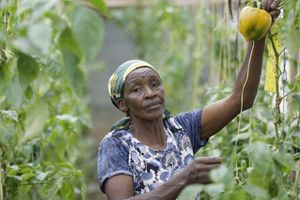
Ms Sandra Cherotich at her parents' avocado farm in Manyatta village, Bomet County on May 29, 2026.
Photo credit: Vitalis Kimutai | Nation Media Group
"With the best agronomic practices, it is possible to get 200 kilograms from one tree per year, which is worth more than Sh16,000 . However, you cannot get even a quarter of that (Sh4,000) from a tea bush per year," he stated.
They started with 20 seedlings, of which 10 survived. This did not deter them, and they have since increased to 250 trees, with plans to further increase this number.
“We have educated our children and paid our bills with the proceeds from the avocado farm, which has been very encouraging. One of our children, who is studying at the Kenya Medical Training College (KMTC), is a beneficiary of the farm's profits, as we are using them to pay their fees and living expenses,” Mr Tonui stated.
Intercropping with traditional vegetables, which do not require spraying with pesticides, has enabled the family to earn more from their investment.
“It is important for the county government to set up an avocado processing factory so that farmers can access a direct market for their produce and earn more from their enterprise,” said Ms Sandra Cherotich, who is helping her parents to apply modern farming techniques to the farm.
“Young people should consider getting involved in agriculture as it is a worthwhile investment that can create employment opportunities. Avocado seedlings are easy to plant and maintain, and then you can wait for the harvest season,” she added.
“Planting avocados is good not only for commercial and nutritional purposes, but also for environmental conservation and the government's initiative to plant 15 billion trees by 2032,” she said.
To avoid brokers exploiting farmers in the region, the family has an unwritten agreement with an exporter who buys the produce for no less than Sh70 per kilogram, but they are open to offers from other exporters with clear terms of engagement.
The Bomet County government is constructing a packhouse in Boito, Konoin Constituency, which will be an aggregation centre for farmers in the region. Farmers are being encouraged to form cooperative societies and leverage high volumes to get better prices.
Mr Bernard Cheruiyot, the County Executive Committee (CEC) member for Finance and Economic Planning, whose department is responsible for the project, said the devolved government unit was keen to help farmers achieve premium prices from exporters by increasing production.
“The demand for avocados in the export market is insatiable, with Kenya’s harvest season falling outside the window of the highest global producer, Mexico,” said Mr Cheruiyot.
“Bomet County is helping farmers to access certified avocado seedlings, increase the area under cultivation and form cooperative societies, as well as providing market linkages to ensure they receive premium prices,” he added.
Mr Joseph Tonui (right), his wife Stella Tonui (left) and with their daughter Sandra Cherotich at their avocado farm in Manyatta village, Bomet County on May 29, 2026.
Photo credit: Vitalis Kimutai | Nation Media Group
Farmers are taught pest and disease control measures by Ministry of Agriculture extension officers. Following these measures will lead to high production.
Dr Kibet Sitienei, the Chief Officer for Agriculture, said that agronomists were helping farmers control pests and diseases to reduce losses.
“Traps are used to catch pests, and beehives have been introduced to boost cross-pollination. Farmers are also taught how to make and apply compost manure to their crops,” said Dr Sitienei.
Apart from the popular export varieties Hass and Fuerte, Pinkerton, Jumbo and Bacon avocados are also grown in Kenya.
Major export outlets for the Hass avocado from Kenya include the Netherlands, Russia, China, Spain, Italy, France, Belgium, the United Kingdom, Saudi Arabia, Qatar and the United Arab Emirates (UAE).
However, Saudi Arabia, Qatar and the UAE have recently been affected by the war in the Middle East, which has made access to these markets challenging for exporters.
In 2025, Kenya produced 105,164 metric tonnes of avocados, compared to 129,706 metric tonnes in 2024 — a decline of 24,502 metric tonnes.