In 2013, Kerubo Askah Nyakwara – known simply as Askah – a trained food scientist, became increasingly concerned about the vast amount of bananas going to waste in her homeland.
Born and raised in Nyamira County, a region renowned for its banana production, Askah witnessed the challenges faced by local farmers, including her own mother, during periods of abundant harvests.
“During harvest time, they would struggle to sell their produce. In most cases, they were forced to accept throwaway prices or watch much of it go to waste. We were losing up to 40 percent of our bananas after harvest,” she says.
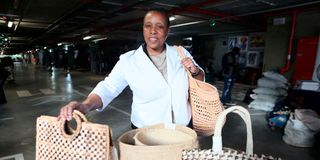
Askah Nyakwara, the co-founder of Wefahson Banana Farmers Cooperative, showcases products made from banana fibres at Sarit Centre in Nairobi on May 14, 2025.
Photo credit: Bonface Bogita | Nation
This realisation led to the establishment of the Wefahson Banana Farmers Cooperative Society, a banana value addition initiative that has since blossomed into a circular economy model, creating jobs and reducing waste.
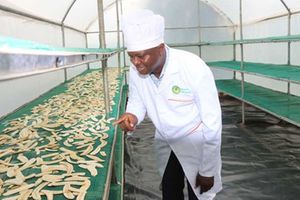
Starting with simple banana crisps and flour in 2013, her operation now produces banana wine, juice, doughnuts, purée and more. Even the 80 percent of the plant that is usually discarded is put to use.
“We don’t call it waste anymore,” says Askah with pride. “It’s a resource.”
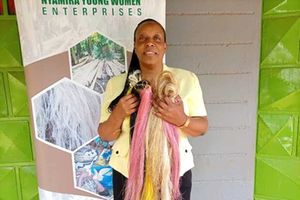
They extract fibre from banana stems, which is used to make a wide variety of eco-friendly products, including baskets, mats, braids and carrier bags made from hard banana pulp. Even the water content extracted during fibre processing is repurposed as foliar feed for vegetable farming. The result? Zero waste.
Items made from banana fibres displayed at Sarit Centre in Nairobi on May 14, 2025.
Photo credit: Bonface Bogita | Nation
According to Caroline Kosgei, an agricultural value chains expert and project coordinator at the Food and Agriculture Organization, demand is growing for value-added banana products.
“This ranges from flour and baby food to fibre-based materials and wine, but the sector is in its infancy, so it needs significant support to grow.”
But Askah’s passion was deeply personal: she was raised in a family of nine and witnessed her mother working as a smallholder banana farmer. “I saw her sell bananas for as little as Sh200 after waiting 16 months. That money wasn’t enough to feed or educate us,” she recalls.
This early struggle instilled in her a sense of determination, and so, after graduating with a diploma in food science from Kisumu Polytechnic in 2002, she returned home and began researching ways to add value to bananas.
This quest led her first to the Kenya Agricultural & Livestock Research Organization (Kalro) and then to the Kenya Industrial Research and Development Institute (Kirdi), where she found both mentorship and machinery.
“I had the ideas, the research and even the prototypes. But I had no equipment,” she says. “Kirdi took us in. We don’t own the machines — we lease them. But that was the start.”
Today, Askah's initiative works with 506 registered banana farmers across Nyamira County. These farmers supply around three tonnes of bananas per month. However, demand still far exceeds supply, not due to a lack of bananas, but due to limited processing capacity.
“We work in a government facility that opens at 8am and closes at 5pm, which limits us,” Askah explains. “If we had our own facility, we could easily double or triple production.”
Askah Nyakwara poses with wine made from bananas at her workshop at the Kenya Industrial Research and Development Institute in Kisii on September 12, 2022.
Photo credit: File | Nation
However, even within these constraints, the initiative continues to thrive, supplying banana doughnuts made from in-house produced flour to schools.
“Crisps are sold in local supermarkets and by hawkers, and the wine – a customer favourite – sells out online within weeks of being posted,” she adds.
Before the pandemic, they exported 10,000 packets of banana products per month to South Africa. However, the pandemic disrupted supply chains and the export market dried up. “We had to start again from scratch,” says Askah.
According to Kosgei, this is just one of several challenges that continue to hinder many banana processors in Kenya. She highlights other major obstacles, including unreliable banana supply due to a lack of clean planting materials; significant post-harvest losses caused by poor handling and inadequate cold chain infrastructure; limited processing capacity coupled with outdated technology; weak branding and low market competitiveness; restricted access to financing; and minimal investor interest.
“These are solvable,” emphasises Kosgei. “Investments in aggregation centres, access to inputs, cold storage, research and development, and certification could transform the value chain. We need to build profitable, inclusive models that secure farmers’ roles and promote private investment.”
For entrepreneurs looking to enter the banana processing industry, she offers the following advice: “Understand your market deeply, partner with cooperatives to secure supply, work with institutions like Kirdi for technical support, and adhere to food safety and regulatory standards.”
Askah Nyakwara poses with wine and crisps made from bananas at her workshop at the Kenya Industrial Research and Development Institute in Kisii on September 12, 2022.
Photo credit: File | Nation
As well as food processing, Askah's work involves transforming her community. She employs 22 people directly, and many more indirectly benefit from her business. For instance, local transporters have found steady work moving bananas. Women, on the other hand, have discovered new income streams by weaving banana fibre products, while the youth are learning technical and business skills within the cooperative.
“We’ve inspired so many people,” says Askah. "There are now several banana processors in Kisii and Nyamira counties who started out after seeing what we were doing."
Her team has even piloted a new model for school feeding programmes. By processing and vacuum-packing peeled bananas, they aim to supply local schools, many of which currently rely on imports or do not include bananas in their meals.
“In Kisii land, bananas are our staple food,” says Askah. “Children eat them at home, but at school they never see them. The problem partly lies in the time-consuming peeling process, and that’s what we are changing.”
She envisages a future where parents supply bananas to schools in lieu of paying school fees — a perfect example of a circular economy in action.
In the meantime, however, she and her team must overcome the challenges that continue to plague their operations, the most pressing of which is infrastructure. “We don’t have a collection centre for bananas,” Askah notes. “That makes it hard to organise our supply chain. We need one place where farmers can bring their produce so that we can collect both the bananas and the so-called waste efficiently.”
Processing capacity is another bottleneck. Without their own equipment, and with access limited by government working hours, the team can currently only process a fraction of what the market demands.
Askah Nyakwara poses with mats made from banana fibre at her workshop at the Kenya Industrial Research and Development Institute in Kisii on September 12, 2022.
Photo credit: File | Nation
She is now calling on the county and national governments to recognise and invest in the banana value chain. “We have 14 cottage industries emerging from one plant,” she says. “That’s employment, food security and rural development. Why ignore it?”
The cooperative that she founded, which she now runs with her husband, the director, is planning to expand across Kisii and Nyamira. The aim is to reduce post-harvest losses further and integrate bananas into school nutrition programmes. “Right now, we’ve reduced losses from 40 percent to between 20 and 30 percent. But we can do better,” she says.
Beyond the numbers, she says it's about restoring dignity to the banana farmer. “No one should wait 16 months for a harvest worth Sh200,” she says. “That’s not just poor economics; it’s a lost opportunity.”