Hello

Your subscription is almost coming to an end. Don’t miss out on the great content on Nation.Africa

Ready to continue your informative journey with us?

Hello

Your premium access has ended, but the best of Nation.Africa is still within reach. Renew now to unlock exclusive stories and in-depth features.

Reclaim your full access. Click below to renew.

Wamatangi’s free seeds and fertiliser give Kiambu farmers bountiful harvests
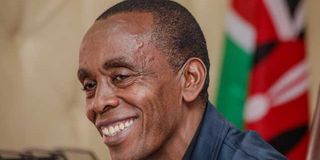
Kimani Wamatangi

Kiambu Governor Kimani Wamatangi.

Photo credit: File | Nation

For years, residents of Ndeiya, a semi-arid area that straddles Kikuyu and Limuru sub-counties in Kiambu County, often relied on relief food from the national and county government as well as well-wishers.

The story is the same for Ngoliba and Gatuanyaga areas in Thika West, another semi-arid block in the county that has also been grappling with famine due to poor harvests and the unavailability of quality farm inputs and harsh climate.

But for the past two years, residents have been recording bumper harvests following Kiambu Governor Kimani Wamatangi's initiative to provide free fertiliser and hybrid maize seeds to all farmers in all arable areas across the county.

The initiative, which was part of his campaign manifesto under the ‘Farm Input Subsidy Programme’ agenda, has seen over 600,000 farmers receive packets of different varieties of maize seeds depending on the location and bags of planting and top dressing fertiliser every planting season.

Mary Wanjiku, a resident of Thigio in Ndeiya Ward, Limuru Sub-County, owns a half-acre piece of land and has benefited from farm inputs at least four times over the past two and a half years.

She says that previously, she struggled to afford quality maize seeds that could withstand the harsh climatic conditions in her home area, where githeri and ugali are deemed to be the staple food.

Wanjiku would buy two 20-kilogramme tins of harvested maize from the local trading centre for planting. Fertiliser was never part of her plan, which often resulted in poor yields, less than a single 90-kilogramme bag.

However, since the launch of the free farm input programme by Governor Wamatangi, Ms Wanjiku no longer worries about acquiring the necessary farm inputs.

“You simply wake up to an announcement from a public address vehicle, informing the community that the governor will be visiting to distribute farm inputs. People, within a five-kilometre radius of the announced venue, come and are registered by the agricultural officers from the county,” Wanjiku said.

“The inputs are laid out, and thousands of people present can pick up a bag of maize and fertiliser. The governor does the supervision and ensures everyone gets it. I had never experienced anything like that before.”

She adds: “Since I started getting the free farm inputs, I have never lacked food in my house. Sometimes I even afford to sell some of it.”

Mr Wamatangi says the free farm inputs are meant to address food insecurity by, among other things, reducing the cost of basic food. He added that the programme, which is fully funded by the county government, targets small-scale farmers.

“Some leaders fail to understand why we have put a lot of focus on distributing maize and fertiliser. With the free input and a good harvest, our people no longer care about the cost of the flour because all they need to do is take the maize to the local posho mill. That is how for the last two and a half years, we have not had cases of people in need of relief food,” the governor said in an interview with Seeds of Gold.

With sufficient food, Mr Wamatangi said the households invest their time and energy into other productive economic activities, which helps them earn income and enhance their overall well-being.

Ms Margaret Wangari from Kwa Maiko in Ngewa Ward, in Githunguri Sub-County, said the county government has been ensuring that before rains start, farmers are always ready with seeds and fertiliser.

She is harvesting the crop she planted early this year, and already has seeds for planting in the next season.

County Chief Officer in charge of Crops, Mr Benson Ndung’u, stated that before placing the initial order, the county government conducted research to determine which varieties of seeds would thrive in specific areas.

The seeds, he said, are bought from the Kenya National Trade Corporation (KNTC), which is a semi-autonomous state entity.