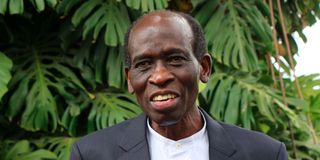
The Global Methane Genetics Initiative is an important step towards making the livestock sector in Africa more sustainable and productive. This ambitious programme aims to accelerate the reduction of emissions from indigenous livestock breeds across the continent. Seeds of Gold writer Richard Maosi spoke to Professor Raphael Mrode, principal scientist at the International Livestock Research Institute in Nairobi, to gain some insights.
In many African countries, livestock plays a critical role in the economy, contributing significantly to gross domestic product (GDP).
In Kenya, for example, the livestock sector accounts for approximately 4.5 percent of GDP, and dairy alone is responsible for 44 percent of the livestock sector's contribution.
Furthermore, the dairy sector provides livelihoods for around 1.8 million smallholder households and directly employs approximately 750,000 people, while indirectly supporting an additional 500,000 individuals across the value chain.
However, climate change is proving to be a challenge and is already having a significant impact on agri-food systems in general, and on livestock-based food systems in particular.
Methane is a powerful heat-trapping gas that is often released alongside other toxic pollutants, contributing to ground-level ozone.
This greenhouse gas is responsible for around 30 percent of the current rise in global temperatures and is therefore the largest contributor to global warming, causing some of the climatic shocks that we are experiencing today.
Here, a chute is attached to the animal and a fan pulls air into the ducting, where the airflow is measured and subsampled for analysis.
Methane laser detectors and high-precision sensors ensure stable and accurate gas detection in a livestock population.
Additionally, we use the oral stomach tubing method for microbiome sampling to measure the abundance of various microorganisms and greenhouse gases in a sample.
We are also collaborating with the Mazingira Centre, a leading research hub dedicated to understanding and mitigating the environmental impact of livestock systems. The Centre focuses specifically on greenhouse gas emissions from animals, manure and soil.
In Africa, livestock account for 18 percent of global livestock methane emissions, with cattle being responsible for 70 percent of emissions in Sub-Saharan Africa alone.
Although Sub-Saharan Africa's current contribution to global livestock emissions is only 10 percent, this figure could triple.
With a projected doubling of the human population by 2050 and increased demand for animal-derived products, these emissions could therefore triple without intervention.
Other emissions come from human-induced activities such as energy production, industrial processes, agricultural practices, land use and waste management.
The Global Methane Genetics Initiative will use cutting-edge science to help African countries breed cattle that produce lower methane emissions.
Focusing on the genetic diversity of indigenous breeds will also help Africa contribute to global climate goals, including the 1.5°C warming target.
The project aims to reduce emissions while strengthening the productivity, food security and climate resilience of millions of smallholder farmers across the continent by improving indigenous livestock.
Experts will oversee the scientific management of the initiative by integrating advanced genetics with indigenous African breeds and farmers' knowledge. This will enable us to achieve meaningful reductions in methane emissions while strengthening rural livelihoods through improved productivity.
One key area is measuring methane from 3,000 cows and production traits in five African countries using advanced laser detectors and mobile apps linked to existing data on 9,000 cows.
The profiling of microbial communities in over 1,000 tropical cows will be used to understand the links between microbes, productivity and methane emissions.
Scientists are using advanced genetic tools to breed cattle that can withstand heat better, require fewer resources and produce fewer greenhouse gases. These climate-smart cattle are being introduced into national breeding programmes across Kenya, Ethiopia, South Africa, Burkina Faso and Benin, helping farmers to adapt to climate change whilst reducing emissions.
Local capacity is being built by recruiting and training technicians, strengthening national breeding centres, and publishing bull and cow rankings that are accessible to farmers.
Curbing methane emissions is key to slowing down the adverse effects of climate change. Have there been any milestones?
A 12 percent cut in livestock methane over 20 years has been achieved through an annual 0.6 percent direct reduction in methane emissions at population level by using bulls and cows that are bred to emit less methane.
Improved productivity is expected to reduce methane production per kg of milk by 20–25 percent over five years.
Publicly available genomic data will support widespread, low-cost breeding improvements. Improve access to productive, climate-resilient livestock for smallholders, with a particular focus on women and young people.
This initiative is a significant step towards aligning livestock research with climate action. It offers a sustainable and cost-effective way to mitigate methane emissions while securing the future of African farming communities.
The International Livestock Research Institute (ILRI) will coordinate the Africa-wide effort from Nairobi, Kenya, and Addis Ababa, Ethiopia, working alongside leading partners.
These include the Agricultural Research Council (South Africa), the French Agricultural Research Centre for International Development (CIRAD), the International Centre for Research and Development of Livestock in the Subhumid Zone (CIRDES, Burkina Faso) and the University of Abomey-Calavi (Benin).
Partnerships with organisations such as URUS and GENUS will ensure dissemination through breeding centres and farmer networks.
In September 2025, the partnership announced the launch of a three-year initiative worth US$3.35 million.