For years, dairy farmer Betty Bett has faced challenges in expanding her enterprise and reaping profits due to shortages of pasture.
Ms Bett, a resident of Kapsoiyo in Silibwet, Bomet County, almost gave up at one point to venture into other businesses so she could pay her ever piling bills.
But an intervention by the county government of Bomet, which introduced a pasture production subsidy programme, came in handy and helped spur growth in her farm.
From three dairy cattle two years ago, she now has eight dairy cows on her farm, which she keeps in a zero grazing unit.
“Initially, I kept the animals in open grazing due to a lack of enough pasture, an undertaking, which did not give me much returns. I almost gave up on it,” Ms Bett said.
“With the support from livestock production and veterinary officers from the Bomet county government, I have since expanded the farm, which is starting to pay off.”
She now gets an average of 70 litres daily compared to the 21 litres she got when the animals were under the open grazing unit.
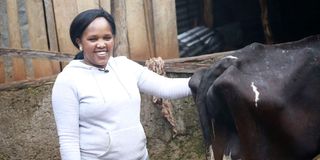
Betty Bett stands by her dairy cow at her farm in Silibwet, Bomet Central.
Photo credit: Labaan Shabaan
Ms Bett supplies fresh milk to hotels in the Silibwet trading centre at a cost of Sh50 per litre, and uses some of it to feed her family.
Evans Kiptoo, who sells Boma Rhodes, said, “Business is good. As a matter of fact, more farmers are embracing modern farming techniques using small units of land to produce milk on a commercial scale,” he said.
A bale of the Boma Rhodes—a drought-tolerant grass that grows up to 90 centimetres high and is good for hay production—now retails for Sh300 from an average of Sh200 during the rainy season.
Kericho, Bomet and Narok county governments are banking on a sustained campaign to have farmers embrace commercial planting of pasture to boost dairy and beef production in the region.
The three counties in the South Rift region have provided farmers with Boma Rhodes seeds under a subsidy programme that has led to increased production and a steady supply of pasture to animals.
Peter Kiprono, a farmer in Kaporuso, Bomet East constituency, said he has leased 10 acres of land in Narok County to grow pasture for his 10 cows.
“Due to the high cost of raising dairy cows with increased prices of commercial feed, I have pasture in store that could last for at least one year,” he said.
Florence Asero, a pasture hawker at Chepkolon village in Kericho municipality, said she sells at least six gunny bags of freshly harvested kikuyu grass to farmers. She hawks the cattle feed on the Litein-Kericho highway.
“I sell a gunny bag of pasture at Sh100 each. Demand for pasture is high,” she said. “I make an average of Sh600 a day.”
Nelson Kiplangat, a farmer in Rongena, Narok West constituency, said: “It only makes business sense for us to raise pasture stock levels during the rainy season and sell them during the dry season. That enables us to make profits and sustain the business.”
Zero and semi-zero grazing of livestock is a practice that is being embraced slowly across the country, even by some of the nomadic communities.
“Farmers are being sensitised on the need to adopt modern farming practices with the use of Artificial Insemination Services (AI),” said Dr Kibet Sitienei, the Chief Officer for Agriculture and Livestock in Bomet County.
Dr Wilson Serem, the county director of veterinary services, said farmers are abandoning archaic farming practices.
Langat Magerer, the County Executive Committee Member (CECM) for Agriculture in Kericho County, said the World Bank supported smallholder farmers to embrace modern farming techniques and rake in profits from their investments.
“The programme is implemented through the Kenya Climate Smart Agriculture Project (KCASP) in conjunction with the county government, benefiting 406 self-help groups,” he said.
In Narok County, farmers are being encouraged to improve their stock to make profits from their enterprises.
“The county government of Narok is training farmers on the adoption of modern farming techniques,” said Joyce Keshe, the County Executive Committee (CEC) Member for Agriculture and Livestock.
Youth and women in the three counties are particularly encouraged to engage in farming to create wealth, curb overreliance on white collar jobs, and boost food security.
“My administration is assisting farmers to improve their livestock breeds,” Bomet Governor Hillary Barchok said.
Dr Erick Mutai, the Kericho Governor, said livestock farmers in the region had been trained on how to improve their animal breeds to improve the production of milk and beef.
Mr Patrick Ole Ntutu, the Narok Governor, said the local community was embracing modern farming techniques that had led to high production of beef and milk.