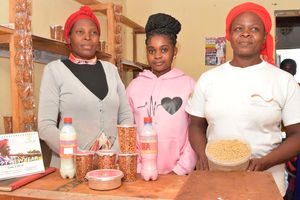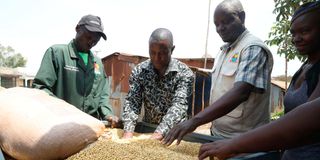
Homa Bay County Director of Agriculture Kennedy Opiyo (second right) Farm Africa Agronomy Technical Lead Stephen Bundi (centre) and aggregator Elijah Odondo sample soya beans delivered at a collection point at God Jope trading centre in Suba North in Homa Bay County on July 22,2026.

Soya bean harvesting season is upon us in Suba North, Homa Bay County, and many farmers are pleased with their decision to grow the crop.
The region was previously known for producing maize. Other farmers grew groundnuts.
However, neither crop is profitable based on the current circumstances, including unpredictable weather patterns.
After harvesting maize, farmers have to reduce prices because the market is flooded.
The crop is sold in 4-kilogram tins for less than Sh80 per tin during the peak harvesting season.
Middlemen purchase the crop from farmers, store it and then resell it at more than Sh150 per tin during the dry season.
Residents say that the lack of storage facilities means they have to sell their produce at rock-bottom prices.
Groundnut farming also faces challenges. In Miyal East Village, for example, farmers grow the crop for local consumption.
It is profitable when sold to food processors, who use it to make products such as peanut butter.
However, high levels of aflatoxins in the crop make many manufacturers reluctant to buy groundnuts from Homa Bay.
Tabitha Achieng is one of many farmers who used to grow groundnuts.
She says that after expending energy on preparing the land and hoping to make money from the crop, the amount she received at the end of the harvesting season was insufficient to meet all her needs.
“Groundnut farming has many challenges. As well as a lack of market, some people pick the crop from the farm and eat it. Often, you will find people eating the groundnuts once they have matured, which reduces production,” says the farmer.
During certain seasons, the groundnuts would fail on her farm.
“I can't say exactly why the groundnuts failed, but I got small nuts that couldn't be sold at market,” says Achieng.
According to agricultural experts, many farmers recycle seeds, which leads to reduced yields.
In most rural areas, residents rely on guesswork for their production, often resulting in failed crops.
After many unsuccessful attempts, Achieng decided to stop growing groundnuts.
Like many others in her village, she switched to producing soya beans after failing to make a profit from other crops.
There is increased demand for soya beans in the country.
As well as being used as food for humans, the high-protein material left over after oil extraction is used globally to feed livestock, poultry, and farmed fish.
It is one of the main plant-based protein ingredients in animal feed.
At Achieng’s home in Miyal East, the one-acre plot of land that was previously covered in groundnuts is now full of soya beans.

Soya beans (Glycine max) are a good source of protein. They are also a good source of most of the B-complex vitamins, and the essential minerals iron and potassium. PHOTO | FILE
Her neighbour, Sarah Okoth, also started producing soya beans two years ago and is happy with her decision to abandon other crops.
She uses the money she earns from selling the crop to pay her children's school fees.
The crop takes about four months to reach harvesting maturity, and experts say that farmers who implement best practices can harvest at least 800 kilograms from an acre of land.
Production can rise to 1.1 tonnes per acre if soil nutrients and weather conditions are favourable.
In a good season, Sarah can produce six 100kg bags of soya beans from her farm and sell them all.
She sells the soya beans at Sh70 per kilogram. This equates to an income of Sh42,000.
Tabitha explained that the crop had changed her life since she started growing it three years ago.
“I am currently building a permanent house with the profits I make from producing soya beans. I have also bought cattle to diversify my agricultural production,” she says.
Their success in producing soya beans is attributed to training they received from Farm Africa, which works in partnership with smallholder farmers and small businesses to unlock the transformative potential of sustainable agriculture.
Both farmers are beneficiaries of a programme called Youth in Sustainable Aquaculture (YISA), which implements poverty eradication through soya bean production.
When they got married in the village, they had no source of income, which made them entirely dependent on their husbands.
Dependence on a spouse for financial support can lead to poverty.
It can also lead to conflict within families when the main source of income is lost.
The stories of Achieng and Sarah confirm that women can contribute equally to the growth of their families and the country in general.
Stacy Lerai, an agricultural extension officer at Farm Africa, says that beneficiaries who have started new businesses have established local trading centres.
Based in Lambwe Ward, she is responsible for identifying farmers interested in producing soya beans.
"Families that have started producing soya beans have children who can go to school. Problems paying school fees are a thing of the past,” she says.
Before they start production, beneficiaries are given training in how to recognise signs that crops are affected by pests and diseases.
They are also taught other best farming practices.
This is meant to ensure maximum production.
According to data from the Kenya National Bureau of Statistics (KNBS), Homa Bay County is the leading producer of soya beans in Kenya, accounting for around 47 per cent of the total national output.
Up to 6,000 young farmers from all 12 sub-counties in the region, aged between 18 and 35, have enrolled in the programme. They are engaged in various agricultural activities, including aquaculture, mariculture and black soldier fly production, as well as other farming ventures.
Eighty per cent of the farmers are female, with the remainder being male.
As part of the programme, farmers are given financial support in the form of grants and interest-free loans.
This helps them to cover the costs of preparing the land and purchasing seeds.
The funds used for production are recovered when the farmers harvest their crops and deliver them to a collection centre.
Farmers are also trained in the best farming practices to help them increase their soybean production.
One of the best aspects of the production cycle is the quick market. Farmers are paid instantly when they deliver produce to one of the five collection points.
Elijah Odondo is one of the village-based agents who collects the harvested crops.
He is both an aggregator and a farmer.
At his aggregation centre in God Jope,
He has been involved in production for over 10 years.
“In the past, I would get 300 kilograms from one acre, which was a loss considering the money I spent on production. Now, I get double that amount, thanks to the new skills I have acquired to help me produce more,” says Odondo.
He now connects farmers with the market. Farmers in the Lambwe area take their produce to the aggregation centre that he runs.
After the harvest, the crop is bagged up and taken to the centre, where it is sieved to remove foreign materials, soil and small stones.
It is then weighed, and payment is made instantly.
'One of the good things about this system is that payment is prompt. Anyone who needs quick cash and has mature soya beans ready for harvest can bring them here. Payment takes place within five minutes,” says Odondo.
The programme has created many employment opportunities in the areas where it is being implemented.
At the aggregation centre, Odondo has hired two people to help him collect crops from farmers and keep records, while another employee makes payments to those who deliver produce.
Dr Stephen Bundi, Farm Africa’s Agronomy Technical Lead for the YISA programme, says that the $20 million programme aims to improve the livelihoods of residents in Homa Bay and other regions where beneficiaries are located.
He notes that the YISA programme has recruited 124,000 young farmers, 68,000 of whom have been trained across six counties.
“Out of these, 16,000 participants are producing soya beans in the six counties where we operate. Some have ventured onto the same farm more than once,” he says.
Dr Bundi says that support is provided in the form of loans, whereby beneficiaries are offered cash which they pay back once they have done business.
He explains that the money is paid back without interest.
'We also offer grants called challenge funds to young people who can prove that their enterprise can thrive with support. We also support other enterprises' assets, which has a ripple effect,” he says.
Most beneficiaries receive direct support in the form of training and capacity building, including business and life skills training.
“Our objective is to reduce poverty by providing young people with the opportunity to create wealth. Testimonies from farmers prove that this project has transformed their lives,” says Dr Bundi.
Soya is one of the most valuable sources of plant protein.
According to Dr Bundi, Kenya produces 2,000 metric tons of soya beans, yet the demand for consumption is 200,000 metric tons. This means that the country produces only two per cent of what is required.
He says the project will bridge the gap in the demand for soya beans in Kenya.
“There is huge demand for soya beans in Kenya. This project is helping to bridge the gap in production in the country,” he says.
Kennedy Opiyo, the Homa Bay County Director of Agriculture, says the region has up to 240,000 registered farmers.
However, he adds that not all of them can receive support, as the county government relies on support from various organisations.
The devolved government has identified soya beans as one of the priority crops due to their high market value and fast maturity.
The agricultural officer wants more farmers to start growing soya beans.
“We encourage farmers to use varieties that mature faster in order to overcome the challenges posed by unpredictable weather conditions. These include SC Saga and DPSB8, which are high-performing varieties of soya bean in Kenya, known for their distinct agronomic traits,” he says.
Opiyo says that Farm Africa has made the necessary arrangements to ensure an adequate market for soya beans by establishing aggregation centres.
These centres purchase soya beans from farmers in their respective villages.
He adds that the county has fertile soil for propagating soya beans.
“One of the greatest challenges in crop production is the lack of a market. We should encourage as many farmers as possible to grow soya beans because the market is available,” says Opiyo.
The project, which started in December 2023, is expected to transform more lives in the county.
Like other agricultural ventures, the programme faces the challenge of drought.
Dr Bundi says that climate change makes it impossible for farmers to predict rainfall patterns, which makes planting difficult.
“We had little rain in 2025 and lost some crops. From this experience, we learnt that some varieties can survive with little rain. We want farmers to embrace climate-resilient seeds,” he says.
Follow our WhatsApp channel for breaking news updates and more stories like this.