For the young Kennedy Mutua, the sound of native bees buzzing around traditional log hives swinging from acacia trees in the sun-bleached terrain of Kalawa in Mbooni East, Makueni County was just part of everyday farm life.
It was this upbringing that would eventually motivate him to turn beekeeping into a climate-resilient business for smallholder farmers.
In order to address the poor and erratic yields that have traditionally limited honey production in Kenya's arid and semi-arid regions, Mutua is combining improved hive technology, better queen genetics, practical training and market access.
“Beekeeping was never introduced to me as a business idea,” he recalls. “It was something I grew up watching my grandfather do. He worked with bees in the same way that previous generations had, using traditional log hives and relying on his intimate knowledge of the seasons, weather, and landscape.”
At the time, there seemed little reason to question the practice. The log hives were affordable, the traditional knowledge was familiar, and beekeeping fitted naturally into rural life.
It was only as Mutua grew older that he began to notice a contradiction. Farmers were putting in the work, yet their hives were not producing yields that matched their efforts.
“Farmers were getting low and unpredictable yields. Colonies would abscond during dry spells and the quality of the honey varied widely. They routinely sold raw honey at low prices, while much of the value of other bee products was never realised,” he says.
He realised that the problem was not simply a shortage of bees or forage, but rather an absence of systems to support the enterprise, including everything from colony management and genetics to harvesting, quality control, and market access.
This realisation led to the establishment of Native Beecare, an agribusiness venture centred on developing a more organised commercial beekeeping enterprise around farmers.
“One of the lessons I have learnt is that innovation does not mean abandoning the past,” he notes. “For many farmers, the traditional log hive is a familiar, affordable and accessible option. Rather than telling them that their methods are wrong, we focus on refining what already works.”
Native Beecare combines improved log-hive designs and quality queen breeding with hands-on extension services, practical training, and structured quality control systems.
“Our objective is simple: more productive colonies, higher-quality bee products, better prices and sustainable incomes,” says Mutua. “The hive becomes more than just a place where bees live. To me, it becomes a productive rural asset.”
For decades, much of Kenya's beekeeping industry has focused on honey, while other hive products have received less attention.
A well-managed colony can also produce beeswax, propolis, royal jelly and bee venom, as well as providing crucial pollination services for surrounding crops.
“A healthy hive produces a diverse portfolio of valuable outputs. Tapping into these products provides smallholders with an additional source of income from the same colony,” he says.
To capture some of this value, the enterprise is developing links to aggregation and processing, where raw hive products can be handled and prepared for different markets.
“Rather than simply selling a bucket of raw honey, the same ecosystem can generate income through multiple products, processing activities, technical services, equipment, logistics, marketing, and specialised employment," he explains.
“The opportunity is therefore not just to produce more honey, but to capture more value from every colony.”
For farmers in Makueni and other arid and semi-arid regions, beekeeping provides a way to utilise landscapes where the production of conventional crops is limited by factors such as water scarcity, unpredictable rainfall and restricted arable land.
Unlike many forms of agriculture, beekeeping does not require large areas of cultivated land or irrigation. Bees can forage across natural vegetation, enabling farmers to derive value from dryland environments without converting large areas for intensive crop production.
“When people look at Makueni and other arid and semi-arid regions, they often see agricultural limitations. I see a different kind of agricultural opportunity,” says Mutua.
“Beekeeping does not require large parcels of irrigated land. The natural vegetation in these landscapes can become an economic resource without farmers having to convert large areas to conventional agriculture.”
However, turning this potential into a reliable enterprise requires more than just placing hives on farms.
“A farmer will not become successful just because they are given a hive. This is one of the hardest lessons we have learnt,” he says.
He adds that even a good hive can fail without proper management. A productive colony without good harvesting practices can produce poor-quality honey. Even good honey can still earn the farmer a poor price without aggregation and reliable buyers.
However, for many farmers, the cost of adopting improved equipment and management practices remains a significant barrier.
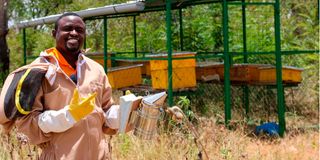
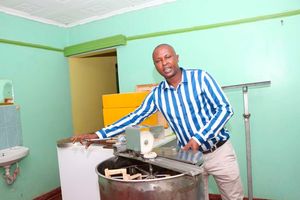
Kennedy Mutua, founder of Native Beecare, at the firm’s model apiary farm in Wote, Makueni County.
Photo credit: Pool
“I have realised that a farmer who wants to modernise may not have the capital to make that transition. We therefore provide ongoing technical support, quality management and links to buyers, while moving beyond basic trading towards an integrated value-chain model,” says Mutua.
To date, the enterprise claims to have supported over 10,000 farmers by providing them with improved hive technologies, bee genetics and extension services. Meanwhile, its wider agribusiness activities have trained over 30,000 people.
Although much of its work is in Makueni, Mutua sees potential for similar initiatives in other dryland regions of East Africa.
“Our goal is to ensure that farmers are active participants in a commercial bee economy, not isolated producers. When technology, farm-level quality and market links align, producers can capture far greater economic value,” he says.
He believes the process must start at the community level, with solutions shaped by the realities of the farmers who will use them. He says that the team first considers what the farmers already know, what they can afford, and what is practical in their environment.
The result is the gradual introduction of new technologies and management practices, which does not sever farmers from the knowledge and traditions that have guided beekeeping in these communities for generations.
This approach also creates employment opportunities beyond the farm, particularly for young people and women. Young people are finding opportunities in technical support, equipment fabrication, processing and logistics, while women's groups are participating in aggregation and adding value.
Building lasting systems also requires patience and trust. Farmers are more likely to adopt new practices when they can see evidence that their colonies are thriving, their yields are improving and their quality is being rewarded.
“Meaningful change cannot be rushed,” says Mutua. 'You cannot walk into a community and announce that everything must change. Farmers need evidence — they need to see colonies thrive, yields improve, and quality be rewarded.'
The transition from traditional homestead beekeeping to commercial production does not necessitate the abandonment of knowledge passed down through generations.
'My grandfather understood the bees, the seasons, and the landscape,' Mutua reflects. “He laid the groundwork. Our task is to connect that ancestral heritage to technology, science and entrepreneurship.”
Mutua's long-term goal is to establish Makueni and neighbouring counties as recognised regional centres for commercial beekeeping.
‘This is about creating lasting economic opportunities for farmers, technicians, processors, and women-led enterprises,’ he says. ‘We want to unlock the full value of the hive for generations to come.’