Dr Tura Isako, Director at the Beef Research Institute, under the Kenya Agricultural and Livestock Research Organization, Lanet in Nakuru County during an interview on February 26, 2026.

Feedlot beef finishing is gaining ground in Kenya, offering faster, controlled production of high quality meat. Seeds of Gold speaks to Dr Tura Isako of the Kenya Agricultural and Livestock Research Organization in Lanet, Nakuru County.
Outline some advantages of feedlot systems in livestock production and farm economies.
Feedlots are among the initiatives promoted under Kenya’s Big Four Agenda to support access to high-end and export markets for live animals and beef products.
However, the system remains underdeveloped, facing challenges such as limited land, high capital requirements, inadequate technical know-how and competition for grains like maize and wheat.
Despite this, feedlots offer clear advantages. They enable faster attainment of market weight than extensive grazing, improve feed efficiency and weight gain, and produce better carcass quality with optimal fat cover and tenderness.
They also reduce pressure on rangelands, support ecosystem sustainability—especially in arid and semi-arid areas—and promote commercialisation of the beef sector while ensuring a steady beef supply.
In the Kenyan context, which livestock breeds are suitable for commercial beef production?
The improved Boran breed is highly suitable due to its adaptability to harsh climatic conditions.
A study at KALRO Lanet comparing feedlot Total Mixed Ration (TMR) and free-grazing systems using Boran steers found higher feed intake (13.13kg versus 11.33kg per day), increased water intake, greater average daily gain, improved body condition and better feed conversion ratios under TMR.
The study concluded that TMR significantly enhances growth, nutrient utilisation and overall productivity.
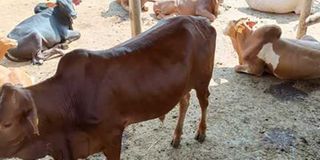
Small East African Zebu cattle are not suitable for a feedlot.
What should be considered when preparing rations for finishing beef animals?
Feed rations are formulated to maximise average daily gain and improve feed conversion efficiency while maintaining animal health and preventing excessive fatness.
Proper formulation also minimises nutrient losses in manure, reducing environmental pollution.
Total Mixed Rations are designed by animal nutritionists, with careful balance between grain and roughage to prevent disorders such as bloat, acidosis and lameness.
What is the composition of Total Mixed Rations (TMR)?
TMR typically consists of about 62 per cent roughage, 31 per cent grains, five per cent minerals and vitamins, and two per cent premix additives.
While high-grain diets boost weight gain, poor management may lower rumen pH and cause metabolic disorders.
How important is site selection for a feedlot?
Site selection is critical for sustainability and profitability.
Key considerations include well-drained topography, loamy soils with moderate permeability, and reliable water sources such as boreholes, rivers or dams.
The site should be located downwind from settlements to reduce odour and dust, and should provide shade and temperature control in hot areas. Good road access, compliance with zoning regulations, and availability of labour and construction materials are also essential.
What characteristics define a well-finished animal?
A well-finished animal should have heavy, evenly distributed muscling, particularly in the hindquarters, a smooth and firm body condition, strong legs, and balanced movement.
Breed differences influence fat deposition, with some animals storing more fat in the tail head and brisket than others.
Understanding breed characteristics helps farmers make better management decisions and prepare animals effectively for the market.
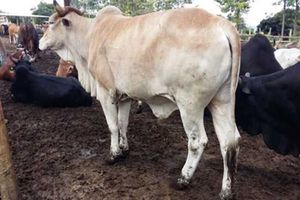
A cow after 90 days of Fattening and finishing at a feedlot. It is good to observe the feeding behaviour of the cattle in a feedlot, especially when using unground hay.
What feedlot management practices maximise growth during finishing?
Farmers should provide adequate feed, clean water and shelter at all times. Animals should be fed two to four times daily—typically 60 per cent in the morning and 40 per cent in the afternoon—while maintaining consistency in feed composition and introducing dietary changes gradually.
Animals should be grouped by age and breed, with equal access to feed ensured. Stress, noise and unnecessary movement should be minimised, and comfortable resting areas provided.
Disease management, including control of coccidiosis, and gradual adaptation to new feeds are also critical.
Besides nutritional value, what factors matter when selecting feed ingredients?
Cost and availability are key. Farmers should prioritise locally available ingredients to reduce production costs.
Feeds must meet dietary requirements consistently, with proper processing and reliable supply.
Alternative ingredients, including additives such as amino acids (methionine, lysine) and vitamin premixes, may be incorporated where necessary.
What key records should be kept in a beef feedlot?
Accurate record-keeping is essential for management, profitability and compliance.
Important records include stocking rates, animal performance, feed consumption and forage production.
Stocking density is particularly critical, as it affects animal welfare, health, productivity and economic outcomes. Maintaining optimal space per animal improves both performance and pen management.
Follow our WhatsApp channel for breaking news updates and more stories like this.