Technological innovation is reshaping Kenya’s agriculture and livestock sector, lifting production efficiency, food safety and product quality. Within the poultry industry—one of the fastest-growing segments of livestock farming—automation is proving transformative as more Kenyans incorporate white meat into healthier diets.
With the national population now estimated at more than 50 million, demand for poultry has continued to climb. A 2022 study by the United Nations Food and Agriculture Organisation (FAO) shows that 92.6 per cent of Kenyans frequently consume chicken meat and related products.
Over the next three decades, FAO projects a sharp rise in poultry consumption, driven by rapid urbanisation, rising household incomes and shifting dietary patterns.
By 2050, chicken meat consumption is expected to increase by 289 per cent and egg consumption by 211 per cent.
For processors, the challenge is not only to match this growing appetite but also to maintain high standards in animal welfare, hygiene and product consistency. At Kenchic Ltd—one of the region’s largest producers of poultry and poultry products—technology and innovation anchor operations from breeding to the consumer’s table.
At the company’s automated processing plant on Kilimambogo Road in Thika, Kiambu County, a high-tech system governs each stage of production.
The entire chain, from slaughter to packing, is designed to ensure precise handling, strict hygiene and full compliance with local and international food safety standards. The shift towards automation comes as the Kenya Food and Feed Safety Control Coordination Bill, 2023, approaches final approval, tightening regulatory benchmarks for industry players.
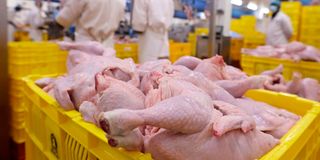
Processed poultry at Kenchic plant in Thika, Kiambu County on November 27, 2025.
Photo credit: Evans Habil | Nation Media Group
According to Mr Alun Maskell, Kenchic’s Head of Plant and Butcheries Operations, modern processing technologies have positioned the company as a global-standard facility. A graduate in Meat Science with advanced training in poultry processing, Mr Maskell explains that quality assurance begins long before birds arrive at the plant.
The company operates hatcheries and breeding centres and works with contracted farmers raising flocks under strict biosecurity protocols to guarantee safety and traceability.
“We partner with growers whose production practices ensure proper biosecurity and full traceability from day one,” he says.
Birds are transported at dawn in ventilated crates with controlled temperatures, misting and airflow systems to minimise stress during transit. On reaching the Thika plant, they enter an automated slaughter line at the firm’s Halal-certified abattoir. Unlike traditional slaughtering—often involving manual handling and inconsistent cuts—the automated system prioritises animal welfare, speed and food safety.
The birds are placed on moving shackles and guided through blue-light technology, a system that induces a calming effect similar to sedation. Maskell says this technique reduces stress hormones, relaxes muscles and lowers the likelihood of physical injuries such as wing fractures or bruising. “Blue-light technology significantly improves meat texture, colour and appearance. It’s also cost-effective and helps processors meet animal welfare standards,” he says.
The birds are then stunned—rendered unconscious but not killed—before Halal slaughterers perform a precise throat cut that allows for complete bleeding.
Adequate bleeding is vital for tenderness, flavour and overall meat safety.
Following slaughter, the carcasses move through automated scalding tanks that loosen feathers before entering mechanical plucking machines capable of removing feathers accurately and at high speed. Kenchic’s processing line handles about 78 birds per minute, an efficiency made possible by high-capacity machinery that delivers uniform results while limiting contamination risks.
After plucking, carcasses enter the evisceration section, where automated equipment removes internal organs. Red offal, including the heart, liver and gizzard, is separated hygienically for further processing, while green offal (digestive contents) is channelled away to avoid contamination.
Workers at Kenchic processing plant in Thika, Kiambu County on November 27, 2025.
Photo credit: Evans Habil | Nation Media Group
The section relies on stainless-steel conveyors, vacuum systems and automated washers to uphold strict hygiene standards.
The birds then move to overnight chillers, where they rest under tightly controlled temperatures. Allowing meat to rest is a scientifically proven process that lets muscle fibres relax, improving tenderness, flavour and overall eating quality. The abattoir currently slaughters between 37,000 and 42,000 birds a day, supported by heavy investment in cold chain systems—critical to meeting both domestic and export-oriented standards.
The following morning, chilled birds proceed to the cutting and deboning area. Advanced cutting equipment and skilled staff portion birds according to client specifications in temperature-controlled rooms. Automation supports precision cutting, with mechanical systems separating breasts, thighs, wings and drumsticks.
Maskell highlights the company’s boneless, skinless thigh as one of its premium products, valued for its juiciness and versatility. No part of the bird goes to waste: trimmings, skin, fat and bones feed into secondary processing lines, where grinders, mincers and blenders produce sausages, nuggets and other value-added products. A mechanical deboning machine extracts residual meat from bones, ensuring maximum utilisation while upholding safety standards.
Some products then move to rapid freezers that drop temperatures to –18°C within hours. Maskell explains that ultra-fast freezing preserves freshness by preventing the formation of large ice crystals that can damage meat structure. Frozen products are then stored in holding freezers at –12°C prior to distribution.
Temperature control, he stresses, is “non-negotiable”. From slaughter to packaging, Kenchic enforces a strict 20-minute rule: any product removed from a chiller must return within 20 minutes to prevent temperature fluctuations that could compromise quality. Workrooms are cooled to safe operational levels, and staff undergo continuous training in hygiene and food safety.
Distribution trucks are pre-cooled before loading and maintain temperatures between 2°C and 3°C throughout transit. Whether delivering fresh or frozen products, the firm ensures items reach retailers and consumers at temperatures below 5°C—a safeguard essential for maintaining flavour, texture and shelf life. “Our goal is to ensure every product meets international quality and safety standards, from the moment the bird arrives to the moment it reaches the consumer’s kitchen,” Maskell says.
With 70 per cent of its volumes sold fresh and 95 per cent of its total production consumed locally, Kenchic remains a dominant player in Kenya’s poultry market. The company continues to expand capacity and technology investments as demand rises, framing automation not merely as a competitive advantage but as a necessity for future food security.