For farmers engaged in large-scale animal production, feed costs remain the most significant barrier to profitability. Across Kenya, poultry, fish, dairy, and pig farmers are struggling to cope with rising prices, which limit expansion and reduce income.
Imported feed ingredients, which are often more expensive, further push costs onto consumers, who ultimately pay higher prices for farm produce.
Agricultural experts say rising feed prices are driven largely by disruptions in ingredient supply, including maize, soy, wheat, and rice derivatives.
“Cheaper feeds may lack essential nutrients,” notes Henry Nziga, Homa Bay County National Agricultural and Rural Inclusive Growth Project (Naripg) coordinator.
“When farmers compromise on quality or quantity to save costs, it slows animal growth and reduces productivity, sometimes forcing farms to close.”
To mitigate these challenges, some innovative farmers have embraced locally formulated feed, a practice that reduces costs while maintaining animal nutrition. Kisaka Farm, located near Kisaka Beach in Lambwe, Mbita Sub-county, Homa Bay, is among the pioneers in this approach.
Established in 2021 by three enthusiasts passionate about organic farming, the farm has grown into a model of cost-effective poultry production, combining animal husbandry with sustainable practices and agribusiness training.
Farm Director Meshack Odongo, a retired high school agriculture teacher, says the farm began with horticultural crops before introducing livestock.
“Our goal was to use locally available materials efficiently. Nothing goes to waste. Animal manure is recycled as fertiliser for crops, and every by-product is optimised,” he explains.
At peak production, Kisaka Farm houses up to 3,500 birds, all requiring carefully managed daily feeding. Relying solely on commercial feeds would be prohibitively expensive, significantly reducing profit margins.
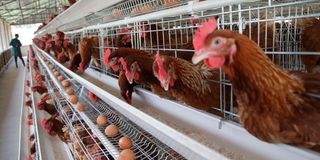
Layers in a battery system at a farm in Meru County.
Photo credit: Joseph Kanyi | Nation Media Group
To overcome this, the farm produces its own feed and supplements it with black soldier flies, a protein-rich, nutritious source high in essential fats and minerals.
Farm manager Kennedy Otieno supervises feed formulation. A former social worker, Otieno discovered a passion for food production and joined Kisaka Farm to manage its poultry division.
“Farming is profitable and creates employment opportunities,” he says.
“However, input costs are rising faster than consumer prices, so farmers must optimise feed efficiency, reduce waste, and explore alternative feed sources.”
Kisaka Farm produces up to one ton of feed at a time, using a mix of locally sourced and supplementary ingredients. The base comprises maize germs and rice germs, each accounting for 200 kilograms per ton, sourced from millers in Kisumu. Wheat germs, at 190 kilograms per ton, provide protein, essential amino acids such as methionine, and vitamin E.
Other components include sunflower seed cake (40 kg) and bone meal (20 kg), supplying energy, calcium, and phosphorus. Lime (40 kg) and cotton seed cake (20 kg) add protein and energy, while soya (60 kg), fish meal (20 kg), and dicalcium phosphate (2 kg) supplement protein and essential minerals. Grower premix, table salt, and lysine, an essential amino acid, complete the formulation.
Currently, mixing is performed manually using shovels, with strict attention to hygiene to prevent contamination. Otieno emphasises that incorrect formulation can lead to health problems, including cannibalism, a behaviour sometimes caused by protein deficiency or unbalanced diets.
“Nutrition directly impacts behaviour and growth. Every ingredient matters,” he says.
Most ingredients are sourced from factories producing raw materials for other industries, supplemented by local suppliers. Producing feed locally saves Kisaka farmers up to Sh13 per kilogram, a significant reduction in large-scale operations.
Commercial feed costs approximately Sh67 per kilogram, while Kisaka’s formulated feed costs Sh54. Otieno attributes his skills in feed formulation to training from a youth-focused NGO that offers courses in agribusiness and entrepreneurship.
Despite producing their own feed, Kisaka Farm uses commercial feeds for layers and mash from agro-dealers for chicks until they reach six to eight weeks. Only at the grower stage do birds consume the homemade formulation.
Modern poultry management
At Kisaka Farm, daily operations are carefully structured to optimise efficiency and maintain the health of poultry. Workers begin before sunrise, inspecting all poultry houses to ensure birds are active, healthy, and feeding correctly. Each bird is counted, and any signs of disease, lethargy, or abnormal behaviour are documented.
Early detection allows the farm to address issues before they escalate, reducing losses and maintaining productivity. Feeding schedules are strictly followed, and water stations are cleaned daily. Feeders are replenished throughout the day, ensuring minimal waste and optimal growth.
The farm also implements a manure management system. Poultry litter is collected and processed into organic fertiliser for horticultural crops grown on the farm. Odongo explains that integrating crops with livestock reduces dependency on chemical fertilisers, lowers costs, and supports sustainable agriculture.
“This is part of our vision to create a closed-loop system where nothing is wasted,” he says.
Kisaka Farm has positioned itself as a training hub for local and regional farmers. The farm regularly hosts groups of farmers, students, and agricultural enthusiasts interested in learning modern poultry management, feed formulation, and sustainable agribusiness practices.
Training includes lectures, demonstrations, and hands-on experience in feed mixing, poultry care, and record-keeping.
Participants also receive guidance on farm economics, including input costs, pricing, and profit margins. Odongo emphasises that knowledge transfer is a key part of the farm’s mission.
“We do not just produce poultry; we teach others to farm sustainably and profitably,” he says.
The farm’s website, kisakafarm.com, complements these efforts by offering educational resources and direct access to poultry products. Online clients can purchase birds or seek advice on feed formulation and poultry management.
This digital presence extends the farm’s impact beyond the local community and positions it as a reference point for modern poultry farming in the region.
Kisaka Farm’s approach demonstrates that local feed production, combined with careful monitoring and training, can deliver sustainable profits and healthier poultry. Its model offers practical lessons for farmers seeking to expand operations without compromising animal health.