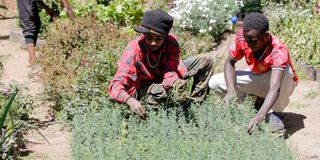
After graduating from Bungoma Bible School in 1998, Peter Warui returned to his rural home in Molo, Nakuru County. After years of hustling and bustling around, in 2005 he came across a group of twenty women planting and growing indigenous and exotic tree seedlings to sell to local farmers and the forest department.
Impressed by what the women were doing, Warui collected around 2,000 Orea Africana seeds that had fallen near riparian land following heavy rainfall. “I bought 2,000 polythene bags for Sh500 and planted the seeds in a seedbed, along with some cypress seeds that other farmers in the area had given me,” said Warui, adding that he relied on rainwater and a borehole on the farm to water his seedlings.
During a recent visit to his nursery in Molo, Warui was tending to fruit trees and flower seedlings alongside. Warui revealed that when other farmers noticed his interest in seedling management and his embrace of agroforestry technology, one of them voluntarily took him to a one-day training session at the Greenbelt Movement in Nairobi, where he learnt more about planting seedlings, management, data collection and networking.
Following the training, he was tasked with collecting data for three years on all the seedlings planted by each group every year, and submitting a report on this to the movement. “In the process, I gained experience and developed skills in seedling management, such as spacing, planting, pruning, rooting and seedling propagation, which have helped me stay up to date,” he said. He added that a minimum seedbed, which can hold 1,000 seedlings, requires spacing of approximately 10 ft by 6 ft, depending on the size of the plot. This spacing allows farmers to water, weed and manage the seedlings easily.
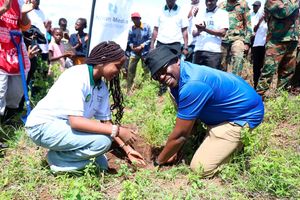
The seminar enabled him to reach out to various groups and urge them to form an umbrella organisation for the movement called the Greenbelt Movement Self-Help Group. In 2006, two out of five groups with seedlings on their farms planted over 5,000 seedlings at a local school and received Sh20,000.
From left: David Kuria, Peter Warui and Paul Thuku, some members of Molo Constituency Forest Association display some of the seedlings they plant for sale in Molo Town, Nakuru County on August 27, 2026.
Photo credit: John Njoroge | Nation Media Group
Mr Warui noted that, during her visit to Molo in 2007, Nobel Peace Prize winner Prof Wangari Maathai had asked him to register the group as a Community Forest Association (CFA) with the Attorney General’s Office, as this would enable him to manage and protect the forests more effectively. He registered the group as the Molo Constituency Forest Association (MCFA) in the same year, and it is still active today.
“Months after registration, I benefited from the association, as it enabled me to acquire a one-and-a-half-acre plot in the riparian area in 2017, where more than 50 active members joined the group.” Due to climate change and inconsistent rainfall, recruiting members has become challenging, but numbers are increasing gradually, especially when it rains. Following the government’s ban on polythene bags, members received medium-sized sacks from a private firm, which we redesigned for use in planting seedlings,” Warui says, adding that every new member contributes a registration fee of Sh5,000 and a monthly fee of Sh200, which has helped the association manage the seedlings to date.
Peter Warui (left) and David Kuria, members of Molo Constituency Forest Association display some of the seedlings they plant for sale in Molo Town, Nakuru County on August 27, 2026.
Photo credit: John Njoroge | Nation Media Group
Warui says that he has planted around 100,000 trees, and adds that a one-hectare nursery plot can hold between 300,000 and 400,000 tree seedlings depending on species, seedbed design, spacing, pathways, irrigation, and management practices. Better management of the various seedlings has led to an increase in partners such as NGOs, self-help groups, schools, individuals, forest conservationists, banks and other companies who buy the seedlings in recent years.
Indigenous tree seedlings retail at Sh50 each, while exotic ones retail at Sh10 each. When the government announced plans to plant 15 billion trees by 2032, the association decided to sell its products through social media platforms such as WhatsApp, Facebook and Instagram.
“Marketing our products online has improved our market, enabling us to introduce avocado, passion fruit, tree tomato, guava, strawberry and vegetable seedlings, among others. They all sell at different prices,” said Mr Warui, adding that grafted avocado seedlings retail at Sh250, orange seedlings at Sh400, and apple seedlings at Sh500. He said that grafted seedlings take two-and-a-half to three years to mature and be ready for harvesting, unlike non-grafted ones which take 15 years.
He added that seedlings are invaded by insects during the dry season and by the blight infection during the cold season. To combat this, Mr Warui urges farmers to use organic methods such as spraying their seedlings or crops with rabbit urine or pyrethrum liquid, in order to avoid using chemicals that could affect their crops or the farmers who keep bees. He said that, despite the challenges posed by the Coronavirus pandemic, the market remained robust as many families restricted their movements and remained indoors.
David Kuria, who grows oranges, flowers and tree seedlings at his nursery, says that most grafted fruits are ready for transplant and sale after two to three months, depending on the variety. He says that the market is good, especially between March and April during the rainy season, but that it can be unpredictable due to climate change. “During good seasons, when there is sufficient rainfall, each member can sell over 1,000 seedlings a day, whereas on normal days, each member sells 300 seedlings. Many students interested in horticulture visit us to learn more about nursery management like watering, pruning, weeding, propagation, and medicinal herbs, among other things,” said Mr Kuria. He added that some of their members also visit schools to teach learners skills as part of the United Nations Food and Agriculture Organization’s (UNFAO) Forest Challenge Bunch Curriculum.
Some of the seedlings growing in one of the nurseries in Molo Town, Nakuru County on August 27, 2026.
Photo credit: John Njoroge | Nation Media Group
To propagate his seedlings, he buys seeds from the local market for Sh400 per 50kg sack and Sh200 per 90kg sack of livestock manure, which he then mixes with compost manure made from sawdust, grass, tree and charcoal waste. This takes six months to prepare for use on the farm. He called on the county government to provide them with large water tanks, fencing and piping to enable irrigation, especially during the dry season. Currently, the members depend on a seasonal river that passes near their nursery.
In line with the association’s vision, “Plant a Tree, Plant Hope”, their future objective is to raise awareness among more young people and farmers of how they can plant, maintain and benefit from tree seedlings, and generate income in a short period of time. Their plan is to grow a variety of trees in the nursery, focus on beekeeping, provide farmers with polythene bags in different sizes, expand the area to 10 acres to accommodate 4 million seedlings, and gain access to better markets. locally and abroad,” said Warui., adding that with enough land, they can start a herbal and fruits processing and conservation hub.
Other farmers in Elburgon have seen fortune in seedling farming since they began selling their products online by increasing and attracting more customers. This has also relayed information to other farmers who grow short-term crops such cucumbers, strawberries, capsicums, poultry and rabbit farmers among others by making good sales through the social media.