The farm is set on a hill-side in Machakos County but close to the border with Murang’a County, Makuyu Sub-county. It is a start-up with beef cattle, sheep and goats.
The owner, David, had called me about three weeks ago to assess the farm and advise on the animals, structures, feeding and management of the livestock.
I went with my two attachment students of Veterinary Medicine from the University of Nairobi. I train students on attachment and for internship after graduating as part of my social responsibility. It is also a good way of sourcing for replacement or expansion staff for my work.
The students were excited to find beef and dairy cattle, sheep and goats all in one day. We arrived on the farm in the early afternoon after having spent the better part of the morning at the farm’s dairy unit which was about 8 km in the lowlands but on the Murang’a County side of the area.
We started by reviewing the goats and sheep. The students identified some of the sheep and goat breeds and I helped them out with the ones they could not place. Most of the ones they had difficulties with were mixed breeds.
Hundreds of quarantined sheep at Korompoi estate in Isinya sub-County on April 8, 2025.
Photo credit: Stanley Ngotho | Nation Media Group
You see, when an animal is bred from a mixture of three breeds, it is difficult to even pick some of the breed traits in the animal. However, a trained eye will always see certain features that are specific to each breed.
The goats were mainly Small East African goats, which made them unsuitable for fattening. The breed is too small in stature and weight gain. The next most common breed was the Galla either as pure or mixed with others.
The Gala is suited for fattening because of its large frame and good weight gain. Fed properly, it may attain the most-preferred slaughter live weight of about 60kg within 40 to 60 days of being in the feedlot if the starting weight is fairly good and the animal is in good health.
There were also some mixtures of dairy goat breeds including Saanen and Torgenburg. These breeds are not suitable for fattening because their bodies are configured for milk production. I advised David to cull or remove the unsuitable breeds from the herd.
I informed David the farm would need to stock pure Gallas but could cross them with good meat breeds such as Boer Goat or Kalahari Red. The offsprings of these breeds are good meat producers and have fast growth rate and weight gains. The Boer goat also has very high quality meat. However, the breed and Kalahari Red are not common in the country. They were bred in South Africa.
Hundreds of quarantined sheep at Korompoi estate in Isinya sub-County on April 8, 2025.
Photo credit: Stanley Ngotho | Nation Media Group
The most preferable sheep for meat production in hot climate in kenya is the Dorper. It is a very fast grower, adds on weight very well and has high feed efficiency even for some low quality feed. It’s meat is soft and favoured by many consumers.
The sheep was developed in South Africa and spread all over the world due to its competitiveness in reproduction and meat production.
We agreed with David he would remove the Red Maasai and their Dorper mixes. He would stick with the Dorpers in all future purchases.
I noted the housing of the sheep and goats was good but needed some changes on the floor. The floor slats had been fixed without leaving the 2.5 cm gap between the slats to allow for urine and pellets to drop to the ground from the raised floor.
Failure of the space caused manure to be trapped on the house floor. This dirties the sheep and goats, makes the house smelly and increases the cleaning labour. It also increases the occurrence of diarrhoea especially in the lambs and kids.
The feeding mainly comprised of super nappier grass and hay. However, the nappier was overgrown and fed whole. I advised the grass should be harvested at the stage of 4-5 feet high or at 60 days from the last cutting which ever came earlier.
This is the stage at which the nappier has the optimum quantity of nutrients especially protein and carbohydrate. I also advised the feed should be properly formulated to fatten the sheep and goats to the required weight of 60kg live weight within about 60 days from entering the feedlot.
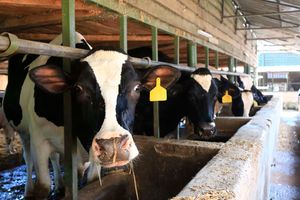
Next stop was the cattle station. The first lot was Friesian bulls from the dairy unit. They were doing very well and had attained the fattening weight of 300 to 350kg. The animals were fed on corn silage, hay, sunflower and vitamin-mineral concentrate prepared as a total mixed ration.
A cow after 90 days of Fattening and finishing at a feedlot. It is good to observe the feeding behaviour of the cattle in a feedlot, especially when using unground hay.
Photo credit: File | Nation
There were also small Friesian bull calves that David had bought from Nyandarua. The calves had pot bellies and needed to be fed high carbohydrate diet to help in the full development of the rumen. The calves were for growing, fattening and finishing.
Such animals are not suitable for feedlot unless the farm has its own-grown feed inputs such as corn, sunflower and hay. Otherwise, the growing of the calves in a feedlot setting is not recommended as it is too expensive.
The calves should be raised in ranching and recruited into the feedlot once they have attained 300 to 350kg live body weight.
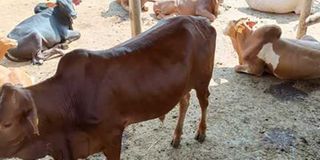
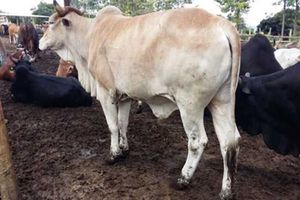
Lastly, I assessed the indigenous beef cattle. They were fed the same feed as the Friesians. However, their weight gains were very poor below 400 grams per cow per day. They had already attained mature body size and weight for the breed.
Their bodies were well-rounded and had nowhere else to deposit more fat or build muscle. In short, they had reached their weight-building capacity of about 250kg.
The bulls had been on the farm for about 6 months. They had entered with about 190kg body weight. I informed the owner the animals were Small East African Zebu. They had attained their optimum growth and fattening.
I advise the animals should be sold soonest as they were just incurring cost every day they remained on the farm. The Small East African Zebu is unsuitable for feedlot fattening and finishing. Most butchers and meat processors require animals that are at least 400kg live weight for them to make profit when they slaughter.
Beef cattle breeds suitable for feedlot fattening and finishing comprise Sahiwal, Boran, Hereford, Charolais, Angus, Brahman, Beefmaster and Friesian among others.