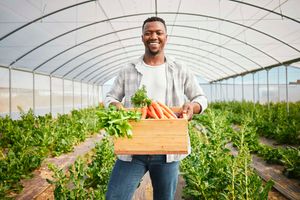
While many university graduates are frantically chasing elusive white-collar jobs, one young man is tilling a different path and is reaping big by investing in the agribusiness supply chain.
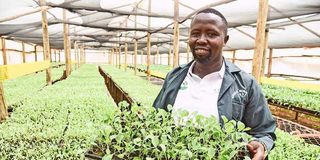
Alex Kiptoo, 42, the proprietor of Mbegu Bora Green Groove Farm Limited, is transforming livelihoods at his Cheptigit village in Ainabkoi constituency, Uasin Gishu County though his successful vegetable and fruit farming.
The Bachelor of Information Science graduate from Moi University went against odds to venture into commercial tray seedling propagation, which has turned into a thriving agribusiness as he supplies a variety of vegetable and fruit seedlings in the Western Kenya region.
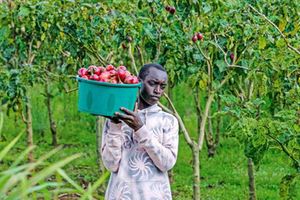
What began as a small backyard investment for own domestic consumption has transmuted into commercial agriculture specialising in propagation of high yielding kales, cabbages, tomatoes, traditional vegetable species, avocados, coffee and tree seedlings.
Most of the vegetable and fruit seedlings are propagated in plastic tray nurseries in greenhouses for maximum production. He targets markets in Western Kenya region where there is rising demand for the produce.
“I have never regretted since venturing into self-employment in Agribusiness. Revenue from the investment is sufficient to support my family away from attaining personal satisfaction from the work,” said the father of four during an interview at his Mbegu Bora farm.
What began as an investment of just Sh18,000 from his savings to grow tomatoes, kales, and cabbages on tray plastic nurseries has metamorphosed into a massive seed propagation with advanced machinery, automation, and precise farming techniques.
“Determination knows no barriers and what started as backyard garden is a seed multiplication centre offering jobs to 20 permanent workers and several others on casual basis in a span of 10 years,” said Mr Kiptoo, noting that they are targeting markets among the East Africa Community (EAC) member states.
Seeds of Gold visited him at his farm. The farm has 200 trays of cabbage seedlings, with each tray containing 200 seedlings going at Sh8 a piece.
He propagates a similar quantity of cabbage four times in a year, earning an average of about Sh3.2 million annually from the investment.
“Just like any other investment, vegetable seed propagation be it sukuma wiki, cabbages, tomatoes or capsicum requires a lot of work, proper care in terms of pest control and steady market for the produce for one to realize profitable returns,” explained Mr Kiptoo.
He has developed strong working relations with the agricultural extension officers, agronomists and adopted a strong marketing strategy to realise quality seeds and sustain reliable clients for the produce.
“Any slight miscalculation in terms of precise soil acidity level, pesticide application of market information can translate to huge losses. One has to exercise a lot of cushion to realise attractive returns,” adds Mr Kiptoo.
Local farmers and agricultural officers have praised his work and his nursery acts as demonstration centre especially for youth aspiring to venture into agribusiness as source of income.
“Despite being a youthful farmer, he has inspired many into smart farming as a business, create jobs and transform the local economy,” said Samuel Kibogy while purchasing vegetable and fruit seedlings worth Sh18,000.
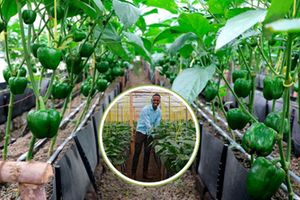
He generates an average of Sh400,000 quarterly from capsicum and another Sh200,000 from a variety of traditional vegetables, and additional income from Hass avocado and tree seedlings.
“High level of soil acidity, increasing cost of pesticides and unsteady market for the seedlings are some of the challenges one has to be ready to encounter in this form of investment,” disclosed Mr Kiptoo.
He incurred a loss of over Sh160,000 this season after more than 20,000 pieces of tomato seedlings went to waste due to a lack of market.
“In any investment, there is profit or losses and one has to be prepared for any eventuality but that does not mean end of the road,” adds Mr Kiptoo.
He has a total of 150,000 Hass avocado trees that will be ready for planting in the next one year, but has not got a ready market for the seedlings.
The Hass avocado seedling goes for Sh150 a piece, meaning the farmer has the potential of generating over Sh20 million from the investment.
“Lack of market for the avocado seedlings has remained my major challenge. I had to give out some of the overgrown seedlings last season after failing to get customers to purchase the plants,” disclosed Mr Kiptoo.
He appealed to county governments and individuals who have invested in avocado farming to purchase seedlings from his nursery.
Smart farming, smart business
In order to sustain a steady water supply for drip irrigation in his nursery, Mr Kiptoo has constructed a water pan apart from drilling a borehole to pump water to his five-acre piece of land.
“The water is supplied through gravity from Kaptagat forest although I have drilled a borehole and put up a reservoir for use during dry spell,” explained Mr Kiptoo.
The purified drinking water is priced at Sh380 per 500ml and is sold in leading supermarket outlets in the region.
“I ventured in bottled water from the drilled bore hole after acquiring purification equipment and certification from the Kenya Bureau of Standards as part of multiplication effects to support the vegetable and fruit seedling deal,” said Mr Kiptoo.
He has been in the water bottling business for the last seven months and plans to expand it as his alternative source of income.