Ongata Rongai, located in Kajiado County, has rapidly developed into a hub for real estate and urban development, largely due to spillover demand from Nairobi.
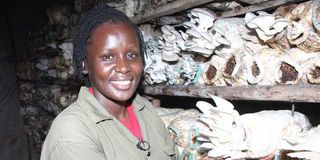
Upon our arrival in Kandisi, the Seeds of Gold team meets Vera Nkirote, a young entrepreneur who is busy harvesting oyster mushrooms for the local market.
As well as cultivating oyster and button mushrooms, Vera has ventured into value addition to extend shelf life and reduce post-harvest losses.
Her value-added products, such as mushroom crisps, are sold under the brand name Bello Mushroom Crisps.
“Fresh mushrooms lose quality within days due to their high moisture content, but processing them into dried products allows them to be stored for months,” she explains.
Mushroom powder is often blended into wheat flour, noodles, or baked goods to increase protein and dietary fibre, and for nutrient fortification.
According to Vera, she began her journey into mushroom farming at the peak of the pandemic.
“Since the beginning of the pandemic, there has been no movement, so many livelihoods have been disrupted, both locally and globally,” she recalls.
Like many others, she had to adapt to new working routines, including remote working, to make ends meet. Mushroom farming became a viable option.
She notes that one key advantage of mushroom farming is that it can be done at the household level as long as all the necessary resources are available.
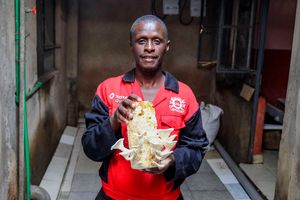
Vera Nkirote a mushroom farmer from Kandisi, Ongata Rongai, showing medium that is used to grow button mushrooms on April 16 2026.
Photo credit: Richard Maosi | Nation Media Group
Initially, she worked as a milk vendor in Uganda. However, she later abandoned this venture and returned to Kenya after realising that it was not financially rewarding.
Determined to find a sustainable livelihood, she used online platforms such as YouTube to learn mushroom farming techniques.
To further develop her expertise, she also attended farmers' field days and visited established mushroom farms across the country.
Vera's decision to start a mushroom farm was influenced by the high demand for mushrooms and the ready availability of a local market.
Vera’s mushroom unit is housed in a multi-storey structure with space for 2,000–3,000 growing bags at various stages of development.
She explains that oyster mushrooms are harvested regularly, unlike button mushrooms, which take longer to mature.
To ensure optimal growth, she says that mushrooms are cultivated in a controlled environment with proper humidity and ventilation.
“The house has the right structure and is well ventilated to allow air circulation. The roof is also insulated to regulate temperatures,” she explains.
Mushrooms require darkness before sprouting because they lack chlorophyll and cannot perform photosynthesis.
Instead, they obtain nutrients by decomposing organic matter, making humid, low-light environments ideal for growth.
Vera Nkirote showing some oyster mushrooms at her farm on April 16, 2026.
Photo credit: Richard Maosi | Nation Media Group
For oyster mushrooms, Vera uses cotton husks as the growing substrate. The husks are soaked in water, packed into growing bags and steamed for around four hours to eliminate contaminants.
Once cooled, the mushroom seedlings, known as spawn, are introduced into the bags.
The bags are watered once daily, and a humidifier is used at night to maintain a moist, foggy environment that accelerates growth.
Typically, oyster mushrooms mature within three to five weeks, although some varieties can grow faster or slower depending on the strain.
She also advises farmers to be vigilant at all times, as failure of the mushrooms to sprout may indicate inadequate watering or depleted nutrients.
Vera describes mushrooms as a 'superfood' due to their high protein and fibre content, and their lack of cholesterol.
Button mushrooms, on the other hand, take up to two months to mature.
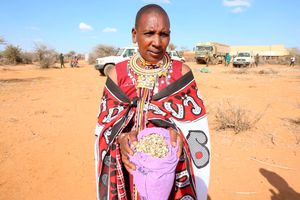
Vera Nkirote, mushroom farmer at her farm in Ongata Rongai in Kajiado County on April 16, 2026.
Photo credit: Richard Maosi | Nation Media Group
Their growing medium consists of chicken manure, gypsum and organic materials, which are composted and regularly turned to ensure uniform nutrient distribution.
Later, the compost is mixed with coco peat to improve the soil's structure. The coco peat holds a significant amount of water, ensuring consistent hydration of the produce.
However, she highlights a major challenge: button mushroom seedlings are imported from South Africa, which increases production costs.
Despite these challenges, when done in the right way, mushroom farming remains a high-value cash crop venture.
A 250-gram packet retails at around Sh250, while a kilogram costs approximately Sh600, depending on market conditions.
Vera supplies her products to restaurants, supermarkets, hotels and local neighbourhoods.
However, she notes that price fluctuations, especially for button mushrooms, remain a key challenge due to shifting market dynamics and production costs.