In Laikipia’s Ilmotiok village, drought once meant packing up and leaving.
Today, neat semicircles of drought-resistant grass surround the manyattas. Beside them stand modest oyster mushroom grow houses, built from innovation.
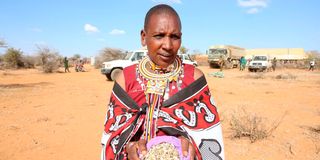
For decades, pastoralist families in semi-arid Laikipia North followed the rains. When pasture dried up, they trekked across counties with their livestock. Fifty-year-old
Members of Green Earth Warriors youth group spread elephant dung to dry in Ilmotiok Village, Laikipia County. Once treated, this nutrient-rich waste becomes a sustainable substrate for growing white oyster mushrooms.
Photo credit: Jospeh Kanyi I Nation Media Group
“The last time I migrated was in 2020, when I walked to Rumuruti, 40 kilometres away, looking for pasture. I had to leave my six children at home under the care of one adult,” she says.
“There was a time I was away for a year. I would call often to check on them because I knew they were not eating well. There was no milk or meat. All the livestock was away.”
For mothers like Nelly, migration meant survival. But it also meant absence, anxiety, and children growing up without their parents.
Today, that story is changing.
Pauline Nakwet, a member of Green Earth Warriors, displays freshly harvested mushrooms in Ilmotiok.
Photo credit: Jospeh Kanyi I Nation Media Group
In 2023, a local youth group called the Green Earth Warriors began training community members in land restoration and fodder farming. The group had been trained by the Wyss Academy for Nature, a global research organisation.
Nelly was among the women taught to grow Maasai Love grass and African Foxtail — perennial grasses bred for arid lands. The varieties survive long dry spells and recover quickly after rain, offering reliable pasture despite erratic weather.
She digs semicircular bunds on her land, each three metres wide, and plants at the start of the rains. When the rain comes, the grass sprouts fast.
“During the dry season, I sow the seeds and leave them in the soil waiting for rain. They stay viable until there is enough moisture.” Winds during prolonged dry seasons, she adds, often blow away light grass seeds before they can germinate.
After one rainy season, the grass spreads inside each bund. By the second, Nelly harvests seed, but only once the flowers turn brown.
Once the grass reaches 60 centimetres, she cuts it, dries it, and chops it fine. Part of the harvested grass is mixed with salt and molasses, then compressed into feed blocks known as grass cakes. A single cake can feed five goats or sheep for a day and lasts up to a year. Nelly sells each for Sh1,000.
The income has diversified her livelihood beyond beadwork, which was once her only income. Beadwork brought in Sh300 to Sh5,000 per piece, but the market, mostly tourists visiting nearby conservancies, was unpredictable, fluctuating with tourist seasons.
In February, the British Army Training Unit in Kenya launched a Sh2.78 million project in collaboration with the Mpala Research Centre to restore 30 acres of community land in Ilmotiok by growing grass for livestock.
Of the 30 acres, five will be set aside for food crops, to improve nutrition and boost household incomes for the Ilmotiok Women’s group.
According to Mpala’s Chief Operating Officer Nelly Palmeris, the project aims to empower over 100 women.
“Women carry the biggest burden in pastoral communities. They fetch water, firewood and everything needed at home, under harsh climate conditions,” she says.
When drought stretches too long, the community turns to the prickly pear cactus, a common arid-land shrub. Pastoralists burn the spines off the pads before feeding them to cattle. According to Emmanuel Miliko, a local pastoralist, singeing softens the pads for chewing. “It must be done carefully, just enough to remove the spines since too much burns away nutrients,” he says.
The cactus, rich in carbohydrates, helps livestock maintain weight during dry spells.
Sometimes, he adds, the community harvests pods from the Acacia tortilis tree and stores them as protein-rich feed for the dry season.
Meanwhile, near the manyattas, the community is finding new ways to feed itself. White oyster mushrooms push through perforated bags. The technique uses treated elephant dung, semi-digested plant material, instead of soil. The nutrient-packed substrate allows the mushrooms to thrive without fertilisers.
The community sits alongside three conservancies: Mpala Research Centre, Karisia Walking Safaris, and Koija Group Ranch, giving them regular access to elephants. Their knowledge of the terrain, water sources, and vegetation helps them predict where the elephants will be.
Once collected, the dung is sorted, crushed into powder, and soaked in clean water for 24 hours. It is then heat-treated using steam generated in large metal drums.
After cooling, the substrate is packed into perforated polythene bags and moved into a mushroom grow house. The structure has two sections: an incubator, where newly planted mushrooms are nursed, and a farm, where they spend three weeks growing to maturity before harvest.
Besides mushrooms, the group has started a vertical garden to grow vegetables. Pauline Nakwet, a pastoralist turned farmer, says mushrooms, once unknown in her meat-heavy diet, have become a household staple.
“When cooking, I mix them with spinach and coriander, using cow milk instead of oil,” she explains. She also mashes them to make porridge.
Dr Fred Kemboi of the KARLO Beef Research Institute warns that feeding livestock raw cactus can be risky. The spines may injure the mouth and digestive tract, causing infections, while excessive intake can trigger digestive problems.
“Burning cactus to remove thorns before feeding is a traditional practice, but it is less efficient and may reduce nutritional value compared to modern pellet processing,” he says.
He says researchers from Jomo Kenyatta University of Agriculture and Technology and the University of Florida have developed a safer alternative: processing the invasive prickly pear cactus (Opuntia stricta) into nutritious pellets. Trials in Laikipia show the pellets are safe, palatable, and improve livestock weight gain.
For the dry season, he advises pastoralists to treat crop residues with urea — stacking maize stover, applying a urea solution, and covering it for two to three weeks to boost protein and digestibility. He also suggests small hydroponic sprouting units, using local seeds like barley or maize in trays with recycled water to produce high-quality fodder in seven to ten days.
As of mid-February 2026, the National Drought Management Authority reports worsening drought across 23 Arid and Semi-Arid Lands (Asal) counties, affecting approximately 3.3 million people. Severe, critical conditions exist in 11 Asal counties, including Laikipia, which is listed in the alarm category due to failed rains