In 2021, Kevin Mwangi Kamau made a bold move to quit the matatu business and explore a new venture — mushroom farming.
The decision came in the midst of the Covid-19 global pandemic, which disrupted many business operations, especially in the hospitality industry and the transport sector, particularly due to lockdowns and cessation of movement within Nairobi and the neighbouring counties.
Having worked in transport since 2016, Mwangi decided to throw in the towel, a move that has since opened vast opportunities for him in his new venture.
“Coronavirus interrupted the transport sector. Income shrank and, with movement restrictions, I could not manage to cater for my young family,” he says.
He worked as a driver of buses plying within Nairobi City and the outskirts, revealing that his Sh2,000 daily pay had been reduced by nearly three-quarters.
Eventually, he lost it all — his job and income, compelling the mechatronics engineering diploma holder to go back to the drawing board. The blow came at a time when his family needed him most, at the age of 32. However, all was not lost.
“The idea to start mushroom farming came from my brother, who encouraged me to research the venture,” he tells 'Seeds of Gold'.
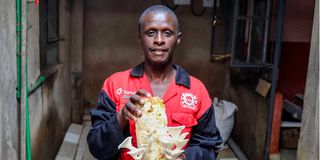
Seattle Organic Farm Founder Kelvin Mwangi Kamau at his farm facility in Embakasi, Nairobi, on March 25, 2026.
Photo credit: Bonface Bogita | Nation Media Group
Passionate about farming, Mwangi turned to YouTube and learned from online content, including techniques shared by an Indian farmer.
He started small. With a paltry Sh15,000 in seed capital — raised from his savings, with part of it supported by his mother — he embarked on a task that has since become his lifeline.
“I purchased mushroom spawn at Sh600 per litre and started with four litres, and using wheat straw bales as substrate, I set up my first structure in Kinangop, Nyandarua County, measuring about 3 by 3 metres, which I built together with my brother,” he reveals.
His initial production involved around 25 bales, each weighing about 10 kilograms, and from the first harvest, he got about 10 kilograms of mushrooms. Within a week, production increased to about 30 kilograms.
“I was able to recover my initial capital within just one week,” he states.
However, operating in Kinangop came with significant challenges, especially poor infrastructure and high transportation costs, particularly during the rainy seasons. It was difficult to access markets, and local demand for mushrooms was low due to limited awareness.
These challenges pushed him to relocate to Nairobi, where he could access a better market. Despite the risks associated with farming, he saw mushroom production as a long-term opportunity that would offer him more freedom and growth compared to employment.
Today, he is among the reliable mushroom producers in the country. The founder of Seattle Organic Farm produces oyster and button types of mushrooms.
Mushrooms are rich in protein, fibre, Vitamins B, antioxidants, and minerals like selenium, supporting immunity, heart health, and low-calorie nutrition.
Over time, Mwangi has expanded his operations from a small structure to a larger facility in Mukuru kwa Njenga, Embakasi, Nairobi County, with eight rooms, most measuring about 5 by 3 metres.
“Currently, I produce up to 2,000 kilogrammes of oyster mushrooms per month, alongside 800 kilogrammes of button mushrooms,” he stated during a visit to his urban-based farm.
His produce sells at about Sh250 per 250-gram punnet, targeting both local and premium markets.
Seattle Organic Farm Founder Kelvin Mwangi Kamau at his farm facility in Embakasi, Nairobi, on March 25, 2026.
Photo credit: Bonface Bogita | Nation Media Group
However, at times, the price drops as low as Sh150, which is relatively affordable compared to supermarket prices.
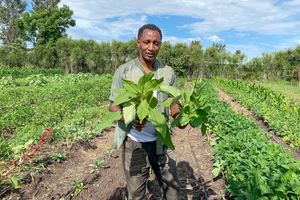
To cut down production costs, the agri-preneur has since adopted Juncao technology (a climate-resilient fodder), which uses a mixture of cotton husk, Juncao grass, rice bran, lime, and water.
“The grass is crushed into powder and mixed with other planting media to form substrate,” he told Seeds of Gold in an interview, observing that Juncao grass has enabled him to reduce production costs by over 50 per cent.
The method involves pasteurizing the substrate, cooling it, inoculating it with spawn (mushroom ‘seeds’), and incubating for about three weeks before transferring it for fruiting.
The entire production cycle takes about four weeks. Compared to wheat straw. This method reduces contamination and improves efficiency.
With Juncao technology offering him a reprieve, Mwangi has now focused more on oyster mushrooms due to their adaptability and cost-effectiveness.
Apart from production growth, Mwangi, who started the mushroom journey alone, now employs about 10 casual workers.
On a personal level, mushrooms, he says, have also improved his lifestyle.
Seattle Organic Farm Founder Kelvin Mwangi Kamau at his farm facility in Embakasi, Nairobi, on March 25, 2026. He left the matatu industry to venture into mushroom farming and now produces organic mushrooms for local markets.
Photo credit: Bonface Bogita | Nation Media Group
“After undergoing stomach surgery in 2022, I replaced red meat with mushrooms, and my family has also embraced them as part of our daily diet, even as snacks. I prepare them using various herbs and sometimes deep-fry them, giving them a taste similar to fish,” says the father of two. His spouse and children are the first consumers of his produce.
Due to lifestyle-related diseases, there is a shift from animal-based proteins to plants or fungi — mushrooms, especially in urban areas.
However, even with the growth and success he has recorded, his journey has not been without ups and downs.
“One of the main challenges I face is marketing, as brokers often take a large share of the profits,” he laments.
Additionally, many consumers are not familiar with oyster mushrooms or how to prepare them. To bridge this gap, he says he is focusing on value addition, consumer education, and direct marketing to hotels and supermarkets.
“I am also exploring export opportunities, particularly in Middle East countries such as the UAE.”
Asked whether he would consider returning to the matatu industry, he quickly dismissed the idea.
“You are an engineer by profession. Suppose you were offered a job paying Sh100,000, would you quit mushroom farming?” he was asked. His response was immediate: “Leave alone that, even Sh200,000, Sh300,000, Sh400,000, Sh500,000 or Sh1 million a month, I would not take it.”
Why? “I see greater long-term potential in mushroom farming, especially through value addition such as processing mushroom-based products. The investment I have already made in this venture surpasses such offers.”
Mwangi, 38, emphasises that mushrooms are not only nutritious and beneficial to health, but also have strong business potential if well managed and marketed.
He was among the participants at the National Capacity Workshop on “Promoting Juncao Technology for Resilient Food Systems, Poverty Eradication and Climate Adaptation in Kenya,” held in Nairobi from March 17 to 19, 2026.
Organized by the Ministry of Agriculture and Livestock Development in partnership with the United Nations Department of Economic and Social Affairs (UNDESA) and the National Engineering Research Centre for Juncao Technology at Fujian Agriculture and Forestry University in China, Mwangi showcased and demonstrated how the climate-resilient fodder can be leveraged as a substrate for mushroom cultivation.