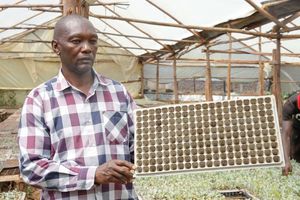
Moses Keben in his farm at Kampi ya Samaki near Lake Baringo on August 28, 2025.
For over 30 years, Moses Keben, a Baringo County resident, has depended on agriculture to fend for his family.
However, the continuous rise of water in Lake Baringo is threatening his only source of livelihood.
The father of nine grows horticultural crops, including tomatoes, vegetables, and cereals such as maize and beans at Kampi ya Samaki, near the freshwater lake. The farming activities are his only source of income.
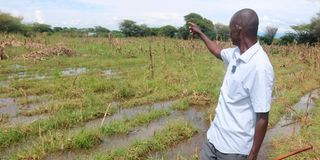
Moses Keben’s maize farm near Lake Baringo submerged in water in this photo taken on August 28, 2025.
However, alongside other residents, their farms have been invaded by Lake Baringo waters, which have been rising since 2021.
“The most recent experience is from July this year, and all our farms are now soaked in water,” Keben told Seeds of Gold during a visit to the area.
The lake used to be about 4 kilometres away from their farms, but now the land they have known for decades as their source of livelihood has been flooded by the waters.
His story cuts across other residents who primarily depend on farming and livestock rearing.
“I am just worried that if the situation continues, my family will suffer,” said farmer Benson Parsalach. He too grows similar crops to those of Keben.
On a bright morning with sun rays landing on their farms, now turned into part of Lake Baringo, we visit the farmers.
Mr Keben’s farm, fenced with timber and barbed wire to prevent wildlife animals such as hippopotamus from invading it, welcomes us with thriving tomato plants.
Just a few metres from the entrance gate, we are forced to take off our shoes as the lake’s waters greet us. One of his farmhands is busy digging trenches. “The furrows he is digging … we are just trying to see if they can stop water from reaching the tomatoes,” Keben says.
Despite these efforts, about three-quarters of his land is soaked in water. What about the tomatoes? “I am just trusting they will survive,” Keben said.
Most of the crops are at the flowering stage, with a few just starting fruiting. It is a stage when water is crucial, but at this point, the produce faces rotting threats.
Keben’s maize farm is another story. “I harvested a few maize cobs – to salvage the ones that survived,” he said.
Some are rotten. The stalks are soaked in water, and had it not been for the flooding, he would be happily looking forward to a good harvest.
Rotting maize from Moses Keben’s farm near Lake Baringo.
Baringo is categorised as one of the arid and semi-arid land (ASAL) counties, and Mr Keben and other farmers practise irrigation to produce food.
In the past, they would harvest over 30 90kg bags of maize from their farms, but they are now harvesting only a handful of bags.
But beyond the lake’s waters threatening their food production, it is posing other dangers. “The waters you see here come with crocodiles, which threaten our lives when we are in the farms,” Parsalach said.
The continuous rise of Lake Baringo water levels is caused by increased rainfall linked to climate change, land degradation and deforestation in upstream catchments that accelerate runoff and siltation, and tectonic activity, which channels underground water into the lake.
This has led to the lake expanding in size and as a result submerging schools, homes, farms, and tourist facilities, and displacing thousands of residents.
The Baringo County government, in partnership with the national government and humanitarian agencies such as the Kenya Red Cross, has been working to address the matter.
Although it remains unclear if nature will reverse, Mr Felix Maiyo, the Head of Region at the Kenya Red Cross in the South Rift Region, said that soil erosion from higher ground is all directed towards the lake. This results in reduced percolation and blocked or reduced outlets, causing the water level to rise and seek refuge on the shores. This cycle continues as it repeats itself.
“Along with the increased volumes of water discharged by the rivers, the level of water in the lake is forced to rise,” Mr Maiyo said.
Moses Keben in his farm at Kampi ya Samaki near Lake Baringo on August 28, 2025.
The increased sediment can clog underground water pathways, reducing permeability and further enhancing surface runoff into the lake.
Apart from Lake Baringo, other lakes experiencing rising waters are lakes Naivasha, Nakuru, Bogoria, and Elementaita, all in the Rift Valley.
According to Mr Keben, who also rears livestock, they used to hear about rising water levels in the lake, but had not felt its impact until it began affecting their farms.
One of his houses on the farm has been submerged in water. “I purposely built it for someone to spend a night there to help scare away hippos [and keep them] from eating crops,” he told Seeds of Gold at his farm.