A cup of mushroom coffee should taste like coffee, but with a little hint of mushroom, says Elizabeth Mibei, founder of Nature Niche, a firm turning agricultural produce into a value-added beverage.
The product combines locally grown coffee with oyster mushrooms, with the latter accounting for about 40 per cent of the blend.
“We don’t want the mushroom to overpower the coffee taste. We have mixed the two in the right proportions so that you get the taste of coffee, the health benefits and a little taste of the mushroom,” she says.
According to Ms Mibei, the innovation gives coffee additional value while creating a market for mushrooms, which many consumers are unfamiliar with.
She showcased the product during the East African Coffee Market and Conference (EACMC) 2026, in Nairobi from October 28 to 30. The theme of the conference was: “From Farm to Flavour: Quality, Compliance and Market Growth.”
Players in the coffee value chain had the chance to explore opportunities in quality improvement, compliance, market expansion and value addition.
Behind the innovation is a personal experience that dates back to the Covid-19 pandemic in 2020, when Ms Mibei’s husband contracted the virus and was hospitalised for about two months.
Her husband’s health affected the family, particularly through loss of weight and strength. As he recovered, the couple began exploring natural products to complement the prescribed medication and help improve his immunity.
“It was a difficult time. We asked ourselves what else we could do to support his recovery,” she says.
Her husband, a mushroom expert, suggested exploring ways of incorporating the fungi into their diet, including mushroom soup, tea and coffee.
The two experimented with oyster mushrooms, which they were familiar with. They settled on mushroom coffee and tea, reasoning that these would be easier to introduce to families accustomed to coffee or tea.
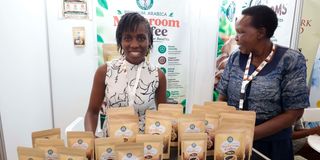
Nature Niche Sales Manager Jennifer Wangari holds a packet of Mushroom coffee at her exhibition stand during The East Africa Coffee Market & Conference 2026 at Oshwal Centre in Nairobi on October 29,2026.
Photo credit: Evans Habil | Nation Media Group
With her husband’s knowledge and her interest in developing agricultural products, the couple established Nature Niche to pursue the idea commercially.
The motivation was to explore a natural food product that could complement other forms of treatment, but they later saw an opportunity to turn their experiment into a business.
“We took the decision to use what we knew. My husband suggested making mushroom soup, mushroom tea and mushroom coffee. Through that, we developed the products,” she says.
The company has since developed a production plan that brings together mushroom cultivation, coffee farming, processing and blending.
It produces its own spawn in a laboratory before transferring it to the growing units. Nature Niche also grows coffee in Bomet County.
According to Jennifer Wangari, who handles laboratory analysis at the company, the coffee undergoes conventional processing after harvesting, while the mushrooms are dried, roasted and ground. The two ingredients are then blended to produce the finished beverage.
Nature Niche has a laboratory in Kileleshwa, Nairobi, where the ingredients are analysed to establish the appropriate quantities for blending and maintain consistency.
Wangari says oyster mushrooms contain beta-glucans, compounds associated with immune system support.
They are also a source of protein and dietary fibre, while having relatively low calorie content.
Beta-glucans are associated with supporting the regulation of blood sugar and cholesterol, including low-density lipoproteins (LDL), which can accumulate in blood vessels and increase cardiovascular risks. The mushrooms also contain antioxidants, which help protect body cells against oxidative stress.
The company packages its mushroom coffee in different quantities. A 50g pack retails at Sh300, while 100g goes for Sh600.
Nature Niche is in the early stages of commercial production, having started selling the product this year.
Ms Mibei says production will grow as the firm expands its market. The pair is also working to popularise mushroom coffee and tea.
“We have realised that Kenyans do not easily embrace new products. That is why we are attending exhibitions and conferences to introduce mushroom coffee and encourage people to try it,” she said during the conference.
The company is targeting local and international markets. It has already sent some products to customers in the US and Germany.
Ms Mibei says the positive response has strengthened her confidence in the product, though expanding the market will need consumer education.
“Our innovation offers lessons for smallholder farmers, who can explore processing and product development instead of relying entirely on selling raw coffee,” she says.
Kenya exports a huge proportion of its coffee, leaving room for increased domestic consumption and local processing. The country exports about 95 per cent of its coffee production. It means there is potential market for local consumption.
According to Ms Mibei, developing products that appeal to local consumers could help expand the market and create jobs.
She adds that collaboration between producers and professionals in other disciplines could unlock opportunities in food processing and herbal products.