After graduating from Chuka University in 2018, Ms Wangari Ndung’u worked as a business development officer for various construction companies across the country and abroad for three years.
Initially, she saw agriculture as an expensive practice, but she was later attracted to and impressed by it as she gained experience from her parents, who practised it. She says that her education came from farming, too.
In 2023, Ms Wangari bought certified potato seedlings from Kisima Farm in Njoro and planted them on a two-acre plot of land. Despite the inconsistent rainfall, she says the production of her potato seedlings was successful. The following season, she extended to eight acres of land, but later decided to alternate her potato farm with cabbage seedlings.
"In 2024, I realised that the cabbage seedling market was doing well. With an initial investment of Sh480,000, I purchased building materials such as wooden bars, polythene sheets, nets, wire mesh, nails, and other necessary items. I then constructed a 15-metre-long greenhouse with an 8-metre footprint, which can accommodate 480 cabbage trays with a maximum capacity of 100,000 seedlings," recalls Ms Wangari.
She adds that she used the remaining funds to purchase seedlings from a recommended dealer in Londiani, Kericho County, and to source quality empty plug trays from another dealer at a cost of between Sh85 and Sh100 shillings each.
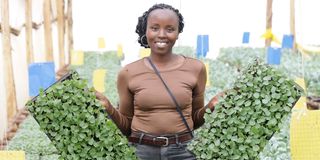
Wangari Ndung’u holds cabbage seedling trays she grows inside a greenhouse at Gathugu Farm near Landi Trading Centre in Molo, Nakuru County on October 30, 2026.
Photo credit: John Njoroge | Nation Media Group
She explained that, before the seedlings are moved to the greenhouse, they are placed in quality trays and mixed with nutritious cocopeat. They are then treated in an improvised dark room next to the greenhouse and covered with a sack for three days to allow them to germinate uniformly.
She spaced her seedling stands well enough to allow access for monitoring, weeding, spraying, harvesting and other important management practices. Inside the greenhouse, a net is set above the seedlings to control the temperature, while insect traps of different colours are placed around the greenhouse to minimise the use of chemicals. However, the farmer sprays her seedlings weekly to kill any visible pests affecting the crop.
She said that the first batch sold well at market after four to six weeks, by which time the seedlings were ready for planting. She sold each seedling for two shillings and received over Sh100,000. However, the second batch was not as successful due to the acidity level of the cocopeat, but this improved over time.
As her project improved with each session, she learnt more from an agronomist who occasionally visited her on the farm about how to treat the cocopeat, how to wash it before replanting other varieties of seedlings, and how to prevent infections. She also learnt about maintaining a medium pH level, seed propagation, fertigation and other techniques.
After a few setbacks that every beginner might experience, she learnt how to do things properly and made good progress in her subsequent practices. One year later, she built another greenhouse measuring 15 by 30 metres for Sh1 million, including the purchase of certified seedlings and quality cabbage trays, as well as other necessary materials. Bigger than the first one, the new greenhouse can hold 3,000 cabbage trays with a capacity of 600,000 seedlings.
Ms Wangari added that this new technology gives farmers over 95 per cent germination survival and makes it easy to control pests and diseases compared to growing them on the ground. She added that there is a continuous market so long as there is enough rainfall.
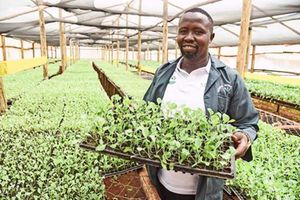
Wangari Ndung'u waters her cabbage seedlings at her greenhouse in Gathugu Farm in Molo, Nakuru County on October 30, 2026.
Photo credit: John Njoroge | Nation Media Group
The young entrepreneur has been able to maintain her customer base by providing quality, certified seedlings that are well-suited to the market, as well as offering consistent, convenient service and delivery. "The number of my clients has increased over the past few months, and I have not even been able to meet their demand. I wish I had started this project a few years ago because I have no regrets about doing it,” says Ms Wangari, adding that she has been able to control the prices of her crops, earn money quickly to run her business, create jobs for over 15 people, and meet other financial needs.
To improve her skills and production, the former Chuka University student conducts online research into the entire production process, including spraying programmes, fertigation and access to new markets. She also attends trade fairs and exhibitions, visits agricultural shows and seminars, and liaises with extension officers who visit her on the farm for guidance.
She also keeps records to help her track daily and weekly sales and identify clients who require seedlings on a regular basis, among other essential business areas.
She cites the cost of production and inconsistent, unpredictable rainfall caused by climate change as the main challenges that farmers in the area encounter. To combat these challenges, the farmer has drilled three wells on the farm and collects rainwater.
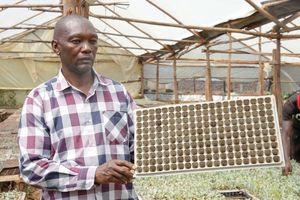
Wangari Ndung'u tends to her cabbage seedlings at Gathugu Farm in Molo, Nakuru County,on October 30, 2026.
Photo credit: John Njoroge | Nation Media Group
"I cannot compare the expense of growing maize to that of seedling farming unless I do it on a large scale. From one cycle in one of the greenhouses, I make sales of about 400,000–600,000 KES, and farmers require 10 acres of land to grow maize to earn the profit I make from a single greenhouse,” says Wangari. She adds that, during a good season, one acre of maize produces 30–40 bags of threshed grain, selling at 3,000 KES per 90 kg bag.
She called on other farmers to embrace this technology, as it generates profit quickly, regardless of plot size. For any farmers looking to start a similar project, Ms Wangari advises sourcing enough water, which is paramount for the business to thrive. She called on the county government to find better markets for small-scale farmers, drill mini-dams, provide water tanks and give grants, using the available resources to support farmers. She also urged financial institutions, such as banks, to provide farmers with access without difficulty.
As many young people have started farming in recent years, especially growing fruit and other short-term crops, it has become difficult to find land to lease in the Molo and Elburgon areas. The price of leasing an acre of land has risen to 20,000 Kenyan shillings, up from 12,000 in recent months.