Straddling the Kenya-Tanzania border in Loitokitok, the fertile Entarara region is quickly establishing itself as Kajiado County's sunflower hub.
Hundreds of farmers, who were once heavily dependent on livestock, are now embracing the bright yellow crop as a more reliable source of income in the face of the harsh realities of climate change.
Every harvest season, trucks ferry tonnes of sunflower seeds across the border into Tanzania, where demand and prices are significantly higher than locally. Farmers say they earn millions of shillings from this thriving cross-border trade, avoiding local brokers whom they accuse of buying their produce at exploitative prices before reselling it in Tanzania.
The crop is proving to be one of the county's most promising agribusiness ventures. According to the Kajiado County Department of Agriculture, sunflower farming scores 92 out of 100 on local soil suitability models, with an ideal average soil pH of 6.55. The crop matures within three to four months, yielding between 800 and 1,200 kilograms per acre.
Sunflower is drought-resistant and thrives in Kajiado's warm, semi-arid climate, particularly on the windward side of Mount Kilimanjaro, where numerous freshwater tributaries provide ideal conditions for irrigated farming. Each crop cycle takes about three months before harvesting.
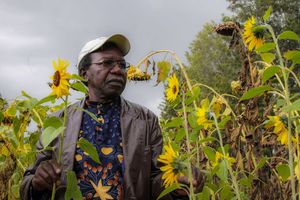
Ms Racheal Kipelian, a 51-year-old sunflower farmer from Entarara, told Seeds of Gold that she has spent the last 20 years diversifying from cattle rearing into agribusiness. Sunflower farming has become one of her most profitable ventures.
Sunflower is proving to be one of the Kajiado County's most promising agribusiness ventures.
Photo credit: Shutterstock
Currently, four acres of her extensive arable land are occupied by flowering sunflower plants, which she grows alongside other crops. She says that she has earned significant profits from sunflower farming over the past two decades. She also extracts cooking oil from part of her harvest for domestic use. She says that pressing four kilograms of sunflower seeds typically yields an average of one litre of cooking oil and 2.5 kilograms of sunflower cake.
“Sunflowers have been the lifeblood of my farming enterprise. In a good season, I harvest at least 10,000 kilograms of dry sunflowers, which usually retail at between 40 and 70 Tanzanian shillings per kilogram in the neighbouring market. Local brokers exploit farmers by buying their produce before selling it in the same Tanzanian market," said Ms Kipelian.
Sunflower farming in the East African region is a highly profitable enterprise that can withstand drought and is expanding rapidly to meet the growing regional demand for edible cooking oil. With Tanzania being Africa's leading producer and Kenya scaling up local production, the sector presents significant market opportunities for smallholder farmers.
According to data from Tanzania's Ministry of Agriculture from 2025, the country produces around three million tonnes of raw sunflower seeds each year, and has the potential to increase production to 10 million tonnes. However, Tanzania consumes around 650,000 tonnes of cooking oil each year, yet local production — primarily from sunflowers — accounts for only around 290,000 tonnes, forcing the country to import substantial quantities. Cross-border trade has also attracted sunflower supplies from Kenya, particularly from Kajiado County, due to its proximity.
Apart from the lack of a local market, Ms Kipelian said that counterfeit seeds resulting in poor yields have become a major setback for many farmers.
In 2025, Kenya's Ministry of Agriculture launched a nationwide campaign to promote sunflower farming, aiming to reduce the country's edible oil import bill of Sh145 billion. Currently, Kenya produces less than 10 per cent of the edible oil it requires.
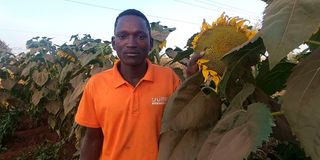
Mr Celestin Sahinkuye, Kimana farm manager, Kajiado County, on July 13 2026.
Photo credit: Stanley Ngotho | Nation Media Group
“The season's yield depends on the variety of seeds used. The market is flooded with counterfeit seeds, which affect production. The seeds, which are often supplied by government agencies, are drought-resistant and do not attract predatory birds when flowering," she added. “I use sunflower stalks and seed cakes as nutrient-dense livestock feed for my cattle.”
She urged the Ministry of Agriculture to support sunflower farmers in Kajiado quickly by introducing value-added initiatives to improve their earnings.
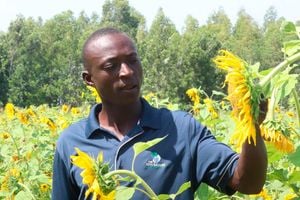
Like many farmers with small parcels of land, Mr Musa Saiperere, 54, practises intercropping, planting sunflowers strategically alongside maize and beans.
He told Seed of Gold that sunflower farming has earned him better returns than rearing cattle and growing other crops.
Like many other farmers, he sells his produce to brokers based in Tanzania, who he claims dictate prices, especially during peak harvest seasons.
'I have no capacity for value addition on my sunflower produce. Predatory middlemen buy the sunflowers even before they have dried fully. During the high season, the price per kilogram can drop to as low as 40 Tanzanian shillings," he said.
Farmers in Entarara and Rombo are optimistic that the ongoing road tarmacking project will improve access to markets and boost agribusiness in the region.
In Kimana, around 30 kilometres from Entarara, Celestin Sahinkuye, a 25-year-old farm manager at a large commercial farm, expressed similar views.
'Apart from tomato and onion farming, sunflowers remain a valuable crop for farmers, but the lack of a local market is a major setback. Sometimes we reduce production for fear of low prices during peak seasons," said Mr Sahinkuye. 'Sunflower stalks and seed cakes are in high demand among livestock farmers.'
Francis Sakuda, the Kajiado County Executive Committee Member for Agriculture, Livestock and Veterinary Services, said that the county government has been providing free training to sunflower farmers across the Loitokitok agricultural belt, with the aim of increasing production through farmer cooperatives.
Mr Sakuda announced that funds have been allocated for the 2026/27 financial year to support sunflower farming and other agricultural activities. However, he noted that the absence of an expanded local market continues to discourage production.
'Last year, we did not supply sunflower seeds to farmers due to erratic climate conditions. However, funds have since been allocated, and agricultural extension officers have been deployed not only in sunflower-growing areas, but across the county," he said. 'We are encouraging farmers, through cooperative societies, to embrace value addition. Local value addition, including the use of small-scale oil-pressing machines, can increase net profits to over Sh100,000 per acre."