On the Elburgon-Salgaa road, approximately 4km from the Elburgon-Njoro road, we arrived at Saptet Farm, owned by David Bor, a former teacher who retired as an Education Officer in 2008 and then started farming.
“For many years, I attended seminars, agricultural shows and field days. Recently, I started growing sunflowers on my farm after learning that this could be done on a large or small scale, and that it would reduce the need to import edible oil,” said Mr Bor.
Retired Educational Officer, David Bor, on his sunflower farm in Elburgon, Nakuru County.
Photo credit: John Njoroge| Nation Media Group
He bought a bag of subsidised fertiliser for Sh2,500 with the Sh9,000 he had as capital, and spent the rest on land preparation, including tilling and labour.
He sourced 8 kilograms of certified sunflower seeds, which the Ministry of Agriculture distributed to farmers for free through the county government. Mr Bor said that the seeds were enough to plant on a one-acre plot of land.
He dug holes 2cm deep in well-drained, nutrient-rich soil, spacing them 10–45 cm apart depending on the variety. Sunflowers require frequent watering, especially during the dry season.
It is important to provide support in the form of stakes once the plants become tall. He added that the spacing allows the crop to get enough water and nutrients from the soil.
"Sunflower stalks can vary in height depending on the variety and produce two or more large flowers at harvest time," he said.
"The government initiative of distributing seeds for free to farmers promotes and enhances small-scale farming. The seeds germinated seven days after planting, so I immediately started weeding at a cost of Sh4,500," said Mr Bor, adding that his crop started flowering after two months.
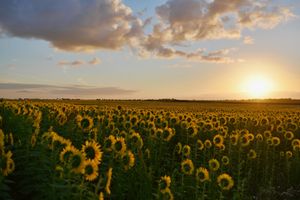
Sunflowers growing on a farm in Elburgon, Nakuru County. Many farmers in the area have started embracing this form of farming since it is less costly than maize farming.
Photo credit: John Njoroge| Nation Media Group
He said he was lucky, as his crop was not affected by pests or diseases. Following average rainfall, his sunflowers were ready to harvest after four months.
However, in July, when the weather turned chilly, his crop was affected by Early Morning Bright, but this did not stop it from thriving because the infection was minimal. He said that a few birds invaded the sunflowers just a few days before harvesting.
"I harvested 850kgs, but this figure could reach 1,000 in a good season. For every four kilograms of sunflower, farmers get one litre of edible oil for domestic use," said Mr Bor, adding that the surplus is sold at the local market for Sh250 per litre.
The former education boss said that farmers could earn Sh62,000 for each harvest, and Sh140,000 after eight or ten months. He added that the cost of each litre of edible oil might soon rise to Sh500 if farmers can access better markets for their products through local processing companies.
After harvesting, Mr Bor noted that the dry flowers are cold-pressed for free by a machine provided by the county government for a group of sunflower farmers.
"The husks are fed to livestock, while the sunflower stalks are cut, ground and mixed with dairy meal for the animals to consume. Nothing from sunflower farming is lost," he added.
He urged farmers in the area to embrace this type of farming, which he said could not be compared with maize farming.
"I switched to sunflowers because there are no middlemen involved, unlike with maize farming. The edible oil product is healthy and safe for human consumption as it contains no chemicals," said Mr Bor, adding that small-scale farmers can also practise this method on their farms as it is labour-intensive.
Retired Educational Officer, David Bor, on his sunflower farm in Elburgon, Nakuru County.
Photo credit: John Njoroge| Nation Media Group
He said that young people could start their own businesses and create jobs through this type of farming.
According to nutritionists, sunflowers and its seeds offer significant health benefits, acting as a nutrient-rich food source containing vitamin E, magnesium, and healthy fats that support heart health, lower cholesterol, and reduce inflammation. It also boosts immunity and supports weight management by promoting satiety.
Mr Bor's vision is to grow sunflowers on a large scale on his farm and become the leading farmer in the region.
"My plan is to switch completely to sunflowers from maize farming, which is now expensive due to the higher cost of seeds. I encourage other farmers to grow sunflowers to access better markets for their produce," said Mr Bor, adding that during a good season, maize farmers only get 20–30 bags from one acre of land after spending a lot on land preparation, seeds, fertiliser and other expenses.
He said that these sales cannot be compared to those of sunflower farmers from the same area. For beginners, only a small amount of capital and farm inputs are required to get started.
Mr Bor called on the county government to support farmers by providing them with enough sunflower seeds and ensuring that subsidised fertiliser is readily available.
He said that when farmers adopt this method of farming, the shortage of edible oil production will be eradicated. He added that sunflower by-products are also good and healthy for livestock.
"The county government should also help us to find markets for surplus edible oil through cooperatives, allow us to export and secure contracts with processors, as avocado and macadamia farmers do,' added Mr Bor.
Mr David Njuguna says sunflower farming has reduced the costs he incurred when he used to grow maize. "It was a sigh of relief for me when I started growing sunflowers three years ago. I have no regrets about switching to this new crop, which is inexpensive to grow even on a small plot," said Mr Njuguna.