Taxpayers have pumped Sh206.46 billion into President William Ruto’s affordable housing programme in three years, creating one of the country’s largest payroll-funded public investment pools.
Treasury records show the housing development levy generated Sh54.16 billion in 2023/24, Sh73.20 billion in 2024/25 and Sh79.10 billion in 2025/26, lifting cumulative collections beyond Sh200 billion despite court battles and political resistance.
The figures show employees and employers have jointly funded the State-backed programme through matching payroll deductions at the rate of 1.5 per cent of pay, transforming the levy into a major source of financing for one of Kenya’s biggest public construction initiatives.
Over the three years, collections fell short of Treasury’s cumulative target of Sh212.78 billion by a modest Sh6.32 billion, or a 2.97 per cent underperformance.
The first year came closest to target, with collections of Sh54.16 billion falling short of the Sh54.58 billion goal by Sh420 million, or 0.77 per cent.
The housing levy receipts increased in financial year 2024/25, rising 35.16 per cent to Sh73.20 billion and exceeding the Sh63.20 billion target by Sh10 billion, or 15.82 per cent.
The government then raised the target aggressively to Sh95 billion in the last fiscal year, but collections peaked at Sh79.10 billion, leaving a Sh15.90 billion gap, or 16.74 per cent below target.
The figures suggest that the levy remains a key revenue source, but its momentum is slowing. Collections grew by 8.06 per cent in 2025/26 after expanding 35.16 per cent the previous year.
The first year of collections was disrupted after a court suspended the levy for three months, ruling that it was unconstitutional because it applied only to workers in formal employment.
Parliament responded by passing the Affordable Housing Act, 2024, allowing collections to resume from March 2024 under an expanded framework that also covers workers in the informal, or jua kali, sector. Official data shows the housing programme has expanded rapidly over the past two years, making it one of the biggest public construction initiatives in Kenya’s history.
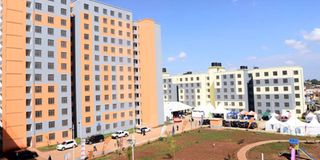
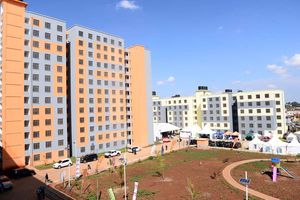
A section of the Affordable Housing Project in Mukuru, Nairobi on December 11, 2024.
Photo credit: File | Nation Media Group
As of December last year, more than 205,000 housing units were under development nationwide at an estimated cost of nearly Sh500 billion, according to the 2026 Economic Survey.
The affordable housing component accounted for 138,474 units valued at Sh385.83 billion, while social housing projects targeting lower-income households comprised 53,350 units worth Sh81.8 billion. Institutional housing included 12,709 units costing Sh28.6 billion for public servants, police officers and members of the Kenya Defence Forces, with further expansion planned into student accommodation.
Current pricing under the programme shows the scale of revenue the government expects to generate from completed units.
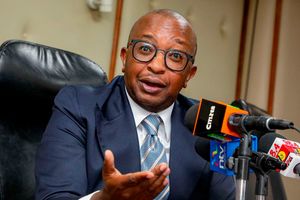
Principal Secretary, State Department for Housing and Urban Development, Charles Hinga, addresses journalists during a press briefing on the progress of the Affordable Housing Programme at Ardhi House, Nairobi, on July 22, 2026.
Photo credit: Lucy Wanjiru | Nation
Affordable housing units are priced at between Sh1.5 million and Sh2.1 million for one-bedroom houses, Sh2 million to Sh2.5 million for two-bedroom units and Sh3 million to Sh3.3 million for three-bedroom apartments. For workers earning Sh150,000 and above monthly, the houses are sold at market-rate, where two-bedroom units cost between Sh2.4 million and Sh4.3 million, while three-bedroom units range from Sh3.6 million to Sh5.76 million.
Social housing units — targeted at lower-income households — are priced lower, ranging from Sh640,000 to Sh840,000 for one-room units, Sh960,000 to Sh1.26 million for two-roomed houses and Sh1.28 million to Sh1.68 million for three-roomed units.
Under the tenant-purchase model, occupants make monthly payments before eventually owning the homes.
Buyers are currently required to pay a 10 per cent deposit, although President Ruto, on May 1, announced plans to reduce the requirement to five percent to accelerate sales of completed units.
The Ruto administration is now banking on completed houses to begin generating substantial cash flows capable of financing the next phase of construction, reducing the programme’s dependence on payroll deductions.
Housing PS Charles Hinga said the post-election spike reflects expectations of significantly higher revenue from housing sales alongside increased collections from the levy.
“Expenditure on affordable housing is projected to spike in FY2027/28 as the Sh360 billion projection includes funds expected to be realised from projected housing sales and increased levy collections,” Mr Hinga said in May.
It is projected that housing levy collections will reach Sh110 billion in the financial year ending in June 2027.