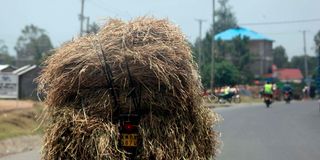
On the busy Kisumu-Ahero road, what catches the eye is not just the paddies but also the yellow “mountains” by the roadside.
Bales upon bales, like loaves of bread, line the shoulder of the road. To a stranger, they appear like hay. To a livestock farmer in a dry season, they are survival.
Motorists slow down with some stopping and asking what the mountains are. It is not grass or hay but rice straw.
The straw, once burnt or left to rot after harvest, is now one of the most sought-after commodities in Nyanza.
A few months ago, after the combine harvesters had passed and the paddy had been taken to the mill, the straw was waste.
Farmers at Ahero Irrigation Scheme would set it alight to clear the fields for the next crop, or simply leave it to decompose in the water.
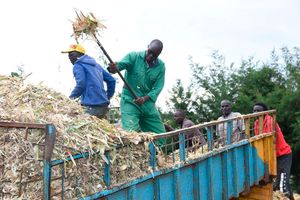
Today, the straw is collected, dried pressed and made into bales. Young men load them on bicycles, motorbikes and pick-ups and deliver them to livestock farmers.
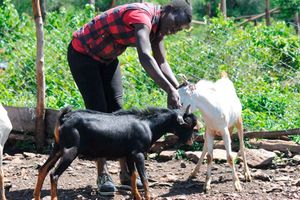
In Kochia, livestock owners no longer witness their animals starve to death during dry seasons. They give them rice straw instead.
Farmers never considered straw as a source of income. Chrisantus Abong’o, a resident of Kibiri, says farmers watched helplessly as their animals died as the grass turned brown, but rice fields remained green. The fields are evergreen in Lower Kochia and parts of Kibiri.
Farmers rely on irrigation, with water sourced from River Awach Tende. Water flows in canals built under the Kimira Oluch Smallholder Farmer Improvement Project and supplies the paddies all year round.
“Here, rice is harvested by hand. When the straw is cut from the base, it is hit to separate the grains from the rest of the plant,” the farmer says.
In the past, the straw would be burnt or used for mulching. Abong’o says all that changed when farmers noticed their cows run to the fields and eating the straw.
Some farmers picked the straw and took it to their animals at home. Others with animals would ask for a share. They soon joined the others in collecting straw from rice fields,” he says.
With the government having sounded the alarm that milk prices will remain high due to dry weather, shrinking formal deliveries and soaring costs for animal feed, the straw came in handy for livestock farmers. Demand has risen sharply in the last few weeks.
On the Homa Bay-Kendu Bay road near Nyangweso market are tens of rice straw stacks of different sizes. A bale goes for Sh50 to Sh100.
Some farmers add grass from the fields to the straw. The grass is also pulled out of the ground by hand.
Due to increased demand for animal feed, all of it is sold to farmers who are desperately looking for what their animals can eat.
Paul Ngicho, a farmer, says the straw business has increased family incomes in Ahero and surrounding areas. An acre can produce 20 to 25 bags of rice.
“Rice straw has helped many farmers who would have counted losses. It puts food on the table,” he says.
“We will not just sell straw like we are doing today. I intend to package it neatly and sell it to farmers in other counties too,” Ngicho says.
In Wahambla village, Homa Bay Town East Ward, Stephen Abich makes weekly visits to Nyangweso to buy straw for his two lactating cows.
Abich says his other animals graze near the river. He buys Sh1,000 straw for the animals.
“I cannot let the two cows out for long. Napier grass and other feed are expensive,” he says.
Oduor Nyagilo, a rice farmer in Lower Kochia, says the region has not experienced rain for five months. He, however, says rice straw is not the solution.
“I don’t think the straw adds any nutritional value to the animal. It only saves the animal from death,” he says.
National Agricultural Value Chain Development Project coordinator in Homa Bay, Henry Nzinga, says straw is not highly nutritious. He adds that it mainly acts as a cheap bulk roughage or “rumen filler”.
“It is primarily fed to ruminants during dry seasons or lean periods when pasture is scarce. Farmers use it because they have no alternative,” the expert says.
Hay is cut from green grass, dried while still nutritious and packed with energy and protein. Rice straw is what remains after the grain – the stalk – is taken. It is high in fibre, low in protein and not easily digested.
On its own, straw cannot fatten a cow or make it give more milk. It fills the stomach and keeps the rumen working. Rice straw also buys the farmer time until the rains come and fresh grass grows again.
Demand for rice straw grows in the dry months of January to March and August to September, when grass in Kochia, Nyando, Muhoroni and Kano plains turns brown.
Farmers, however, say they will continue giving their animals the straw.Grazing land is shrinking as settlements expand and farms become smaller. Rains too have become unpredictable. A farmer who once relied on free communal pasture now has to plan, buy and store feed.
In transforming by-products into emergency fodder, farmers in Kochia are rewriting their climate narrative from one of isolated survival to collective resilience.
They now want agricultural organisations to help them learn to make silage and other feed using the rice straw.
John Jigo, a farmer, says he is considering adding molasses to straw to create an energy-rich supplement that improves palatability and helps preserve feed.
“Scientists are sounding the alarm on climate change. There needs to be solutions to problems caused by such weather phenomena. My idea is one of them,” he says.
Some animal owners source the straw directly from rice fields. They drive to the paddies and wait for farmers to harvest before buying directly from them.
Like the rest, she would leave the plants to dry up before planting new ones.