Hello

Your subscription is almost coming to an end. Don’t miss out on the great content on Nation.Africa

Ready to continue your informative journey with us?

Hello

Your premium access has ended, but the best of Nation.Africa is still within reach. Renew now to unlock exclusive stories and in-depth features.

Reclaim your full access. Click below to renew.

Olo Lokwe Mountain
Caption for the landscape image:

The roads that cost Kenya billions of shillings

Scroll down to read the article

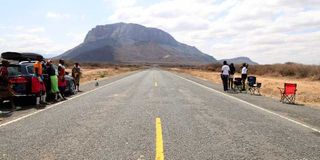
Tourists take pictures near Olo Lokwe Mountain along Marsabi-Moyale Road (A2)on july 26,2026. The road connects Marsabit to Moyale town

Photo credit: | Nation Media Group

Mohamed Abdullah Mahad’s general shop in Turbi, Marsabit County, stocks just about everything households and travellers need.

From water, soft drinks and snacks to foods, toiletries and soaps, it is a shop positioned to serve travelers as well as locals.
Sitting about 120km from Marsabit town and 125km from Moyale, Turbi shopping centre’s location also gives Mr Mahad options when buying stock. He can either restock in Marsabit town or Moyale.

“I get my stock from Moyale and Marsabit, which makes it easier to keep my shop stocked throughout. Running the business has been easier since this road was constructed, easing travel times and access to services such as schools, hospitals and supplies of fresh fruits from Meru,” Mr Mahad says.

On a normal day, he gets clients both from among locals of this sparsely populated area, as well as travellers traversing through the vast Marsabit County, towards Kenya’s border with Ethiopia.

Located about 660km north of Nairobi, Turbi is closer to Ethiopia than Kenya’s capital, and Mahad’s story is a combination of entrepreneurial ingenuity and the impact of an expansive road network.

That network has opened up one of the most remote parts of Kenya.

Construction of the 505km Isiolo - Moyale Highway not only cut travel time between Moyale and Nairobi, a 776km distance, from three days to 12 hours, but also enabled residents to access services they only dreamed of.

Today, it is one of Kenya’s most beautiful roads, stretching hundreds of kilometres and triggering an upsurge of businesses and shopping centers along the route, as local and foreign tourists throng Northern Kenya.

New Content Item (1)

Tourists in front of the Olo Lokwe Mountain along Marsabit-Moyale Road (A2) that connects Marsabit town to Moyale town on the Kenya Ethiopia border on July 26,2026

Photo credit: Sila Kiplagat | Nation Media Group

It might be one of Kenya’s most iconic roads due to the impact it has had, but certainly not the only.

Over 15 years, successive governments have spent Sh1.9 trillion on the development of roads, averaging Sh126 billion annually for construction, maintenance and repairs, the single largest development spending in any sector.

Three Presidents


During the two terms of former President Uhuru Kenyatta, for instance, the government used Sh1.3 trillion to fund roads, implementing crucial infrastructure such as the final phase of the Isiolo-Moyale Highway from Merille River to Moyale town, the Dongo Kundu Bypass, the Nairobi Expressway and several bypasses across the Nairobi metropolitan.

By the end of June next year, President William Ruto will have spent about Sh590 billion on roads, with key projects under his first term including the ongoing Rironi-Mau Summit road, the Isiolo-Kulamawe-Modogashe Highway and several other roads in Northern Kenya.

A section of the Thika Super Highway. 


Photo credit: File | Nation Media Group

During former President Mwai Kibaki’s tenure, Thika Superhighway became one of the most iconic roads ever constructed in the country, opening up the link between Nairobi and Mt Kenya regions.

Mr Kibaki also implemented the first batch of the Isiolo-Moyale Highway, running about 140km from Isiolo town to Merille River.

240,000km roads

It’s this spending that has seen Kenya’s road network grow nearly fourfold from 63,640km by the time Kibaki handed over power to Uhuru, to 239,123km last year.

Tarmac roads specifically have increased from 14,500km in 2016 to 25,412km last year. This means that the length of total tarmac roads has increased by three-quarters in the past decade alone.

The bulk of Kenya’s road network, however, is still murram/gravel and earth roads, which constitute 90 per cent of the 239,123km network.


So, what has come out of this significant investment?

Official statistics show that of the Sh74 trillion generated in the Kenyan economy in the past five years, Sh11.8 trillion (16 per cent) came from the road transport sector.

This means that activities ranging from public transport through matatus and bodabodas, to cargo transport as businesses move goods, are contributing Sh16 out of every Sh100 the economy generates.

Roads have a tendency to open up the remotest of areas, allowing communities to trade and households to access services with ease since good roads cut travel times and lower the cost of production, economists reckon.

“Infrastructure investment should expand at the same level as the real economy. If it occurs at a slower pace than the rest of the economy, bottlenecks and choke points begin to form, but also if it expands faster than the rest of the economy - there is underutilization and white elephant projects start to appear,” says Ken Gichinga, chief economist at Mentoria Economics.

As we take a trip from Nairobi, through the Thika Superhighway, the newly built Kenol-Marua dual carriageway, then through Isiolo upwards to Moyale- the Ethiopian border town- the socioeconomic impact roads have had is all clear.

Kenol-Marua road

The Kenol–Sagana–Marua Dual Carriageway in a picture taken on July 24,2026.

Photo credit: Sila Kiplagat | Nation Media Group

It ranges from malls and major supermarkets that have opened along several towns located along the developed roads, financial institutions making inroads, resorts serving travellers and corporate entities, to the smallest of economic players, hawkers and market women who now sell fruits and vegetables by the roadside.

Along the Thika Superhighway, for instance, at least six shopping malls have come up since the expansion of the road 15 years ago, providing space to hundreds of businesses that now operate. They include Garden City, Thika Road Mall (TRM), Spur Mall and Juja City Mall.

The superhighway expanded from a four-lane dual carriageway previously clogged by traffic snarl-ups into an eight-lane road flowing 50km.

“Thika Superhighway is a perfect example of the impact that properly planned road infrastructure can have. It has opened up residential and commercial areas, real estate value has gone up along the route, and many people have moved there to live and do business,” says Mr John Mutua, Programs Coordinator for the Institute of Economic Affairs (IEA).

As you enter Murang’a from Kiambu County, Kenol is one town whose glory rests squarely on the expansion of the Superhighway, and now major supermarkets and other businesses have set up shop to serve growing numbers of residents.

The Kenol-Marua Road has connected Nairobi to Nyeri by extending a four-lane highway from where the Thika Superhighway ends.

“When this road was still a single carriageway, the number of businesspeople selling here was quite low, and the majority of them would just lay their items on top of sacks. Now people have built about 50 stalls from which they sell fruits and vegetables. It has turned into a full-time marketplace from a seasonal one before since on weekends many people take road trips from Nairobi along this route,” says Agnes Musee, a fruit vendor at Kamiti, along the Kenol-Marua Road.

Mr Mutua from IEA notes that when roads trigger a growth of economic activities by easing transportation costs and timelines, the government is then able to generate more revenues from taxes, and is able to provide more services to citizens.

All it takes, he reckons, is proper planning through feasibility studies to ensure that there is an actual need for a road to serve people and businesses, and avoiding political interference that creates white elephants.

At Marua, where there is an interchange transitioning the road to a two-lane single carriageway, some land owners who were compensated for their land have put up some brick shops and bodaboda operators here can now afford to extend shifts in wait of late night passengers, including revelers who patronise upcoming entertainment joints.

Towards Nanyuki town after leaving the dualled road, the roadside economy stretches, accommodating businesses dealing in foodstuffs, shops, resorts, furniture, hardware and even sawmills.

“Just about a third of the clients we sell to are based here; the majority of them are travellers and passersby who will admire our furniture and buy or take our contacts, then reach out later. We do deliveries to places such as Meru, Isiolo, Samburu and Nairobi,” says Jane Rose Njeri, who sells furniture at Ichuga, along the road to Nanyuki.

Vehicles cruise along Isiolo-Moyale highway. The relatively new road has attracted investors to the region  with the number of tourists visiting various destination sites in Northern Kenya continually soaring.

Isiolo to Moyale

The Isiolo-Moyale Highway equally had its impact on the national and local economy.

It had operated as a gravel road since 1974, before it was built as part of the Lamu Port-South Sudan-Ethiopia-Transport Corridor (Lapsset) over a decade until 2017, opening up Northern Kenya and crucially connecting Kenya to her northern neighbour, Ethiopia.

The road was built between 2007 and 2016 under the administrations of former Presidents Kibaki and Uhuru, first covering Isiolo to Merille River, then stretching all the way to Moyale.

Isiolo-Moyale highway

A section of the Isiolo-Moyale highway at Merille bridge at Marsabit County.

Photo credit: File | Nation Media Group

Since its completion, exports to Ethiopia have more than doubled, growing from Sh40.56 billion in the 2016-2020 period to Sh84.7 billion in the 2021-2025 period.

A gate attendant at the Moyale One Stop Border Post says upto 100 trucks pass through the border when activities are at peak, with Kenya mostly moving fertilizer and chemicals as Ethiopia brings chicken feeds.

In Kenya, development of roads is undertaken by Kenya National Highways Authority (KeNHA), Kenya Urban Roads Authority (Kura), Kenya Rural Roads Authority (KeRRA) and county governments.

Kura says it has constructed 2,082km new roads, upgraded 219km and maintained about 9,618km across different urban areas since its establishment.

“Over the 2012/13-2026/27 period, funds used in road construction and maintenance amount to over Sh200 billion. Government spending is still heavily concentrated on keeping the network serviceable, expanding and upgrading strategic corridors,” Kura says.

Construction all over

The Kenya National Bureau of Statistics (KNBS) reported a select Sh226.4 billion worth of roads that were under construction by December last year, including the 225km Kibwezi-Mutomo-Kitui road, the 150km Garissa-Isiolo, Isiolo-Kulamawe (77km), Kulamawe-Modogashe (128km), Wajir-Tarbaj (57km), Tarbaj-Kotulo (64km), and three lots of Mau Mau roads in the Mountain region.

Construction of The Isiolo - Garba Tula Road

Construction of the Isiolo - Garba Tula Road goes on. The road serves the northern Kenya transport corridor, linking Isiolo to Garba Tula, Modogashe, Wajir and Mandera.

Photo credit: Sila Kiplagat | Nation

The construction of 29km Kwale-Kinango, Mtwapa-Kilifi (40km) and Kwa Jomvu-Mariakani (30km) roads in the Coast is also ongoing, while KeNHA says it has since completed the Isebania-Ahero road.

Along the Nairobi-Nakuru Highway, construction of the four-lane Lironi-Mau Summit road is in top gear, with dozens of excavators, bulldozers, sheepfoot rollers and tippers now a permanent feature of the route from Limuru to Gilgil, Nakuru County.

Along the road where the government is adding four lanes to the existing two-lane single carriageway, works including ground levelling, installation of culverts, preparation for interchanges and demolition of old overpasses is ongoing.

Rironi–Mau Summit Road

Construction of a section of the Rironi–Mau Summit Road at Gilgil on July 2, 2026.

Photo credit: Boniface Mwangi | Nation Media Group

Last year, road transport contributed Sh2.57 trillion to Kenya’s economy, which was 14.6 per cent of the Sh17.58 trillion Gross Domestic Product (GDP).

This has been witnessed as trade with countries bordering Kenya by road grows, particularly Uganda, Ethiopia, the Democratic Republic of Congo (DRC) and South Sudan.

More Kenyans also continue to acquire vehicles, with KNBS data showing that about 1.5 million new vehicles have been registered in the past five years alone.

The 395,235 new vehicles registered last year alone were more than double the 173,044 vehicles that were registered in 2012.

Road agencies are also lining up several projects for roads expected to be implemented in the coming years, as Kenya keeps up the tarmacking momentum.

Follow our WhatsApp channel for breaking news updates and more stories like this.