Farmers across the North Rift are spending nearly double the government price to buy fertiliser from private dealers, as conflict in the Middle East disrupts global supply chains at the worst possible moment of the planting calendar.
Calcium Ammonium Nitrate under the government subsidy programme is meant to retail at Sh1,950 per 90kg bag, but remains unavailable in many NCPB depots, leaving farmers to rely on private dealers charging about Sh2,800 per bag. Without subsidy, a 50kg bag of planting fertiliser now retails at between Sh6,000 and Sh6,500. Top-dressing fertiliser through private agrovets ranges from Sh4,500 to Sh4,700.
"This is the period when maize requires top-dressing fertiliser the most," said one farmer from Bungoma County, who requested anonymity. "In many NCPB stores, the fertiliser we need is unavailable."
Joshua Kipngetich Tiongoi, a farmer from Aldai in Kapsabet, Nandi County, confirmed the same situation on the ground.
"In the NCPB depots, there are no DAP and top-dressing fertilisers such as urea. We are struggling to access the farm inputs," he said.
The shortages are expected to drive fertiliser prices higher, reducing affordability and application rates, and likely reducing yields. Elevated shipping and insurance costs are also expected to push up prices for heavily imported food commodities such as wheat, rice and cooking oil. This could erode consumer purchasing power particularly among low-income households, according to the Famine Early Warning Systems Network, which flagged the situation this season.
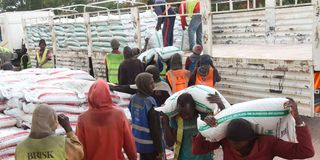
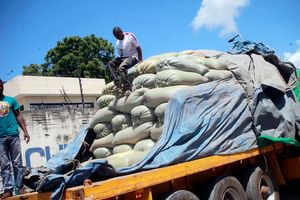
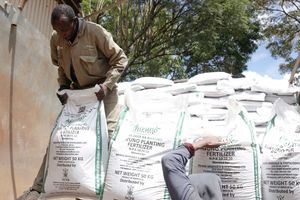
Workers offload bags of subsidised fertiliser from a truck at the National Cereals and Produce Board (NCPB) depot in Elburgon, Nakuru County on March 25, 2025.
Photo credit: John Njoroge | Nation
The immediate trigger is the ongoing military confrontation between Iran and Israel, which is disrupting the Strait of Hormuz. Up to 30 per cent of the global fertiliser trade normally passes through this strait.
Iran was the third-largest urea exporter in 2024, with export volumes of around 4.5 million tonnes and a production capacity of around 8.9 million tonnes a year, serving markets in Turkey, Brazil, Argentina and beyond. When attacks on Iranian gas infrastructure knocked production offline, the consequences spread quickly. Egypt's fertiliser operations also came to a standstill after Israel reduced its natural gas flows to the country, prompting Egypt to slow and then stop production.
Augustin Grandgeorge, Head of Development Initiatives at the Paris Peace Forum, told an AGRA webinar on May 28 that the price consequences arrived with striking speed.
"Urea prices, particularly FOB Middle East prices, rose from approximately $490 per tonne before the conflict to around $750 by late March, an increase of over 50 per cent in under six weeks," he said.
"The halt in Qatari LNG exports has compounded the crisis because natural gas accounts for up to 80 per cent of ammonia production costs, and ammonia is the building block of all nitrogen fertilisers."
War-risk insurance premiums, he added, have risen tenfold. Those costs do not stay offshore.
"Importers in East and West Africa buy in dollars, and the combination of higher commodity prices, higher freight costs and war-risk insurance premiums is being passed down the chain," Grandgeorge said.
Most of Kenya's fertiliser is imported through the Port of Mombasa from suppliers in the Middle East and North Africa, including Saudi Arabia, the United Arab Emirates, Qatar and Oman. Kenya is the second-largest fertiliser importer in Sub-Saharan Africa.
That dependency is not new, but it has never been adequately addressed. Since Russia's invasion of Ukraine in 2022, fertiliser prices in Kenya rose by approximately 30 per cent, with imports of chemical fertiliser components declining by 48 per cent in the April to June quarter of that year compared to the year before.
"Each intermediary in the supply chain adds its own margin against rising risk and uncertainty," Grandgeorge warned. "The effective price increase for farmers can be well above the reported 50 per cent rise in global prices."
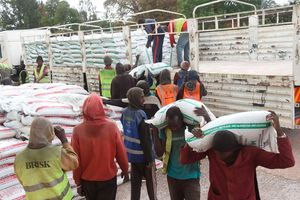
Workers offload the government's subsidised fertiliser from a truck at the National Cereals and Produce Board, Eldoret depot in Uasin Gishu County on March 18, 2026.
Photo credit: Jared Nyataya | Nation Media Group
In western Kenya, some brokers are already sourcing supplies from as far as Bondo in Siaya County to fill the gap left by empty NCPB depots.
"We fail to understand why the government makes a last-minute rush to avail low-cost fertiliser, resulting in some farmers missing out on the scheme and contributing to low yields," he said.
However, the National Cereals and Produce Board (NCPB) has dismissed claims of a widespread shortage of subsidised top-dressing fertiliser, saying distribution under the ongoing long rains season has remained largely on track, despite temporary disruptions in some depots.
NCPB CEO and Director Samuel Ndung’u Karogo said supply has been largely consistent under the government subsidy programme.
“During the current long rains planting season, the Government through the NCPB has distributed 4.1 million bags of planting fertiliser and 3.2 million bags of top-dressing fertiliser, totalling 7.3 million bags to registered Kenyan farmers. This is against 6.6 million bags distributed during the 2025 long rains planting season,” Mr Karogo told the Nation .
He was responding to concerns from farmers in Uasin Gishu, Trans Nzoia, Nakuru and Bungoma counties, who say they are unable to access top-dressing fertiliser.
Mr Karogo added that since the beginning of the 2026 long rains subsidised fertiliser season on December 18, 2025, both planting and top-dressing fertilisers have been made available to farmers, with most already accessing their allocations.
However, the NCPB boss acknowledged that some depots had experienced slower deliveries of top-dressing fertiliser towards the end of the season. He attributed these delays to sudden price increases triggered by supply chain issues related to the ongoing conflict in the Middle East.
Regarding the impact of the global fuel crisis on fertiliser availability in Kenya, the NCPB confirmed that the government had anticipated potential supply chain issues and pre-positioned stocks in advance under the subsidy programme. The agency confirmed that the types of fertiliser required by farmers have continued to be supplied, except for a brief two-week interruption caused by a surge in demand after the long rains arrived earlier than expected, leading to panic buying. Mr Karogo said that the demand had subsequently been met.
On management changes at NCPB depots, Mr Karogo dismissed concerns, stating that there have been no unusual or disruptive changes. “There are no unusual changes in the management of NCPB depots.”
The fertiliser subsidy programme, introduced under President William Ruto’s administration in September 2022, initially reduced the cost of a 50kg bag of planting and top-dressing fertiliser from as high as Sh6,500 to Sh3,500 in an effort to improve affordability and boost agricultural productivity.
The programme was later expanded. And in August 2023, President Ruto announced a second phase of the subsidy, further lowering the cost to Sh2,500 per bag. However, each transaction attracts an additional Sh80 charge, effectively raising the cost to Sh2,580.
The government says it plans to distribute 12.5 million bags of fertiliser annually under the subsidy programme. The NCPB did not say when.