For decades, work has relied on conventional methods, with farmers walking through their fields to inspect crops, teachers marking assignments by hand, researchers spending hours searching through books and journals, and office workers handling repetitive paperwork and customer inquiries.
However, that way of working is now shifting as digital technologies, particularly artificial intelligence (AI), reshape how tasks are performed, information is processed, and decisions are made. AI is moving workplaces from conventional methods to digital systems that can process vast amounts of information, identify patterns, and handle repetitive tasks in seconds.
The transformation is being seen in agriculture, education, healthcare, research, banking, hospitality, security and manufacturing, with the tool increasingly being used alongside human workers instead of as a stand-alone technology. The shift was evident at the ongoing 2026 Nairobi International Trade Fair at Jamhuri Showgrounds, Nairobi, themed “Promoting Climate-Smart Agriculture and Trade Initiatives for Sustainable Economic Growth,” where innovators and institutions are exposing visitors to emerging digital technologies. The agricultural event is organised by the Agricultural Society of Kenya (ASK).
Elena Mwai, Coordinator of AI Digital Transformation and Emerging Technologies at Mount Kenya University (MKU), said AI can be applied almost anywhere computers are used, particularly where people perform repetitive tasks. “It is basically anywhere where you have computers and repetitive tasks. It can be applied in almost every sector,” she said.
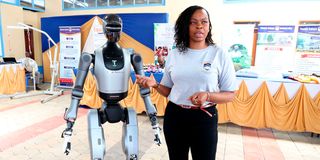
Elena Mwai, Coordinator of AI, Digital Transformation and Emerging Technologies at Mount Kenya University demonstrates how an AI-powered robot works during the Nairobi International Trade Fair at Jamhuri Park Showground, Nairobi, on September 30, 2026.
Instead of relying entirely on conventional systems, organisations can feed large volumes of information into AI tools, which analyse the data and produce insights that can support decision-making. The tool creates a database.
In agriculture, for instance, the AI expert said it could change how farmers identify crop diseases, select seeds, manage irrigation and respond to changing weather.
“AI systems can analyse information on soil type, humidity, weather and crop performance and use the data to generate recommendations,” she explained. Cameras can also be used to capture images of crops and identify possible diseases from leaves, giving farmers an additional tool for detecting problems before they spread across a field.
Ms Mwai, however, stated that Kenya faces a major challenge in getting AI systems to provide locally relevant agricultural information because much of the data used to train generic systems comes from outside the country. “AI needs data. If you want AI to give you the right answers for Kenya, you need Kenyan data,” she noted.
A system trained on information from countries with different soils, weather conditions and farming practices may provide advice that does not fully correspond with conditions on a Kenyan farm. This makes data collection and digitisation critical to the country’s AI transition. Organisations that have accumulated information in paper files or conventional databases will need to convert it into formats AI systems can process.
Technology is also changing classrooms. AI-powered tutors can analyse students’ performance in quizzes, assignments and other assessments before tailoring learning materials to individual needs. At MKU, Ms Mwai revealed that students are gaining practical exposure to AI and robotics through a Walker S2 humanoid robot acquired for education and research. The robot, which was on display at this year’s Nairobi ASK Show, she revealed, cost the institution about Sh20 million. The machine has human-like hands, fingers and joints, as well as cameras that enable it to interact with its environment.
Students can programme the robot to respond to speech, move and pick objects, giving them experience in developing and training robotic systems. “AI is also creating opportunities in healthcare, where large volumes of medical information can be analysed more quickly than through conventional methods,” Elena Mwai said. “It can help us in health because we have clinical data and historical records. You can use that information for prediction.” AI can assist in analysing medical images, including CT scans, while similar systems can be used in malaria microscopy, drug discovery and research into diseases and their treatment.
In research, AI can reduce the time spent searching through large volumes of literature and analysing data. Researchers can use digital tools to identify relevant studies, organise information, analyse datasets and carry out repetitive tasks.
Ms Mwai, however, cautions researchers against accepting AI-generated information without verification. “You can ask AI to give you research papers, and it can give you papers that do not exist,” she shared, advising researchers to cross-check information with established academic databases and journals before using it.
At Kabete National Polytechnic, lecturer and AI expert David Ochieng, during the interview at ASK 2026, stated that the institution is preparing students for a workplace where automation will become increasingly important. The polytechnic introduced its Industrial Automation and Robotics course about three years ago, allowing trainees to work with robotics and automated systems.
The institution has developed a robot known as the AI-powered Kabete Poly-TVTBOT, a general-purpose machine designed to perform and adapt to different tasks. It is built using human dummies and fitted with components such as cameras, microphones and a remote-control system. “It can be a customer-care agent, it can be a secretary, it can be a public speaker,” Mr Ochieng said. The robot could, for instance, receive visitors when a secretary is away, provide information to students or assist with career guidance during visits by secondary school students.
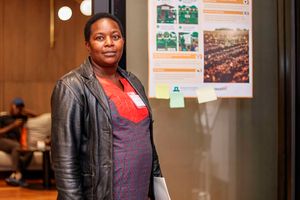
Kabete National Polytechnic lecturer and AI expert David Ochieng demonstrates how an AI-powered robot works at Jamhuri Park Showground, Nairobi, during the Nairobi International Trade Fair on September 30, 2026.
Photo credit: Sila Kiplagat | Nation Media Group
The lecturer said the technology can also be adapted for agriculture, where cameras fitted on robots can capture images of crops and help identify diseases. “If you give it a camera and you take a picture of a leaf, it can tell you whether that leaf has a disease and what treatment can be applied,” he stated.
The application of AI in agriculture could extend to accessing existing research databases, processing information collected from farms and helping farmers make decisions based on available data.
Technology is also finding a place in banking. Ms Mwai said financial institutions can use existing customer information to automate parts of the loan assessment process, although cybersecurity must remain a priority. “As we digitise, we must also think about security because we are dealing with people’s information,” she emphasised.
The move from conventional systems to AI is also likely to alter the demand for labour, particularly for jobs dominated by repetitive activities. Mr Ochieng, in an exclusive interview, stated that an organisation that previously needed 10 secretaries for routine work could potentially require fewer people after introducing automated systems. “You may have 10 secretaries, but with AI you may find that you only need one or two people to supervise the system,” he explained. This does not mean that people will disappear from the workplace, he added, because humans will still be required to operate, supervise and improve the technology. “AI is not here to replace human beings. It is here to support people, make work more efficient, increase productivity in sectors such as agriculture and enhance surveillance in the security sector,” Ochieng says.
The shift is consequently creating demand for new skills, including AI development, data science, robotics, programming and cybersecurity. According to Elena Mwai, MKU has expanded its training programmes to respond to this demand. “AI and data science have previously been taught through Computer Science and Information Technology programmes, while the university now offers a Bachelor of Science in Artificial Intelligence and Data Science,” she said.
The university has also developed curricula for a Bachelor of Science in AI and Robotics and offers short courses in areas including AI, 5G and fibre optics. Students are also exposed to hackathons and research activities that provide practical experience in emerging technologies.
At Kabete National Polytechnic, Mr Ochieng said students are gaining hands-on experience by helping develop and programme robotic systems. The robot incorporates components such as servo motors, circuit boards and cameras. Students participate in assembling and programming the machine, enabling them to understand how hardware and software work together.
“We are trying to show our trainees that this is something we can build locally,” he stated. The robot can use cameras to recognise people and interact with them, including remembering names and previous conversations, depending on how it is programmed.
Apart from agriculture and education, AI has applications in hospitality, security, transport and manufacturing. In hospitality, robots can handle selected customer-service functions, while AI-powered security systems can monitor camera feeds and alert human operators to activities requiring attention. Autonomous vehicles and industrial machines can also use AI to interpret their surroundings and respond to changing conditions.
Climate resilience is another area where technology could become important. AI can analyse historical and current weather information to support predictions and help farmers make decisions on crops, seeds and planting periods.
Already, some farmers and agriculture-based companies are using AI-enabled drones for farm operations such as spraying, aerial imagery, crop scouting for diseases and pests, and identifying plants that require water, among other applications.
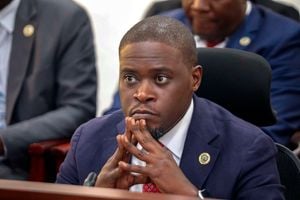
Agriculture CS Mutahi Kagwe during the official opening of this year’s Nairobi International Trade Fair at Jamhuri Park Showground on September 30, 2026.
Photo credit: Sila Kiplagat | Nation Media Group
Speaking during the official opening of this year’s Nairobi ASK Show on Wednesday, September 30, Agriculture and Livestock Development Cabinet Secretary Mutahi Kagwe emphasised the adoption of modern technologies and digitalisation to drive growth in the sector, increase productivity and help address food security challenges.
“Technology and digitalisation are at the heart of our efforts to transform agriculture. A farmer in Turkana harvests today, but the system that should support her is still fragmented. Her location is not clear, advisory services arrive late, and access to inputs depends more on chance than design. This is the gap we have to close through digitalisation,” the CS Kagwe said.
“It is the skills and knowledge gap, the technology gap, as well as the route-to-market gap. We have therefore launched the Kenya Agricultural and Digital Information Centre (KADEC), which participated in this show for the first time, as a single source of truth on agricultural data and technology in the sector,” he added.
Mr Kagwe said KADEC will serve as a vehicle for fixing the country’s agricultural system so that it serves every farmer, responds in real time and delivers services with precision.
He said the government is working on the legal, policy, regulatory and fundamental infrastructure required for KADEC to effectively discharge its mandate.
When combined with Internet of Things sensors measuring soil moisture, temperature and humidity, AI can support more precise irrigation and help farmers use water and other inputs efficiently. However, according to Elena Mwai, Kenya needs to strengthen its ability to generate and organise local data if it is to gain maximum value from AI. “We need to have our own data, because without data, AI cannot give us accurate information,” she said. There is also a need for policies and responsible use as more institutions adopt the technology. AI systems, the experts say, should not be allowed to operate without human oversight, especially in sensitive areas such as health, education and research. Excessive dependence on AI could affect people’s ability to think critically and creatively, particularly where students or workers use the technology as a shortcut instead of developing their own skills.