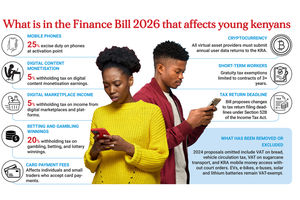
The cost of mobile money transactions will go up by at least 33.4 percent if lawmakers approve the Finance Bill, 2026 as proposed by the National Treasury.
Telecommunications service providers have warned against the introduction of a 25 per cent excise duty on the value of imported cellular mobile phones, which will affect the overall cost of gadgets, financial transactions, and access to banking services.
The Treasury is proposing to increase excise duty on imported cellular phones which service providers like Safaricom and Airtel have opposed.
The Treasury is also seeking to reclassify imported or locally purchased telephones for cellular networks and other wireless networks from zero - rated to value added tax (VAT)-exempt supplies, which will increase the tax burden that is likely to be passed on to consumers, as businesses will be unable to claim input VAT.
Phones on display.
Photo credit: FILE
The Treasury wants the First Schedule to the Excise Duty Act to be amended in Part I, in the second table by deleting the description “imported cellular phones” and the corresponding rate of excise duty and substituting therefor by imposing 25 percent of excisable value of telephones for cellular networks and other wireless networks of tariff heading 8517.
Safaricom Limited, Airtel Kenya, PriceWaterhouseCoopers (PWC), and RSM (Eastern Africa) Consulting Ltd said they are likely to disproportionately affect low -income earners, small businesses, and individuals who rely heavily on mobile money.
The stakeholders want Clauses 34, 35 & 36(a)(i) which proposes to change the time of supply and payment to the point of activation and impose a 25 percent excise duty on telephones for cellular and other wireless networks under tariff heading 8517 deleted.
Safaricom said a simulation of the combined tax burden of adopting the proposal would be an increase in transaction fees by 18.4 percent.
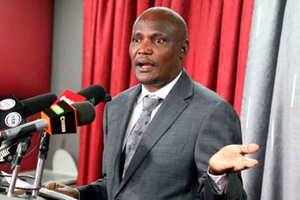
“When excise duty of 15 percent is applied to VAT at 16 percent, the effect will be to increase transaction charges,” Ryan Wamae told the committee chaired by Molo MP Kuria Kimani.
National Assembly Committee on Finance and National Planning Chairperson Kuria Kimani.
Photo credit: File| Nation Media Group
He said if the proposals sail through, fees on M-Pesa transfer of Sh5,000, the VAT cost will rise from the current zero percent to Sh9.12.
“The total cost price on fees on M-Pesa transfer, excise duty at 15 per cent, VAT at 16 percent and will rise from 15 percent to 33.4 percent,” Mr Wamae said in submissions on the Finance Bill, 2026.
“Delete Section 31(b (1) of the Finance Bill to maintain the status quo. Consequently, these services supplied over a software or platform for a fee or commission by a payment service provider should continue to enjoy VAT exemption similar to financial services over traditional channels.”
Mr Wamae said the deletion of the proposal will preserve coherence in the tax framework and ensure a single point of taxation.
He said the removal of the proposed taxes will maintain affordability of financial services. protect consumers, support financial inclusion objectives, safeguard government revenue through optimal tax design, and ensure neutrality and avoid market distortions.
“Shifting the excise trigger to activation creates material uncertainty, reliance on third parties, and enforcement complexity compared to clear existing tax points,” KPMG said in submissions to the committee.
“Higher rates reduce affordability and digital inclusion, and aligning effective dates improves consistency and implementation while giving enough time for drafting of the regulations.”
RSM (Eastern Africa) Consulting Ltd said the proposal to increase excise duty on cellular telephones and services is likely to disproportionately affect low -income earners, small businesses, and individuals who rely heavily on mobile money, banking agents, and cash - based transactions for day - to- day commercial activities.
“The increased transaction costs may discourage the use of formal financial systems and digital payment channels, potentially driving taxpayers back to cash transactions and informal payment methods, contrary to the government’s broader financial inclusion and digital economy objectives,” the company said.
RSM (Eastern Africa) Consulting Ltd argued that the proposed taxation of these services may increase the cost of doing business by raising operational and transactional expenses across the economy, particularly for sectors that rely on high volumes of financial transfers and cash handling services.
The consulting firm said retaining the VAT exempt status of these services would support affordability of financial services, encourage continued uptake of digital and formal payment systems, promote financial inclusion, and avoid cascading costs to consumers and businesses alike.
“Introduction of 25 per cent excise duty will raise low-income smartphones. We propose that to protect youth employment and prevent enforcement crisis, the Finance Bill, 2026 should raise the low-income smartphone tax exemption from Sh8,000 to Sh20,000, while shifting the proposed 25 percent cellular excise duty from point of activation to the point of import to guarantee tax compliance,” Rev Kepha Nyandega, the General Secretary, Evangelical Alliance of Kenya, told MPs.