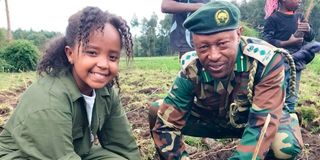
At just 13 years old, Karen Wanjiru has planted more than 48,000 trees across Kenya.
While many of her peers are still discovering their interests, Wanjiru is steadily restoring landscapes, mobilising fellow young people, and turning small, personal actions into a nationwide environmental movement.
Meet 13-year-old Karen Wanjiru tackling climate change by planting trees
“I am an environmental ambassador, the voice of young environmental conservationists,” Wanjiru said during an interview with Nation , “and a climate change champion.”
At the centre of her efforts is The Karen Forte Environment Conservation Foundation, which she has built on practical, youth-friendly approaches to conservation.
One of its standout initiatives is Trees for Birthdays , a programme that transforms personal celebrations into environmental action.
“If any member of my club is having a birthday, we help them plant trees equal to their age,” Wanjiru explained.
A club member turning 13, for instance, plants 13 trees. Friends usually join in, turning the event into a communal effort.
According to Wanjiru, the idea builds a culture of responsibility, where environmental conservation gradually becomes part of everyday life.
“This programme helps someone adopt a tree,” she said. “It also makes someone plant a lot of trees because every year you have a birthday.”
Beyond birthdays, the foundation runs inter-school programmes, visiting institutions to plant trees and establish environmental clubs where none exist.
“If a school does not have an environmental club, we start one for them,” she said.
These visits are designed to be engaging. Alongside tree planting, there are games, mentorship sessions, and interactive activities aimed at making environmental awareness both accessible and enjoyable for students.
Wanjiru’s work does not stop at schools. Through inter-county programmes, her organisation travels across regions, planting trees and nurturing young leaders.
“We crown an ambassador in the county we visit,” she explained. “They help the children there plant more trees and take care of them.”
This approach ensures that conservation efforts continue long after the initial visit. It also creates a decentralised network of youth-led environmental action.
In addition, the foundation runs a Virtual Forest Initiative , which extends participation beyond physical events. Through social media, followers are encouraged to plant trees and document their progress.
“They tag me on their posts so I can see how the trees are doing and encourage them,” she said.
Wanjiru is using online platforms not just for awareness, but for measurable environmental impact.
Her social media presence is carefully managed. As a minor, her parents provide oversight, while she remains actively involved in creating her content.
“My father manages all my social media accounts since I am still under the age of 18,” Wanjiru said. “However, I select the posts, the pictures, and the captions to use.”
Wanjiru’s journey into environmental conservation began unexpectedly, through modelling.
At the age of six, she participated in the Little Miss United World competition, where she created a dress out of recycled plastic bags.
“That was my first-ever award,” she recalled. “It really encouraged me to do more for the environment.”
From there, her interest grew. She began recycling plastics, planting vegetables in containers, and engaging in environmental activities across different counties, including Kisumu and Murang’a.
Her inspiration deepened when she learned about Wangari Maathai, whose legacy continues to shape environmental conservation in Kenya.
“She is my role model,” Wanjiru said. “Without her, I couldn’t have done any of this.”
Wanjiru’s knowledge of sustainability is drawn from multiple sources. She attends climate forums such as the Conference of the Parties (COP), where she listens to panel discussions and engages with experts.
“I learn from the panellists who are speaking,” she noted. “I also learn from my poems, my speeches, and from school.”
Her learning is both formal and experiential, combining classroom education with real-world exposure.
Wanjiru is now stepping into one of the most ambitious phases of her journey, the launch of a 50-acre forest in Kinale, supported by the Kenya Forest Service.
“Tomorrow, Friday, 10 April 2026, I will be launching my 50-acre forest,” she said.
The project marks the beginning of her initiative, One Child, One Mission, One Million Trees . Her goal is to plant one million trees within two years, a target that reflects both urgency and scale.
The project is also supported through a partnership with one of the region’s leading media organisations, Nation Media Group (NMG), which helps amplify climate action stories. This collaboration gives visibility to grassroots initiatives like Wanjiru’s, while connecting environmental champions with broader audiences and potential partners.
Through its platforms and sustainability-focused initiatives such as Climate Action, NMG shines a spotlight on youth-led climate solutions, encouraging public participation and corporate involvement in environmental conservation.
Wanjiru’s environmental journey has also brought her face-to-face with global figures. She had the opportunity to plant a tree with King Charles III at Karura Forest during his last visit to Kenya.
Britain's King Charles III with the help of Karen Wanjiru water a tree at Karura Forest in Nairobi on November 1, 2023.
Photo credit: Lucy Wanjiru | Nation Media Group
“It felt like a dream come true,” she said.
During their interaction, Wanjiru shared her broader vision, including supporting girls in arid regions and restoring degraded land.
Despite her achievements, Wanjiru faces a major challenge in securing funding.
“As an individual and as an organisation, lack of funding is a big challenge,” she said.
According to Wanjiru, accessing financial support, especially as a minor, remains difficult. Opportunities such as international climate conferences often require resources that are not readily available.
“Sometimes they do not support us, young environmental activists, because we are minors,” she said.
Her organisation largely relies on family support, with limited external funding.
While institutions like the KFS provide logistical assistance such as transport, much of the work is sustained through personal effort.
“My organisation is basically for young people, children, and youth,” she said. “But we don’t have funding.”
Behind Wanjiru’s work is a strong support system from her parents, who play a crucial role in sustaining her efforts.
“We are proud of her,” said her mother, Ann Njeri. “But many parents do not support their children’s talents.”
She encourages parents to recognise and nurture their children’s abilities, noting that talent, if supported, can open doors and create opportunities.
“Don’t ignore what your child can do,” she said. “Support them.”
However, she also highlights the challenges families face, particularly the lack of funding opportunities for young people.
“Every door you knock, they tell you they cannot support a child,” she said.
“Climate change is not waiting,” she noted. “Why should the children wait?”
For Wanjiru, maintaining a balance between education and environmental work is essential.
Her activities are scheduled around school holidays, ensuring that her studies remain uninterrupted. When travel is necessary, her school provides online classes to help her keep up.
“We don’t mix school with events,” Njeri said. “Everything is planned.”
Support from her school has been instrumental, allowing her to pursue both academic and environmental goals.
She is currently Ambassador and Junior Miss United World 2025–2026, a recognition earned through her impactful environmental initiatives and commitment to climate action.