Africa fights for fair climate finance as COP31 approaches in Türkiye
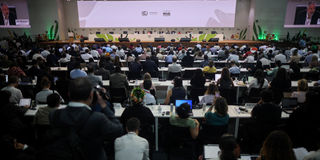
Negotiators attend a plenary session during the UN Climate Change Conference (COP30), in Belem, Brazil, November 21, 2025.

What you need to know:
- For a continent bearing the brunt of a crisis that it did hardly anything to cause, walking into the negotiating rooms often means confronting an uncomfortable reality: Is Africa winning the game or not?
Every year, countries meet for the Conference of the Parties (COP), the largest climate talks. Held annually since 1995, with COP31 coming up in November, these global summits bring countries together to check progress, make new climate rules, and tackle climate change under a major UN agreement: the United Nations Framework Convention on Climate Change (UNFCCC).
This year, COP will be held in Antalya, Türkiye.
However, navigating these summits is rarely straightforward. Delegations operate through organised regional blocs, and the corridors are frequently crowded with corporate and fossil-fuel interests seeking to influence outcomes. As such, achieving progress requires participating nations to arrive with a clear, unified agenda and strategic intent.


Last week, the African Group of Negotiators Expert Support and its partners convened a strategic planning session to elevate Africa's readiness heading into COP31.
On the sidelines of the meeting, the Nation sat down with Nana Dr Antwi-Boasiako Amoah, the new chair of the African Group of Negotiators (AGN), to discuss Africa's core negotiation pillars.
“We have a broad agenda. So basically there are three things that are running. The first thing is about climate finance and especially adaptation finance,” he says.
For a continent bearing the brunt of a crisis that it did hardly anything to cause, walking into the negotiating rooms often means confronting an uncomfortable reality: Is Africa winning the game or not?
In his view, the straightforward answer is no. “We are not getting it. Should we continue to lose the fight? No.”
When the AGN chair says ‘we are not getting it,’ he means that wealthy nations, the historical drivers of global emissions, either make financial and policy commitments that fall woefully short of what developing countries need, or fail to make them at all.
“Second, we're talking about just transition. Just transition for whom? From where? Is it going to be the so-called narrative that people are trying to put in the minds of others and saying that it is energy transition? Granted that it is even an energy transition, where would Africa's starting point be? We don't even have access in the first place. So where are you even transitioning from in the first place? So now that the opportunity has availed itself within the UNFCCC to discuss the transition being just, we see it as an opportunity to also put forward the agenda of Africa in the just transition,” he says.
For the continent, it's about labour, adaptation, re-industrialisation, and trade-related issues. “All these issues must be equitably and fairly discussed in the just transition system. For labour, now we have quite a number of economies that depend on fossil fuels. Some of them are within the transport sector, others within the electricity sector, and I can give you several examples of countries such as South Africa, Nigeria, Ghana, and Kenya. And so when we are transitioning from a fossil-dependent economy to a green economy or green energy, those whose livelihoods are dependent on the current strategy are going to obviously be affected. So what is the narrative for these people who are dependent on this sector when the transition is happening? We need to make sure that they don't lose their jobs.”
Dr Antwi says that the youth agenda is also a key priority for the continent. “Our negotiators are getting older, and very soon they will be out of the space.
As Africa heads to COP next month, the question from many quarters is whether money is flowing to Africa to help individuals adapt and cushion against the climate crisis.
“No, it's not flowing. At Antalya, we foresee a situation where the West will be pushing for the mobilisation, because that allows them to dwell on private capital instead of public financing that will be coming from the national budgets. And so, that's why we are asking for an agenda item at this COP31 on climate finance, Article 9.1 of the Paris Agreement. That gives us the opportunity to be able to understand and unpack the decision that was achieved in Baku, because Belém built on that one,” he adds. Notably, COP29 and COP30 were held in Baku and Belém respectively.
“The COP30 presidency has done well to put an agenda item for COP31. We have heard that the developed world is not happy, and they are going to fight the removal of that agenda item (climate finance) because that is the only space where we can discuss and ascertain how well we are doing in terms of the flows. I work with the Green Climate
Fund as a board member, and we are going into replenishment. We've seen in the room the appetite from the West to focus on loans instead of grants. There was a recent recapitalisation of the GEF, which is the Global Environment Facility. There was a decline of about 34 per cent in the past replenishment. So the flows are not coming the way they're supposed to be. And this is why we have to wake up and start defending what we are doing.”
Unlike COP29, where there was a major decision on finance, that is not going to happen at COP31 in Antalya. The AGN chair says that the conversation will centre on mobilising the finance decision that was achieved in Baku. “And then what would be the share of that mobilisation for climate change adaptation? So adaptation financing. Two, the work programme for just transition needs to be reviewed.”
On agriculture, the continent is pushing for a formal framework to secure its future, given that farming remains the backbone of African economies and livelihoods. “We're also looking at issues that have to do with gender-related issues.”
Why Africa must keep showing up
Year after year, as climate talks yield sluggish progress and essential funding trickles in far too slowly, a recurring question echoes across the continent: Why keep going to these COPs when nothing ever really changes?
It is a fair and frustrating question. But as the African Group of Negotiators points out, walking away carries a far greater cost than the friction of staying at the table.
“We need to continuously push. And then, incrementally, we'll get something. Because it is those COPs that actually produce the Green Climate Fund. At the time when Africa was pushing for the establishment of the Green Climate Fund, people thought we were mad. Now, you have the Green Climate Fund that everybody wants. The Adaptation Fund is also a decision of the COP.”
“There are many other things that the COPs have delivered. They don't come easily. We think that they are also very good decisions that have come out of this. So, we will not stop going. We'll continue to see. Maybe one day the whole narrative will change,” notes the AGN chair.


