Africa’s solar revolution is already here. Our governments need to catch up
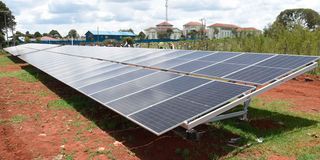
Solar panels at Moi University in Kesses, Uasin Gishu County.

What you need to know:
- Between 2023 and 2026, Kenya is expected to add solar capacity equivalent to more than half of the country's entire installed grid capacity in 2023.
- Yet much of this extraordinary transformation barely exists in the official statistics.
For years, Africa’s energy debate has been framed around what the continent lacks: electricity, investment, infrastructure and access to finance.
But something remarkable is happening that turns that story on its head. Across the continent, African households and businesses are quietly building a new energy system for themselves.
New research by Ember and the African Tech Futures Lab estimates that Africa will install a record 17 gigawatts of solar power this year, a 45 per cent increase on 2025 and enough panels to amount to roughly 100,000 being installed every day.


This is not a boom confined to South Africa or a handful of wealthy markets. Thirty-six of Africa’s 54 countries are expected to install record amounts of solar this year. Nineteen have seen annual growth of more than 100 per cent. The Democratic Republic of Congo is up 544 per cent, Zimbabwe 282 per cent, Egypt 176 per cent and Zambia 117 per cent.
Perhaps most strikingly, South Africa’s share of new African solar installations is expected to fall below 20 per cent for the first time since 2019. This is becoming a genuinely continental phenomenon.
And Kenya is part of it.
Between 2023 and 2026, Kenya is expected to add solar capacity equivalent to more than half of the country's entire installed grid capacity in 2023.
Yet much of this extraordinary transformation barely exists in the official statistics.
That is because this is not primarily the familiar story of governments commissioning enormous solar farms. It is happening on rooftops, at factories and businesses, and behind electricity meters.
Ember estimates that three-quarters of the solar capacity added across Africa between 2023 and 2025 was distributed solar, mostly customer-side systems installed for businesses and households to use themselves.
Africans have not waited for the perfect international climate finance deal or for governments to construct vast new electricity systems. Businesses facing expensive and unreliable electricity have looked at the plunging cost of solar panels and made a rational economic decision.
In Kenya, there did not even need to be the kind of trigger seen elsewhere, such as South Africa's load-shedding crisis or Nigeria's removal of fuel subsidies. Ember's report concludes that expensive electricity and unreliable supply were themselves enough to stimulate investment.
This should change the way we think about Africa’s energy transition.
Too often, renewable energy is still discussed as though it were primarily an environmental obligation imposed on Africa by wealthy countries. That framing has always been wrong. The solar revolution now unfolding demonstrates why.
This is about economics, energy security and development.
Diesel generators remain a costly lifeline across much of Africa. Solar changes that equation dramatically. Ember calculates that the Chinese solar panels imported into Africa in the 12 months to June cost $2.4 billion. Generating the same amount of electricity using diesel generators would require roughly $2.4 billion worth of diesel every three months.
That is money African economies can keep rather than repeatedly sending abroad to purchase fossil fuels.
Batteries are accelerating the shift. Since 2024, Africa has imported more dollars' worth of batteries than solar panels from China. Over the past two years, the value of solar panel exports to Africa doubled while battery exports quadrupled.
Together, cheap solar and batteries offer African countries something enormously important: the possibility of leapfrogging parts of the old, centralised energy model, just as mobile phones allowed Africa to leapfrog much fixed-line telecommunications infrastructure.
But there is a danger. Ember could find official national solar-capacity reporting for only 36 of Africa’s 54 countries, and only 14 had figures for 2025. Just South Africa, Tunisia, and Tanzania publish some solar data monthly or quarterly.
The consequences go far beyond inaccurate spreadsheets.
If planners cannot see distributed solar, they can overestimate future electricity demand from the grid and procure generating capacity that is not needed. They can make the wrong decisions about grids, batteries and tariffs. Most alarmingly, they can commit scarce public resources to new fossil-fuel power stations that may become increasingly uneconomic or sit idle.
The scale of the disconnect is extraordinary. The African Union’s Continental Power Systems Masterplan forecasts 23 GW of solar being installed by 2040. Ember estimates that Africa installed 26 GW in just the three years from 2023 to 2025.
Governments are planning for yesterday while Africans are building tomorrow.
There is another challenge we should confront. Ninety-four per cent of the panels installed in Africa this year are estimated to have been imported from China. Meanwhile, African solar-panel manufacturing is expected to quadruple to around 3.5 GW, but much of the new production in Egypt and Tanzania is intended for export rather than African rooftops.
Africa should celebrate cheap Chinese technology helping to drive electrification. But the next stage must be about capturing more of the economic value ourselves: manufacturing, assembly, installation, maintenance, batteries, finance and the thousands of businesses that will grow around a distributed electricity system.
This is therefore not an argument for governments to get out of the way. It is an argument for them to catch up.
They need to measure what is happening, simplify registration, modernise grids, enable storage, create sensible rules for distributed generation and design national energy strategies around the revolution already taking place.
Africa has spent decades waiting for an energy transformation to arrive.
It turns out that it did not arrive through a grand international plan. It arrived panel by panel, rooftop by rooftop and business by business.
Now our governments need to see it, support it, and make sure its benefits reach everyone.
Mohamed is the Founder and Director of Climate and Energy Think Tank Power Shift Africa