Agro-chemicals association wants Amboseli elephant deaths probe report made public
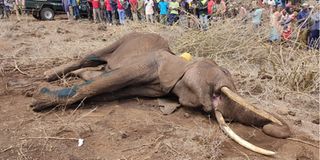
A wave of unexplained elephant deaths swept through the Amboseli ecosystem, claiming over 15 animals.

An organisation that brings together stakeholders in the pest control sector, including producers, manufacturers, importers, formulators, re-packers, distributors and users of pest control products, is pushing investigative agencies to fast-track investigations into the deaths of 18 elephants in the Amboseli ecosystem two months ago and make the final report public.
The aak-GROW is disputing suggestions that farm chemicals were responsible for the deaths, arguing that more scientific evidence is needed to establish the source of the toxic substance detected in some samples.
In June and July this year, 18 elephants were reported dead in the Amboseli-Kimana ecosystem, with the Kenya Wildlife Service (KWS) saying preliminary findings pointed to cyanide poisoning, possibly from tomato farms in the surrounding areas.

However, according to aak-GROW, the investigation should establish how the animals came into contact with the substance and whether agricultural chemicals were actually involved. KWS commenced investigations weeks ago and is yet to release a report on what happened.
Speaking at an event jointly organised by aak-GROW, the Kenya Editors Guild and media practitioners, the association’s CEO, Joel Mutai, said the findings should establish the source and pathway of exposure before farm chemicals are blamed for the deaths.
He questioned the theory linking the deaths to pesticides used on tomato farms around the Amboseli ecosystem, arguing that if the carcasses contained lethal quantities of cyanide, scavengers that fed on them would also have been affected.
“If the elephants died after consuming tomatoes treated with a pesticide containing cyanide, the hyenas that fed on the carcasses would also have died,” Mr Mutai said.
His comments come amid an ongoing multi-agency investigation into the elephant deaths reported in the Amboseli-Kimana ecosystem between June 24 and July 31.
In a statement to Parliament, Cabinet Secretary for Tourism and Wildlife Rebecca Miano said seven deaths were recorded in Kimana Sanctuary, seven in Motikanju or Kuku Ranch and one in Kitenden Ranch, with the official account indicating 16 deaths, which was later revised to 18. The deaths involved mainly adult females and calves.
KWS said the affected elephants exhibited weakness and partial paralysis of their limbs before dying. Veterinary and scientific teams were deployed after the first case was reported on June 24 to conduct post-mortem examinations, collect samples and investigate possible causes.
Preliminary laboratory analysis by the University of Nairobi indicated cyanide poisoning as the probable cause in the cases examined. KWS said it was working with the Government Chemist and other laboratories to conduct toxicological, microbiological and related analyses.
The wildlife agency, however, said the preliminary findings were not sufficient to establish the source and pathway of exposure. It has been investigating whether pest control products or other crop-protection chemicals were improperly used, stored or disposed of in the Kimana, Kuku, Kitenden and wider Amboseli areas.
aak-GROW’s position comes against the backdrop of concerns over the possible misuse of pesticides in farms bordering wildlife habitats. Kimana is a major tomato-growing area, and previous reports have raised questions about the use of toxic substances in crop production.
KWS had said stomach contents recovered from one elephant included large quantities of tomatoes, prompting investigations into whether contaminated farm produce could have been involved.
Farmers in the area have rejected suggestions that they used cyanide on their crops. They have also questioned why other animals feeding in the same environment were not similarly affected.
Mr Mutai said the pest control industry supports a scientific investigation because the credibility of the findings is important to farmers, consumers, wildlife conservation and Kenya’s agricultural export markets.
He stated that conclusions should be based on validated evidence instead of assumptions, noting that pesticide regulation in Kenya involves extensive safety assessments before products are approved. “Anything that is said to be chemical is sometimes immediately associated with pesticides. We need accuracy in this space,” he said.
Kenya’s pesticide regulatory system is overseen by the Pest Control Products Board (PCPB), while KWS is responsible for wildlife conservation and management. The two agencies have been involved in the multi-agency investigation into the Amboseli deaths.
Mutai said the investigation should also establish whether the chemicals detected in the elephant samples originated from agricultural activities, another source or natural causes. “The industry has been advocating responsible pesticide use, including farmer training, spray service providers, integrated pest management and technologies such as drones to reduce human exposure and improve the precision of pesticide application,” he explained.
Mr Mutai said the industry was ready to cooperate with investigators and other stakeholders to establish what killed the elephants and determine whether any pest control product was involved.
The organisation is also urging stronger communication of scientific findings to the public, saying information surrounding pesticides should be based on verified evidence and clearly explain the level and significance of any chemical detected.
Follow our WhatsApp channel for breaking news updates and more stories like this.