President William Ruto is recasting his political message ahead of the 2027 General Election, placing equality, historical marginalisation and equitable distribution of development at the centre of a campaign that could redefine how he seeks a second term in office.
Four years after riding to State House on a populist promise to empower ordinary Kenyans against established political dynasties, Dr Ruto has introduced a new rallying call: Usawa ni Sawa – Mbele Pamoja (Equality is fair – Forward together).
The slogan, which he has been popularising during his North Rift tour, presents the next election as a contest over who can deliver development to all parts of the country, rather than one determined by ethnic alliances and political personalities.
However, behind the language of national unity and equal opportunity lies a more pointed political argument that communities historically excluded from economic power and development should have a greater share of the country’s resources.
President William Ruto flags off trucks with electricity transmission poles during the launch of last mile connectivity at Moiben Campus in Uasin Gishu County on October 12, 2026.
Photo credit: Jared Nyataya | Nation Media Group
The emerging narrative is particularly evident in remarks by Health Cabinet Secretary Aden Duale, who has defended the President’s emphasis on equity while outlining plans to bring historically marginalised communities together in a political coalition.
“The only crime President Ruto has committed and which his opponents are asking is, ‘Why are you bringing equity? Why are you talking about equality?’” Mr Duale said.
“Kenya has many challenges. We are going to form a coalition of the marginalised. Those who were excluded, discriminated against and sidelined will unite, from Nyanza and Western to the pastoralist communities and all the way to the Coast. We shall come together and form a coalition of the marginalised,” added Mr Duale.
He invoked historical grievances dating back to the early years of independence to explain the case for such an alliance.
“We were discriminated against through Sessional Paper No. 10 of 1965. We were discriminated against again through land resettlement schemes and land-buying companies established during President Jomo Kenyatta’s era. We were discriminated against once more when the policy of Africanisation of businesses was introduced. They wanted only one group to access wealth,” he said.
Mr Duale’s remarks provide a glimpse into the political thinking behind the administration’s new message.
Rather than abandoning the populist language that defined his 2022 campaign, Dr Ruto appears to be broadening it, shifting the emphasis from the economic divide between ordinary citizens and established political families to questions of regional inequality, historical exclusion and access to state resources.
But pundits say that the political significance of the approach will depend on whether the administration can translate the promise of equality into measurable outcomes and persuade voters beyond its traditional support base that its development record addresses longstanding disparities.
In 2022, Dr Ruto’s central campaign message was that Kenya’s political and economic system had been captured by a small circle of powerful families, leaving ordinary citizens struggling to make ends meet.
The “hustler versus dynasty” narrative divided the political landscape between the hustler, represented by Dr Ruto, and the dynasties, associated with established political families and leaders who had dominated successive administrations.
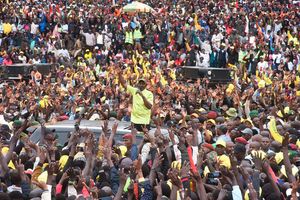
President William Ruto addresses members of the public at Kenya School of TVET, Technical and Vocational Education and Training Moiben Campus in Uasin Gishu County on October 12, 2026.
Photo credit: Jared Nyataya | Nation Media Group
The Deputy President-turned-presidential candidate presented himself as a political outsider who understood the struggles of small traders, boda boda riders, mama mboga and low-income households.
His opponent, the late Azimio leader Raila Odinga, backed by then President Uhuru Kenyatta, were portrayed as representatives of a political establishment that had monopolised power and opportunity.
The narrative was reinforced by the Bottom-Up Economic Transformation Agenda (BETA), which promised to prioritise the economic needs of ordinary citizens through support for small businesses, affordable housing, agriculture and employment creation.
It proved an effective mobilisation tool, helping Dr Ruto build a coalition that extended beyond his traditional Rift Valley base.
He won the August 2022 election after securing 7,176,141 votes (50.49 percent) against Raila’s 6,942,930 votes (48.85 percent), a margin of just over 233,000 votes.
The new Usawa ni Sawa – Mbele Pamoja message retains the promise of economic inclusion but broadens the argument.
Instead of concentrating principally on the divide between ordinary citizens and established political families, it raises the question of whether communities across the country have enjoyed equal access to development, land, jobs, business opportunities and public resources.
The change also comes against a different political backdrop. Having been in office for four years by the time of the next election, Dr Ruto must defend his own record while seeking to convince voters that his administration has delivered on the promises made in 2022.
“His challenge is to demonstrate that the language of equality is reflected in public spending, infrastructure, employment, healthcare and household economic prospects,” argues Geoffrey Mbona, a political analyst.
During his North Rift tour, the President sought to frame the election as a choice between his administration’s development agenda and an opposition he accuses of relying on ethnic alliances without a coherent policy alternative.
Speaking in Kinyach, Baringo North, on Tuesday, he challenged his opponents to explain what they would do differently.
“They are now regrouping in the name of unity, but even if they unite and have no agenda, tribal arithmetic will not win them anything. Have an agenda and a programme through which Kenyans can see themselves in the transformation,” he said.
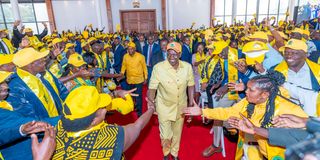
President William Ruto addresses 12,353 UDA aspirants for the 2027 General Election at State House, Nairobi on April 23, 2026.
Photo credit: PCS
He added: “In 2027, we will vote to completely root out divisive and tribal politics. We are not going to vote based on ethnicity, hate, jealousy, exclusion or marginalisation, but on an agenda, a plan and a manifesto through which Kenyans can hold their leaders to account.”
Mr Mboya adds that the: “messaging allows the President to challenge opposition coalition-building while presenting his own political partnerships as vehicles for national development.”
“However, the distinction between a development-based alliance and an ethnic coalition will ultimately be tested against the composition of political alliances, their policy commitments and the distribution of government resources.”
At the heart of Mr Duale’s argument is Sessional Paper No. 10 of 1965, titled African Socialism and its Application to Planning in Kenya. The policy document, adopted two years after independence, set out the economic philosophy of the Jomo Kenyatta administration and the principles that would guide national development.
The paper advocated African socialism, combining private enterprise with a role for the state in directing development, promoting social welfare and mobilising national resources. It also addressed regional development, land, education, employment and the Africanisation of the economy.
However, critics of Kenya’s post-independence economic model argue that the development strategy entrenched inequalities by concentrating investment and economic opportunities in already advantaged areas.
The paper itself recognised the need for balanced development, making its legacy a subject of debate over the difference between stated policy objectives and their implementation.
Health Cabinet Secretary Aden Duale.
Photo credit: File | Nation Media Group
For Mr Duale, the document represents a historical grievance among communities that believe they were left behind as the new state allocated resources and developed infrastructure.
At independence, the government inherited a country in which colonial land policies had displaced many Africans, while large agricultural farms remained in the hands of European settlers.
The settlement schemes introduced during the transition to independence sought to address landlessness by purchasing former settler farms and redistributing them to African buyers.
The programmes included the Million-Acre Scheme, under which land was acquired for settlement, while private land-buying companies also emerged. These companies commonly purchased large tracts of land and subdivided them among shareholders.
Although the schemes opened previously restricted areas to African ownership, access was not uniform. Historical accounts and investigations have raised concerns that influential politicians, senior civil servants and wealthy individuals benefited from some schemes intended to assist landless people.
Meanwhile, some communities continued to press claims over ancestral land and historical displacement.
The programmes therefore became part of a broader debate over whether independence delivered land justice to all communities or created new patterns of unequal ownership.
Mr Duale’s reference to Africanisation raises a related question about access to commercial opportunities.
After independence, Africanisation policies sought to increase African participation in an economy in which significant sections of formal commerce and industry had been dominated by Europeans and Asian communities. Measures included efforts to expand African ownership of businesses, promote local entrepreneurship and use trade licensing to favour African applicants in certain circumstances.
Sessional Paper No. 10 supported Africanisation but also cautioned against pursuing it in ways that undermined economic growth. Subsequent policies sought to expand citizens’ participation in trade, including through restrictions on certain commercial activities by non-citizens.
The policy was not, in itself, a formal programme to enrich one ethnic community. Nevertheless, its implementation, alongside access to capital, land, government connections and commercial networks, shaped who could benefit from the expanding economy.
President William Ruto addresses members of the public during the commissioning of the Kipkundul-Kamelei-Kabyego-Makutano road in Elgeyo Marakwet County, and a water project at Kabyego Trading Centre on October 13, 2026.
Photo credit: Jared Nyataya | Nation Media Group
These historical experiences provide the context for Mr Duale’s argument that a coalition of marginalised communities could become a vehicle for addressing longstanding disparities.
Analysts say that Mr Duale’s claims about deliberate discrimination against particular groups, however, remain a political interpretation of a complicated history that also involved colonial legacies, regional investment patterns and decisions made by successive governments.
The new messaging is already being accompanied by grassroots mobilisation within the ruling United Democratic Alliance (UDA).
In Uasin Gishu, the Warembo Na Ruto Tutam chapter says it has recruited more than 7,000 grassroots leaders as it mobilises support for the President’s re-election. The group has linked its campaign to the administration’s development programme, citing affordable housing projects in Eldoret, road construction and electricity connections.
UDA National Treasurer Japhet Nyakundi has also promoted the slogan, declaring: “UDA going forward, our slogan is Usawa ni Sawa, Mbele Pamoja!”
The party is simultaneously engaging aspirants through its UDA Aspirants Forum, which is intended to familiarise prospective candidates with party processes and align their mobilisation efforts with its broader electoral strategy.