AI platform linking farmers to quality seedlings amid climate change
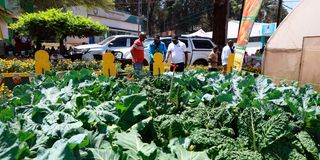
Agriculture enthusiasts have a look at vegetables at Kenya seed company farm at Jamhuri Park Showground,Nairobi on September 30,2026 during the Nairobi International Trade Fair.

Access to quality seeds and seedlings is critical to successful farming, determining whether farmers produce enough food for household consumption or generate income from commercial agriculture.
As climate change intensifies pressure on food production, access to suitable planting materials is becoming increasingly important in helping farmers manage crop diseases, changing weather patterns and the risk of poor harvests.
In Kenya, where millions of households depend on agriculture for food and livelihoods, farmers need reliable information on suitable crop varieties and trusted suppliers. However, finding quality seedlings, identifying legitimate nurseries which are Kenya Plant Health Inspectorate Service (KEPHIS) certified and obtaining timely agronomic advice is challenging, particularly for farmers who rely on informal networks to source agricultural inputs.


An artificial intelligence-powered digital platform, OnLima Grow Solutions, is seeking to bridge this gap by connecting farmers with verified vegetable seedling propagators and other agricultural service providers through a mobile phone.
Developed by Prema Group, which operates PremaGrow Vegetable Seedlings Nursery, the platform uses WhatsApp to help farmers identify nearby seedling suppliers, obtain their contact details and initiate transactions without travelling long distances in search of planting materials.
Godfrey Mwenda, the CEO of the OnLima app and director of PremaGrow Vegetable Seedlings Nursery, says the innovation emerged from the difficulties farmers experience when searching for quality seedlings. “Farmers looking for seedlings often rely on numerous WhatsApp groups. You will find a farmer looking for tomato seedlings posting the same request in several groups, even when there is a nursery close to their farm,” he says.
The problem is compounded by the difficulty of establishing whether a supplier is legitimate and whether the seedlings on offer meet the farmer’s needs. Some farmers travel considerable distances to find planting materials, incurring additional costs and losing valuable time.
OnLima, according to Mr Mwenda, seeks to simplify this process by using location-based technology to connect farmers with nearby suppliers.
“It is GPS-enabled, allowing farmers to easily locate nearby seedling nurseries,” he tells Climate Action. Farmers with smartphones can visit onlima.shop through a web browser, which redirects them to WhatsApp, where a virtual embedded artificial intelligence (AI) agent guides them through the search.
The farmer specifies the crop required, the quantity and their location. The system then identifies suitable seedling suppliers within a radius of about 50 kilometres and provides available options, including contact details. “The farmer and the nursery can then communicate directly to confirm availability, prices and delivery or collection arrangements,” he explains.
The location feature is intended to reduce the time and transport costs associated with searching for planting materials, while helping nurseries reach potential customers beyond their immediate neighbourhoods.
Mwenda says the platform is designed to address concerns about the authenticity of agricultural service providers. Onboarding involves verification and authentication of participating nurseries and other providers before they are listed.
“Farmers can also rate the services they receive, providing feedback that can help other users assess suppliers,” he states.
At the time of the interview during this year’s Nairobi International Trade Fair organised by the Agricultural Society of Kenya (ASK), OnLima had onboarded about 47 seedling propagators across Kenya, with the team working on a further phase of piloting and wider adoption. Held at the Jamhuri ASK Showgrounds in Nairobi from September 28 to October 4, 2026, under the theme “Promoting Climate-Smart Agriculture and Trade Initiatives for Sustainable Economic Growth,” the exhibition provided OnLima with an opportunity to showcase its AI-powered platform, engage farmers and other agricultural stakeholders, gauge market interest and explore partnerships to improve farmers’ access to quality vegetable seedlings.
The platform’s value to climate-smart agriculture, the founder said, lies partly in improving farmers’ access to information that can guide crop selection and production decisions. As rainfall becomes less predictable and temperatures change, selecting appropriate crop varieties and obtaining healthy planting materials can help farmers manage production risks.
Mr Mwenda says the system is being developed to provide research-informed information on crop varieties, good agricultural practices, spacing requirements and disease management. Information from seed companies’ catalogues is incorporated into the system, while research partners help validate the agricultural information supplied.
“For instance, a farmer may want to know the best tomato variety to grow in a particular area. The system can filter the available information and suggest a variety that suits the farmer’s needs,” he shares.
The approach could help farmers explore newer crop varieties with characteristics suited to their production conditions, including resistance to particular diseases. This is important because crop losses arising from diseases, unsuitable varieties and poor-quality planting materials can undermine food availability and household incomes.
The platform’s usefulness in climate adaptation will, however, depend on the quality and relevance of its recommendations, the accuracy of location information and the availability of suitable seedlings from listed suppliers. Farmers also need to consider local weather forecasts, soil conditions, water availability and advice from qualified agricultural experts when making planting decisions.
The initiative has received support from the International Institute of Tropical Agriculture (IITA), the International Centre of Insect Physiology and Ecology (ICIPE) and CGIAR.
“The partnerships are intended to support the development of digital solutions that improve farmers’ access to agricultural services and information,” Mwenda said in an interview.
Apart from seedling sourcing, he revealed that OnLima is being developed to connect farmers with agronomists, agro-dealers, seed vendors, suppliers of drip irrigation systems, agricultural machinery providers and other players in the agricultural value chain.
“The wider ambition is to bring these services together on one platform, allowing farmers to find relevant providers without navigating multiple informal networks.”
For farmers confronting climate-related production challenges, such connections could make it easier to access advice on crop management, suitable planting materials and water-efficient production technologies. Drip irrigation, for example, can help farmers manage limited water supplies when systems are properly designed and maintained.
The platform also seeks to improve accountability in agricultural service delivery. Farmers sometimes receive advice from individuals whose qualifications or experience are difficult to establish. By verifying service providers before onboarding them and allowing customers to rate their interactions, OnLima hopes to improve confidence in the services available through the system.
Mwenda says the initiative grew out of PremaGrow’s experience in vegetable seedling production, a business it has operated for close to a decade. The company has operations in Meru, Machakos and Kajiado, and produces seedlings using trays that retain the root plug during transplanting.
Unlike seedlings uprooted from open-ground nurseries, tray-grown seedlings can be transplanted with their root systems largely intact. This can reduce root disturbance and support faster establishment, provided the seedlings are healthy and farmers manage transplanting properly.
Follow ourWhatsApp channel for breaking news updates and more stories like this.