Halima Husein Noor has learned to live with waiting. At 60, the mother of nine spends her days scanning the dusty road that cuts through Awara village in Mandera North, hoping to catch the first sight of a government water lorry whose arrival has become the difference between survival and despair.
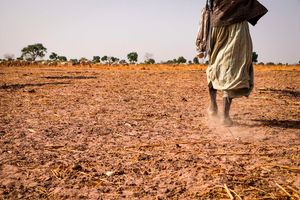
In a place where the land has hardened into a vast, sun-baked crust, water is no longer a basic need but a weekly gamble.
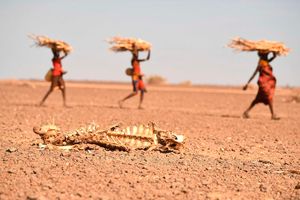
Livestock carcasses at Chabibar village in Mandera North constituency on February 14, 2026. The area is among the worst hit by drought.
Photo credit: Manase Otsialo | Nation Media Group
Awara is one of many villages across Mandera where drought has tightened its grip with brutal certainty, leaving crops dry, pasture wiped out, and livestock collapsing under the relentless heat.
For Halima, the drought is not an abstract crisis discussed in reports or meetings; it is written in the empty jerrycans outside her home, in the weak cries of goats too frail to stand and in the exhaustion of raising her two youngest daughters in a village where life is slowly being drained away.
“Life is becoming unbearable each day,” she says, explaining that the water bowser comes only once a week, forcing families to ration every drop while animals weaken and children endure thirst that no mother should have to witness.
Her husband lives in Wajir with their older sons, but Halima has remained behind in Awara, holding together what is left of her household and livelihood.
Until recently, she measured her wealth in livestock as most pastoralist families here do, but the drought has swept through her herd with devastating speed.
“I used to have 650 goats,” she says quietly. “They have all died. I am left with only 70, and I am worried I will lose them too.”
Keeping even those remaining animals alive has become a costly struggle, forcing her to travel once every week to Rhamu town, about 10 kilometres away, where she buys fodder because nothing grows anymore in Awara.
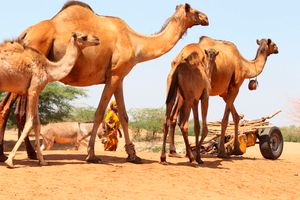
A child carried on a donkey cart in Mandera County on February 14, 2026 as families migrate in search of water and pasture for their livestock
Photo credit: Manase Otsialo | Nation Media Group
“I buy maize stalks whenever I can. I also give them maize and beans because I don’t want them to die,” she explains.
Across Mandera, the landscape itself seems to have retreated into lifelessness, with thorn bushes shrinking under the sun and the earth cracking open as though it can no longer bear the weight of another dry season.
Climate Tracker
Kenya Satellite Analysis
Developed by Geoffrey Onyambu • © 2026 Nation Research Desk
Yet it is not only villages like Awara that are suffering; even border points once seen as routes of opportunity have now become corridors of desperation.
At Malka Nadina, which is the crossing between Kenya and Ethiopia, Alphone Adan, a single mother of seven, makes the exhausting journey across the border every day in search of pasture, only to find that the drought has erased grazing fields on both sides.
“I cross into Ethiopia to graze my goats, but there is no pasture there. My goats survive only on river water,” she says.
Only a month ago, she had 1,000 goats. Today, she is left with just 20 after the rest were wiped out by hunger, thirst and the long treks across barren ground. By evening, she struggles back across River Dawa into Mandera, sometimes forced to carry the weakest animals after a day-long walk that yields nothing but fatigue.
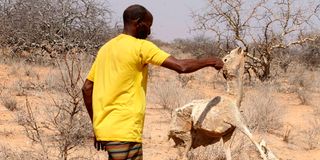
Mr Kaiyah Mohamed Ibrahim walks past livestock carcasses in Mandera on February 14, 2026.
Photo credit: Manase Otsialo | Nation Media Group
With her hope fading, Adan has made the painful decision to sell the few remaining goats at any price because keeping them alive has become impossible.
“I have lost so much. I have children to feed, but now I have nothing to keep me going,” she says in an interview.
Photo credit: Gitonga Marete | Nation Media Group
The desperation has turned markets into places of exploitation. In Rhamu town, livestock dealers from as far as Isiolo have descended on Mandera, taking advantage of families forced to sell animals at throwaway prices simply to survive.
“The animals are cheap here because of the drought,” says trader Adan Haro. “We buy them, take them to areas with pasture and water, then sell them later.”
A goat that once fetched several thousand shillings now sells for as low as Sh1,000, while cows that used to go for Sh70,000 are being bought for Sh10,000.
Even the traders admit the gamble is risky because many animals die during transport. For pastoralist families, however, the loss is not calculated in profit margins but in hunger, unpaid school fees and collapsing futures.
In Chabibar village, the devastation is stark. Carcasses of goats and sheep lie scattered under the hot sun, a grim reminder of how quickly livelihoods have been erased. Halima Mohamed Ukuro stands among them with her eyes mirroring the emptiness of the land.
“This was our gold just a few months ago. Now we are staring at a bleak future. There is no water here and no help is coming,” she says, gesturing at the dead animals.
To access water, villagers must contribute Sh25,000 to hire a 10,000-litre bowser, which is an impossible amount for families already stripped of their livestock wealth.
Ukuro fears that soon children will begin dropping out of school as households crumble under the pressure of drought.
A boy fetches water from a well in a seasonal riverbed in Kerio, Turkana Central sub-County on February 12, 2026. Residents trek long distances in search of water for domestic use and livestock.
Photo credit: Jared Nyataya I Nation Media Group
Kaiya Mohamed Ibrahim, a resident, says communities feel abandoned, with outsiders often visiting to take photographs and promise support that never materialises.
“If this situation continues, we will start losing lives,” he warns.
In the same village, Abdikadir Gabow Hussein has been left with only five goats after losing 95, admitting that he hesitated to sell early because he believed the dry spell would pass quickly.
Mandera County Commissioner James Chacha says the situation is worsening across the county, with Mandera North, Mandera Central, Lafey and Mandera West among the hardest-hit areas. About 300,000 people are affected, and the number continues to rise as rains fail and pasture disappears.
“The drought remains alarming. There is need for continued interventions to save lives, both human and livestock,” he says.
The county government is supplying water to nearly 299 sites, but needs far more resources. Livestock trek longer distances, milk production has dwindled, and household purchasing power continues to collapse.
For families like Halima’s, survival now hinges on a weekly bowser and the faint hope that the next rainy season will come before everything else is lost.