COP31 talks stumble over adaptation finance
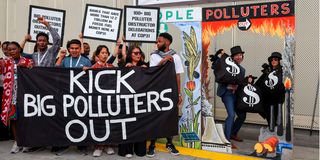
Activists take part in a demonstration calling for "Kick Big Polluters Out" during the UN Climate Change Conference (COP31) in Antalya, Turkey, November 13, 2026.

What you need to know:
- Developing countries are calling for increased financial support from wealthy nations to help them cope with climate crisis.
- Their argument is that developed countries bear the greatest historical responsibility for greenhouse gas emissions.
In Antalya, Turkiye
You probably know a farmer who has switched from planting maize to drought-resistant crops, a pastoralist who has diversified their livestock breeds or a household that has started harvesting rainwater because the rains can no longer be relied upon.
Or perhaps this is your story.


For many individuals in Kenya, adapting to climate change has become a necessity. But these adjustments cost money that many cannot afford.
In Antalya, developing countries are calling for increased financial support from wealthy nations to help them cope with the consequences of the climate crisis.
Their argument is that developed countries bear the greatest historical responsibility for greenhouse gas emissions, having built much of their economies on fossil fuels, that is non renewable energy sources like coal.
But as week one of the COP 31 negotiations come to a close, financing adaptation remains a sticking point.
Adaptation needs
Countries are divided over how to calculate the commitment to triple adaptation finance, where the discussions should take place and what form that support should take.
The United Nations Environment Programme's (UNEP) Adaptation Gap Report 2026 released recently estimates that developing countries will need approximately USD 305 billion (about Sh39.6 trillion) annually by 2035 to meet their adaptation needs.
When future inflation is factored into some projections, the figure rises further.
Yet, international public adaptation finance from developed to developing countries, the UNEP report shows, stood at between $28.2 billion and $31.7 billion in 2024, equivalent to approximately Sh3.7 trillion to Sh4.1 trillion.
This is where the call to triple adaptation finance comes in.
“A lot has happened over the last five days. There have been a couple of diplomatic fights, particularly around what should be included on the agenda and what should not be covered. That started on Monday. The African Group was pushing for a decision on tripling adaptation finance. This is critical because the African continent is facing rising adaptation costs in various ways, and the impacts of climate change have not been welcoming. They have been quite brutal,” says Fred Njehu, Pan African Political Strategist at Greenpeace Africa.
Last year, at COP30 in Brazil, countries agreed to make efforts to at least triple international public adaptation finance to developing countries by 2035. But agreeing to triple the money is one thing. Establishing how much money this means, who provides it and how it reaches vulnerable communities is another.
To understand the disagreement, you have to go back to what countries agreed at COP26. It all starts with the baseline. There, developed countries committed to doubling adaptation finance from 2019 levels to approximately USD40 billion annually by 2025.
Developing countries want this $40 billion to be the baseline for tripling, which would bring the annual target to $120 billion (approximately Sh15.6 trillion) by 2035.
However, developed countries are contesting this calculation, with discussions around the baseline still unresolved.
For developing countries, the concern is not just about the amount but also the nature of the money. They want international public finance from developed countries, preferably in grants rather than loans, to avoid pushing already indebted countries further into debt.
They also want clear delivery timelines and accountability mechanisms to establish who is responsible for providing the money.
Developing countries want the tripling of adaptation finance discussed under the Global Goal on Adaptation (GGA), the framework established to strengthen global adaptation efforts and measure progress.
A source familiar with the intricacies, said the reason is straightforward. Countries have been developing targets and indicators to measure how well they are adapting to climate change.
Adequate financing
But achieving these targets requires resources. For instance, how can Kenya implement its national adaptation plans, strengthen early warning systems or protect communities from floods and droughts without adequate financing?
Developing countries fear that moving the discussion exclusively into broader climate finance negotiations could dilute the specific commitment to adaptation.
They are therefore pushing for the issue to remain firmly within adaptation discussions, even as finance negotiations continue.
Even if the proposed tripling is achieved, UNEP estimates that it would cover only 20 to 29 per cent of developing countries' adaptation needs.
In other words, tripling the money would be an important step, but it would not close the adaptation financing gap.
“The Africa group is now putting that in every discussion that are happening within the negotiations around adaptation, but also around finance. And if they don't succeed and hold rich historic polluters accountable by way of paying for the pollution they've caused, we will not be able to provide the kind of assurance our climate vulnerable population needs. One of the sad things about Antalya is that they don't have a big ticket mandate. Every other COP has always had a focus issue,” offers Mohamed Adow, founder and director of Power Shift Africa, a climate think tank.
Follow our WhatsApp channel for breaking news updates and more stories like this.