The Council of Governors (CoG) is seeking Sh130 billion ($1 billion) from donors to finance the second phase of the Financing Locally Led Climate Action (FLLoCA) programme, which it describes as the only initiative of its kind globally to place communities at the centre of climate action.
The five-year flagship programme, implemented by the government, the World Bank and international development partners, is due to end in June next year.
At COP31, governors are seeking more than three times the Sh38 billion ($300 million) raised during the first phase. They say the programme has benefited millions of Kenyans and should be emulated by other countries.
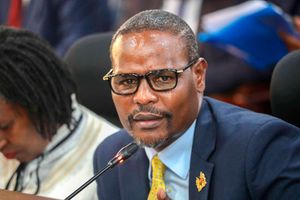
Wilber Ottichilo, chair of the CoG Environment and Climate Change Committee, said counties had been allocating between two and three per cent of their budgets to the initiative.
Mr Ottichilo said counties had prioritised water conservation and distribution, smart agriculture and climate-resilient infrastructure.
“Majority of the projects have been on water conservation and water distribution,” he said, add-ing that counties were introducing small-scale irrigation, building dams and adopting greenhouse technology to boost agricultural production.
He said counties were also addressing infrastructure challenges, including bridges washed away by heavy rains.
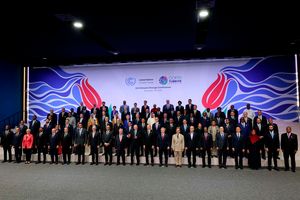
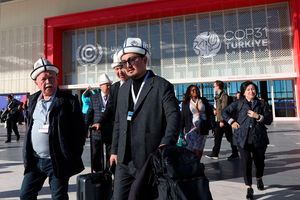
World leaders in Antalya, Turkey, for the UN Climate Change Conference (COP31) in Antalya.
Photo credit: Reuters
Under the World Bank’s Programme-for-Results framework, funding is tied to verified mile-stones rather than upfront commitments. To access subsequent disbursements, counties must demonstrate progress through completed infrastructure, functional administrative systems and compliance with environmental and social safeguards.
The governors say FLLoCA delivers measurable results at the grassroots, raising awareness of climate change while supporting adaptation and mitigation efforts.
Mr Ottichilo said climate financing should prioritise communities rather than large-scale energy projects.
“Climate change can only be handled and succeed at the community level,” he said, arguing that the effects were most severe among communities whose livelihoods depended on climate-sensitive activities.
The Vihiga governor said the delegation had met World Bank President Ajay Banga but did not disclose the outcome or whether any funding commitments had been secured.
Mr Ottichilo said the governors were also presenting their case to UN Secretary-General António Guterres.
CoG chair Muthomi Njuki attributed the programme’s success partly to what he described as limited interference from the national government, saying funds flowed directly to counties, wards and communities.
“FLLoCA money flows directly from the Treasury to the devolved units, to the wards and to the communities that have designed the programme,” he said.
He urged other government programmes to adopt the model, arguing that too much money was spent on recurrent costs such as workshops, seminars and capacity building instead of reaching beneficiaries.
Mr Njuki said the programme had helped counties address challenges in water, agriculture, health and infrastructure. He linked access to clean water to better maternal health, saying many health challenges began with difficulties in accessing safe water.
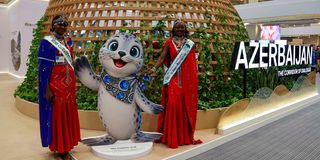
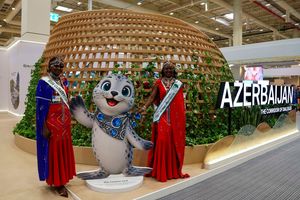
Models from Kenya pose with a mascot in front of the Azerbaijan pavilion on the opening day of the UN Climate Change Conference (COP31) in Antalya, Turkey, November 9, 2026.
Photo credit: REUTERS
He said counties were also targeting health infrastructure as part of efforts to strengthen their resilience to climate change.
Preparations for the second phase were already under way to strengthen counties’ capacity to absorb and utilise additional funding.
“FLLoCA phase two has already started in terms of preparation so that we build the capacity to take up the finances and implement projects, even as the first phase comes to an end,” Mr Njuki said.
With additional funding, counties hope to move beyond small interventions such as community dams and invest in larger water projects serving entire constituencies and counties.