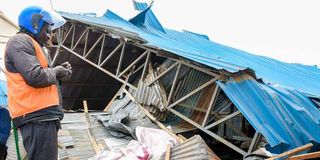
When strong winds tore through a classroom in Nakuru County earlier this year, ripping off the roof and killing a young pupil, the tragedy was widely described as an unfortunate accident, a freak weather incident.
But climate scientists say it may be time to rethink how Kenyans understand wind.
Strong winds are not new to Kenya. They are a familiar feature of the country’s dry seasons, particularly between January and February, and again from July to September.
What is changing, experts warn, is how dangerous these winds are becoming, not necessarily because the weather itself is entirely new, but because climate change, unpredictability and weak infrastructure are colliding in ways that leave communities exposed.
As Kenya grapples with rising temperatures, prolonged droughts and devastating floods, strong winds are emerging as a largely overlooked climate risk; one that can be just as destructive, and in some cases deadly.
According to the Kenya Meteorological Department (KMD), seasonal strong winds are a normal part of the country’s climate system. They are driven by temperature differences during dry periods and by large-scale atmospheric circulation patterns that cut across the region.
A section of the collapsed structure at Kibuye Market in Kisumu on October 3, 2025, after strong winds and heavy rains brought down part of the market.
Photo credit: Alex Odhiambo| Nation Media Ground
One of the most influential of these systems is the Turkana Low-Level Jet, a powerful stream of wind that enters Kenya from the coast, driven by pressure differences between the Indian Ocean and the interior, before channelling through counties such as Isiolo, Marsabit and Turkana, and exiting towards South Sudan.
During the June to September period, the Turkana Low-Level Jet becomes significantly stronger when it interacts with another low-level jet over the Indian Ocean, resulting in the highest sustained wind speeds of the year.
These interactions do not represent new wind systems, scientists say, but seasonal intensification of existing ones, a process that can produce sudden, damaging gusts even in areas not traditionally considered high-risk.
“During the dry seasons, we normally experience high-speed winds due to temperature differences,” says Saumu Tama Shaka, a climate scientist and principal meteorologist at KMD. “This is especially common in January, February and between July and September.”
In areas identified as wind-prone such as parts of northern Kenya, the Rift Valley escarpments and coastal regions, average wind speeds range between 25 and 30 knots.
During certain periods, gusts can reach up to 50 knots, strong enough to uproot trees, damage power lines and tear off weak roofing.
Traders continue with business under a collapsed section of Kibuye Market in Kisumu despite the dangers it may pose on October 3, 2025, after strong winds and heavy rainfall brought down the roof the previous evening.
Photo credit: Alex Odhiambo| Nation Media Ground
In context, a knot is a unit of speed equal to one nautical mile per hour, or exactly 1.852 km/h. In practical terms, a light breeze usually ranges between 5 and 10 knots, while winds of about 15 knots are strong enough to make flags wave fully. At the extreme end, winds of 50 knots, equivalent to roughly 92.6 km/h, are powerful enough to cause damage, including blowing off weak roofs or structures.
These patterns, Saumu explains, are not unusual. What often catches communities off guard is how suddenly wind gusts can intensify or shift direction, spreading damage to areas not traditionally considered high-risk.
However, meteorologists are careful not to attribute every wind-related tragedy directly to climate change. But they are increasingly clear on one point: what turns strong winds into disasters is often what they encounter on the ground.
In the Nakuru incident, preliminary assessments point to structural vulnerability. Light roofing materials, poor anchoring and ageing buildings significantly increase the likelihood of damage when strong winds strike.
“There is greater infrastructural vulnerability where structures are not well grounded, especially roofs and walls,” Saumu says. “When strong winds occur, especially gusts, they can easily blow off roofing in such conditions.”
Schools, in particular, are among the most exposed. Many public institutions were not designed with extreme weather resilience in mind, despite changing climate realities. A single strong gust can turn a classroom into a death trap.
Wind-related hazards also extend beyond buildings. Strong winds can topple trees onto roads and power lines, disrupt electricity and communication networks, and pose serious risks to motorists, especially along open highways where trucks and smaller vehicles can be blown off course.
When winds are accompanied by storms or heavy rainfall, another growing concern in a warming climate, the damage can be compounded.
A section of the collapsed structure at Kibuye Market in Kisumu on October 3, 2025, after strong winds and heavy rains brought down part of the market. Traders have been forced to sell outside their designated areas that were covered by the fallen structure.
Photo credit: Alex Odhiambo| Nation Media Ground
Climate scientists caution against framing wind as a completely new climate phenomenon, instead, they describe climate change as a risk multiplier intensifying existing systems and increasing their potential for harm.
“Climate change doesn’t always introduce new weather patterns,” Saumu explains. “Often, it amplifies what is already there.”
Rising global temperatures increase the amount of energy in the atmosphere, creating stronger pressure differences that can fuel more intense winds.
While direct attribution studies on wind in Kenya are still limited, research published in 2020 suggests climate change could intensify systems such as the Turkana Low-Level Jet.
More studies are underway, but the direction of travel is clear: as temperatures rise, the behaviour of wind systems is likely to become more volatile.
“This is an area that is still under active research,” Saumu says. “But climate change is already affecting temperature and rainfall, and wind is not left out.”
A section of the collapsed structure at Kibuye Market in Kisumu on October 3, 2025, after strong winds and heavy rains brought down part of the market.
Photo credit: Alex Odhiambo| Nation Media Ground
For communities on the ground, this means that even familiar weather patterns may carry unfamiliar risks.
Despite its destructive potential, wind remains one of the most underestimated climate hazards in Kenya.
Floods, droughts and landslides dominate public attention and government response. Wind, by contrast, is often treated as a background inconvenience rather than a serious safety concern.
“People tend to focus more on rainfall and flood-related hazards,” Saumu notes. “Wind hazards are often downplayed, even though they can cause significant damage.”
This gap is reflected in preparedness and policy. While KMD regularly issues weather forecasts and strong wind advisories particularly when wind speeds exceed 25 knots, public response is uneven. Unlike floods, which trigger evacuations and emergency plans, wind warnings rarely lead to concrete mitigation measures.
County governments receive meteorological advisories through regional directors, but translating forecasts into action reinforcing vulnerable buildings, trimming trees and securing schools remains inconsistent.
Experts argue that the problem is not a lack of information, but a lack of follow-through.
“When warnings are issued, people need to act on them,” Saumu says. “Secure loose structures, reinforce roofs and windows, trim overhanging trees, and have contingency plans for shelter if conditions become extreme.”
At an institutional level, this requires rethinking building standards and disaster preparedness. As climate risks evolve, so too must infrastructure design especially for public facilities such as schools, health centres and markets.
The Nakuru tragedy is not just a story about weather. It is a warning about what happens when familiar climate systems meet changing environmental conditions and fragile infrastructure.
As Kenya confronts the realities of climate change, expanding the conversation beyond floods and droughts is critical. Wind may be invisible, but its impacts are not.