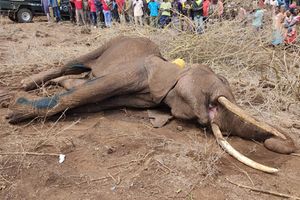
The recent deaths of elephants in Amboseli National Park have renewed attention to what happens to their carcasses and tusks after death.
According to the Kenya Wildlife Service (KWS), the process begins with establishing the cause of death, particularly where disease is suspected. Veterinary officers then determine how the carcass should be handled, depending on the circumstances.
For elephants that die naturally or from causes that pose no disease risk, the carcass may be left in the ecosystem, allowing scavengers to feed on it and return nutrients to the environment.
But where a contagious disease such as anthrax is suspected, the approach changes. The carcass may be buried or burnt, while the surrounding area is decontaminated to prevent the disease from spreading to other animals.
A visitor looks at monuments at the Ivory Burning Site in Nairobi National Park, a historic site where tonnes of ivory were destroyed in a series of landmark ivory destruction to raise awareness about elephant conservation, on August 25, 2026.
Photo credit: Lucy Wanjiru | Nation
Speaking to Climate Action, Dr Isaac Lekolool, KWS veterinary officer, said the location of disposal is also important. Rather than transporting a potentially contaminated carcass over a long distance, KWS seeks to bury it as close as possible to where the animal died.
“It is better to do it as close as possible to the scene or the site where the animal has died,” he explained.
Moving a carcass unnecessarily could result in contaminated material being spilt and potentially spreading the disease to another location.
“The best one is just to bury the carcasses,” Lekolool said. “Burying helps prevent other animals from excavating the remains.”
The area may also be secured after decontamination, including by using thorn bushes in remote locations to discourage other animals from returning to the site.
The choice of decontaminant depends on the suspected disease. Lekolool cited lime-based decontaminants and formalin as examples, but said the treatment varies depending on the type of contamination involved.
According to Lekolool, the answer is no.
The tusks are removed before the carcass is buried, even where a disease such as anthrax is suspected. They are assessed, documented, weighed and measured, with details such as length, width and diameter recorded.
Where circumstances allow, the animal may also undergo a post-mortem examination as veterinarians work to establish the cause of death.
“This distinction is important because the manner in which an elephant died helps determine what happens to both the carcass and the tusks,” Lekolool said.
However, tusks recovered from an animal suspected to have died from a contagious disease require additional precautions because they may also have been exposed to contamination.
“The tusks are first treated to address the possibility of them carrying contaminants,” he said.
They are initially handled in a quarantine-like area away from high human activity before being transferred to secure storage.
The carcass, meanwhile, is buried without the tusks.
In suspected anthrax cases, the carcass is not opened for a conventional post-mortem because of the risk of contamination.
“You do not open the carcass because there is contamination,” Lekolool said.
Once removed and treated, the tusks enter a chain of documentation and storage designed to ensure that every piece of recovered ivory can be accounted for.
“They are all stored in this strong room,” he said, describing the facility as similar to an armoury because of its security features.
The security measures are important because elephant ivory remains valuable on illegal markets, making recovered tusks a potential target for theft or diversion.
“You do not want it to get to the wrong hands,” he said. “Because once it gets to the wrong hands, it might go into the market that could be an illegal market.”
For this reason, recovered tusks are inventoried and stored under strict security arrangements.
When ivory stocks accumulate, the government has also, at various points, opted to destroy rather than release them into the market.
Kenya has previously held high-profile ivory burning exercises, including at Nairobi National Park. President Daniel Moi burned tonnes of ivory there in July 1989, while President Uhuru Kenyatta presided over another major destruction exercise in 2015.
The remains of some of the burnings can still be seen at designated ivory-burning sites in the park.
“Such destruction has been used when government decides to dispose of accumulated ivory stocks,” Lekolool said.
The presence or absence of tusks on a dead elephant can sometimes raise suspicion, particularly when the circumstances surrounding its death are unclear.
Ashes and charred ivory fragments from the remains of burnt ivory at the Ivory Burning Site in Nairobi National Park, on August 25, 2026.
Photo credit: Lucy Wanjiru | Nation
But Lekolool said the recovery of tusks from a carcass does not, on its own, mean the animal was poached.
Veterinarians assess the condition of the carcass and investigate the circumstances surrounding the death to determine whether it was natural or unnatural.
“If they feel like somebody has done it intentionally, then people will think it is an avenue of harvesting the ivory,” he said.
However, he cautioned against automatically linking the recovery of tusks to poaching.
“The circumstances surrounding the death, rather than the mere presence or absence of tusks, form part of the assessment,” he explained.
There is also a common assumption that tusks remain firmly attached to an elephant after death. Lekolool said this is not always the case.
“Tusks can occasionally fall out naturally while an elephant is alive,” he said, particularly where an injury or infection affects the area around the root.
“It’s not quite rare, but once in a while you can find them falling off,” he said.
According to KWS, the information collected during the process also contributes to wildlife management. Details on the animal’s condition, location, measurements and suspected cause of death can help KWS maintain records on elephant mortality and identify patterns that may require further investigation.
“The process provides an opportunity for authorities to monitor threats beyond poaching.” KWS noted. “Disease outbreaks, human-wildlife conflict, injuries and environmental conditions can all contribute to elephant deaths, making the investigation of each carcass an important part of understanding pressures facing elephant populations.”