In Kenya’s arid and semi-arid regions, traditional rain-fed agriculture is becoming increasingly unreliable as prolonged drought and erratic rainfall continue to undermine rural livelihoods.
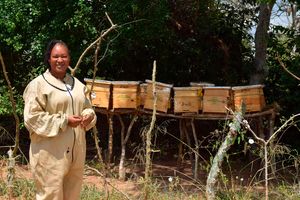
Joan Watheri and Tony Nzomo recognised these challenges and identified beekeeping and value addition as viable alternative sources of income for youth and women. The two founded Yatta Beekeepers Limited in 2018, a social enterprise that equips communities with practical beekeeping skills and supports income generation through honey production.
“As harvests fail and livelihoods disappear, communities are often left with limited survival options, pushing many towards unsustainable activities such as illegal charcoal burning and logging,” Joan says.
She adds that such activities accelerate ecosystem degradation and intensify human-wildlife conflict as shrinking habitats drive animals onto farms in search of food.
“Apiculture requires relatively low capital investment and can be undertaken on a small scale or commercial scale, making it accessible to women, youth and other groups with limited economic opportunities,” she says.
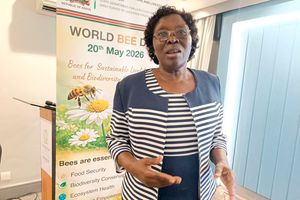
Joan notes that, unlike conventional crop farming, beekeeping requires minimal water and can remain productive even during periods of prolonged drought, making it one of the more climate-resilient livelihood options for dryland communities. Beyond honey, apiculture produces a range of products including beeswax, pollen, propolis, royal jelly and bee venom, while pollination contributes to agricultural productivity and the regeneration of vegetation.
Changing climatic conditions
The enterprise provides training, equipment and related technologies to help farmers adapt to changing climatic conditions and improve productivity. In areas affected by human-wildlife conflict, it promotes the use of bee fences to deter elephant incursions into farms.
Honey products from Yatta Beekeepers Limited are displayed at the company's processing facility in Juja, Kiambu County, on June 11, 2026.
Photo credit: Bonface Bogita | Nation Media Group
“We also provide pollination services for commercial crop production, including fruits and vegetables such as strawberries, cherries, eggplant, watermelons and peppers, particularly in controlled environments such as greenhouses,” she adds.
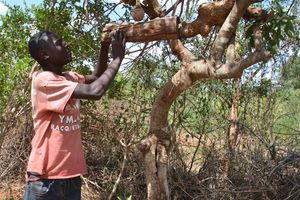
The company conducts site assessments for existing and prospective apiaries, advising farmers on hive placement, environmental conditions, water access and forage availability, as well as general colony management.
Through its training centre, it supports skills development and small enterprise growth, alongside the manufacture and distribution of beekeeping equipment across Kenya and the wider East African region.
Joan says the initiative seeks to convert degraded landscapes into productive apiculture zones that support livelihoods, create employment and strengthen local economies as part of climate adaptation efforts in arid and semi-arid regions.
Working with a team of 15 employees, the enterprise produces more than 10,000 litres of honey per year, aggregating output from beekeepers in West Pokot, Kibwezi and other regions of Kenya, as well as parts of East Africa, before processing it at a central facility in Juja.
The honey is distributed through a warehouse network and a range of stockists across the country. It is packaged from 250 grammes and retails from Sh300, while wholesale prices vary depending on volume and market destination. The company also supplies organic beeswax derived from fresh honeycombs and processed to retain its natural characteristics.
The wax is melted, cleaned and filtered through a vertical leaf filtration system to remove impurities while preserving its colour, aroma and quality. It is then molded into 2.5kg to 3 kg blocks for easier handling, storage and transport, and is available in block form, pallet quantities and full container load shipments.
Nzomo explains that each batch undergoes independent laboratory testing to verify quality, purity, and compliance with organic standards.
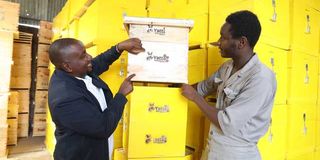
Beekeeping equipment, including honey frames, a smoker, a bee brush, a queen excluder, and other hive management tools, displayed on a wall at Yatta Beekeepers Limited's facility in Juja, Kiambu County, on June 11, 2026.
Photo credit: Bonface Bogita | Nation Media Group
“A Certificate of Analysis (COA) is issued for every batch, covering residue levels (including pesticides and other contaminants), melting point, ester and acid values, hydrocarbon content, and measures of colour and purity,” he adds.
The beeswax is available in different grades depending on end use, including raw, cosmetic, food, and pharmaceutical applications. The cosmetic grade, which meets British Pharmacopoeia (BP) and European Pharmacopoeia (Ph. Eur.) standards, is refined for use in skincare and personal care products.
“It is 100 percent pure beeswax, valued for its structural and stabilising properties, as well as its role as an emollient and protective barrier. It also helps improve texture, consistency, and water resistance in formulations by supporting viscosity and product stability,” he adds.
The company has diversified into the supply of beekeeping equipment, ranging from beehives and harvesting tools to honey extractors, sieves and starter kits for new beekeepers. The move complements its honey aggregation and processing business while supporting the growth of small-scale apiculture. In partnership with county-level Ministry of Agriculture offices, the initiative supports women farmer groups through apiculture projects.
Since its inception, over 5,000 farmers have been trained in climate-smart beekeeping, processing, and packaging, to strengthen technical capacity and improve incomes through bee products.
The enterprise maintains a register of both existing and aspiring beekeepers, helping to strengthen producer networks, facilitate knowledge exchange and support collective action within the sector. It also strengthens linkages between producers and buyers while investing in traceability systems that improve transparency across the value chain and enable farmers to access higher-value domestic and export markets.
However, the business continues to face challenges associated with sourcing from a geographically dispersed network of smallholder beekeepers. Variations in production levels, harvesting methods and post-harvest handling can affect both supply volumes and product consistency.
Nzomo says environmental degradation presents an additional challenge for the sector, as the loss of natural vegetation reduces forage resources and habitats for bees and other pollinators.
“The decline in natural vegetation due to increased agricultural activities has negatively impacted bee and insect populations by reducing their habitat and resources,” he says.
To address these constraints, the company has invested in centralised processing and stricter quality control measures, while strengthening coordination among producers to improve traceability and meet commercial market requirements.
Looking ahead, Joan says the organisation plans to expand climate-smart beekeeping programmes to more vulnerable communities, promote wider adoption of modern apiculture practices and improve market access for smallholder farmers. She adds that the initiative will continue to encourage sustainable land management practices and biodiversity conservation to support healthy bee populations and diverse forage habitats.
“We are also looking to scale up landscape restoration efforts, strengthen traceability systems and expand access to premium export markets for honey and beeswax products,” she says.