Kenya Dairy Board: Milk supply may stabilise in a month if rains improve
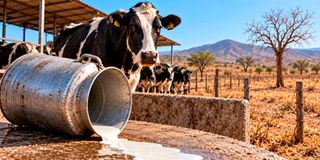
Declining production has affected the milk business over the past three months, with the situation worsening by the day.

What you need to know:
- Nairobi, Mombasa and Kisumu are the hardest hit by the milk shortage
Milk supplies could begin stabilising within a month if rainfall improves and fodder availability recovers, the Kenya Dairy Board (KDB) has said, offering hope to consumers grappling with shortages in major urban centres.
KDB Managing Director, Dr William Kimutai Maritim, told the Nation in an exclusive interview that Nairobi was the hardest-hit market, followed by Mombasa and Kisumu, as reduced milk production and changing distribution patterns disrupted supplies to major urban centres.
“When milk is in short supply, the child is prioritised. Children, especially infants, and older people are given priority in the little milk available,” Dr Kimutai said. He attributed the shortage largely to inadequate animal feed following poor rainfall, which has reduced fodder availability and increased the cost of feeding dairy cattle.


The situation has affected milk deliveries to processors, with preliminary figures indicating that supplies to New Kenya Cooperative Creameries (New KCC) declined by about 5 per cent in July and August.
Dr Kimutai said the Board was updating the figures to establish the extent of the decline in September, warning that the situation could worsen if rainfall remained unreliable.
“We have been waiting for rain, and it is not coming. It can rain for three weeks, and if it stops, we are back to the same situation,” he warned.
The shortage has also altered how farmers sell their milk, with many opting for buyers who pay cash instead of processors and supermarkets whose payment arrangements can delay farmers’ earnings.
Kimutai said farmers had traditionally received between Sh40 and Sh50 per litre from processors, but the shortage had created opportunities to sell directly to buyers offering better prices.
Also read: Are Kenya’s cows stressed? Expert explains milk shortage, gives tips for detecting adulteration
“Farmers have been getting less money and, in a way, subsidising consumers. The current shortage appears to be benefiting farmers because they are now selling milk to willing buyers offering the highest prices,” he said.
Some dairy farmers are already selling milk directly to consumers at Sh80 per litre at their farm gates, showing the differences between processor payments and direct sales.
In Kiambu County, for instance, dairy farmer Salome Ndegwa Waithera, who supplies milk to Limuru Dairy, told the Nation she sells a litre to the processor at Sh50, while customers buying directly from her farm pay Sh80.
“Consumers, gate price a litre I sell at Sh80,” she said in a recent interview.
President William Ruto recently announced that New KCC would increase its farm-gate buying price to Sh65 per litre, a move intended to improve farmers’ earnings.
However, Dr Kimutai cautioned that a higher price paid to farmers would not automatically translate into a similar increase in retail prices.
He said packaged milk in supermarkets was selling at about Sh65 to Sh70 per half-litre, while consumers buying from some kiosks could pay as much as Sh80, depending on availability and local market conditions.
He stated that the shortage had affected supermarket supplies partly because retailers often take time to pay processors for deliveries. Consequently, processors have increasingly directed their limited supplies to outlets that pay cash, including small shops and kiosks.
He said low-income consumers had continued accessing milk through informal outlets, although at higher prices.
“The shortage has not necessarily affected low-income consumers in terms of availability because they do not always buy milk in supermarkets. They buy it from kiosks, where milk is still available, although the prices have gone up,” he explained.
On national production, Dr Maritim said the Board tracks milk delivered through formal channels, including cooperatives and processors, while also estimating milk consumed at home and supplies moving through informal markets.
He noted that formal milk deliveries had increased to about 1 billion litres, up from approximately 700 million litres previously, as farmers became more motivated to sell through cooperatives and other formal channels.
“Delayed payments had previously discouraged farmers from delivering milk to cooperatives, with some processors taking three to four months to pay. Farmers consequently preferred selling directly at the farm to buyers who could pay immediately,” noted the KDB boss.
The shortage comes despite Kenya’s rising national milk production.
During the Agriculture and Food Systems Transformation Summit 2026, held at the Jamhuri ASK Showgrounds in Nairobi from October 7 to 9, President Ruto said annual milk production had increased from 4.5 billion litres to 5.6 billion litres, making Kenya Africa’s largest milk producer.
The President attributed the growth to agricultural reforms, including subsidised fertiliser that has helped farmers expand fodder production and improve livestock productivity.
The Head of State said the country needed to build on the gains by improving farmers’ earnings and increasing production.
“It’s not just the price going up, we are producing more milk today,” President Ruto said during the summit.
The Government has allowed duty-free imports of feed ingredients, including maize and soya, to lower production costs.
Dr Kimutai said the intervention would help, but much of the feed consumed by dairy cattle was grass and other fodder whose availability depended on rainfall.
The Government is also exploring alternative sources of milk, including camels, goats, sheep and water buffaloes, as part of efforts to diversify the dairy sector and reduce pressure on conventional dairy cattle.
At the Agriculture Summit, President Ruto directed the PS for State Department of Livestock Development Jonathan Mueke to develop a plan for introducing water buffaloes into Kenya’s livestock industry.
The proposal has attracted interest from farmers, with the Government reporting about 800 orders from those seeking to acquire the animals.
“Veterinary certification requirements for importing the animals from India have been completed, while negotiations on purchase prices and transportation costs are ongoing,” Mr Mueke revealed in a recent interview.
“We have finished the requirements in terms of veterinary certification to ensure that we can import them into our country. We are now working on the commercial aspect, including how much they cost and how much it will cost to bring them into Kenya,” he said.
The Government is targeting the Murrah breed, a domesticated water buffalo known for its high-butterfat milk, which can be used to manufacture cheese, yoghurt, butter and ghee.
The initial imports are expected to be placed at public research farms to assess the animals’ feeding requirements, behaviour and suitability to local conditions before wider access by private farmers.
Mr Mueke said the initiative could also create opportunities in meat and leather production, adding that Kenya needed to assess the animals’ commercial potential beyond milk.
Follow our WhatsApp channel for breaking news updates and more stories like this