The Judicial Service Commission (JSC) received 127 new petitions against judges in the year to June 2026, putting the process of holding judicial officers accountable under the spotlight.
Of these, 168 were concluded, while 91 remained pending at the end of the financial year, bringing the total number of petitions handled to 259.
According to the Judiciary’s latest State of the Judiciary Annual Report (SOJAR 2025-2026), JSC handled 259 complaints during the period.
Petitions against judges form part of the constitutional accountability process. The Commission considers complaints and may recommend a judge’s removal where legal grounds are established. A petition is not proof of misconduct.
Of the 259 petitions handled, 158 alleged gross misconduct or misbehaviour. Another 55 concerned alleged incompetence, while 46 cited breaches of the judicial code of conduct.
“The majority of petitions against Judges related to gross misconduct or misbehaviour (61.0 per cent),” the report states.
The Commission concluded 168 petitions, about 64.9 per cent of its workload. Of these, 107 were dismissed at preliminary evaluation, 45 after considering judges’ responses, two after full hearings and 14 after petitioners withdrew them. The remaining 91 were carried forward at June 30, 2026.
Chief Justice Martha Koome.
Photo credit: File | Nation Media Group
The report says petitions were dismissed mainly because they challenged the merits of judicial decisions, which should be addressed through appeals or reviews, or lacked sufficient evidence to establish grounds for removal.
“The petitions were dismissed principally because they raised issues relating to the merits of judicial decisions, rather than disciplinary matters,” says the report.
Disagreement with a ruling does not, by itself, establish misconduct. The Commission must determine whether a complaint raises a disciplinary issue. The report does not name judges who faced petitions, identify complainants or detail allegations.
The report also says 16 disciplinary cases involving judicial officers were initiated during the year. It does not provide, in the summary figures, the outcome of each individual matter.
Separately, 80 disciplinary cases involved Judiciary staff, of which 27 were concluded and 53 remained in progress at the end of the reporting period.
Staff allegations included desertion of duty or absenteeism in 38 cases, soliciting or receiving bribes in 20, and tampering with or falsifying court records in 13 cases. Three cases each involved sexual harassment, forged academic certificates and financial malpractice.
In the previous year (2024/25), Judiciary had received 143 petitions and 100 in 2024/23 period.
The figures come amid wider challenges in the administration of justice. Courts received 561,580 new cases and resolved 576,702 in 2025/2026, achieving a 103 per cent clearance rate. Pending cases fell by 15,122 to 579,954 by June 30, 2026.
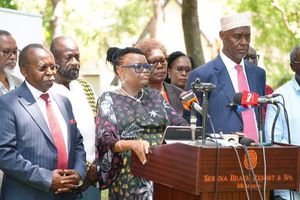
The Judicial Service Commission, led by Chairperson and Chief Justice Martha Koome, issued a detailed statement on the recruitment and selection of judges to the High Court and the Environment and Land Court.
Photo credit: Victor Ngaruiya | Nation
Yet 341,412 pending cases, or 58.9 per cent, qualified as backlog because they had remained unresolved for more than a year. More than half had been pending for over three years. Magistrates’ Courts accounted for 274,177, while the High Court had 40,673.
Courts recorded 274,478 adjournments. The absence of witnesses was the leading cause, the report says. The figures show pressures facing people awaiting decisions in criminal, land, employment and commercial disputes. Absences disrupted hearings at court stations nationwide.
Staffing and funding add to the constraints as the Judiciary says it had 8,017 employees against an approved establishment of 12,079. Its budgetary allocation rose to Sh27.15 billion, but the reported funding gap stood at Sh12.95 billion.
Chief Registrar Winfridah Mokaya said development budget absorption was 47 per cent. She said Sh547 million set aside to buy a building could not be spent after the tender attracted no responsive bid. Stalled projects and contracts also slowed spending.
The report lists reforms including automated registry operations, expanded e-filing and migration to the Jumuika enterprise system.