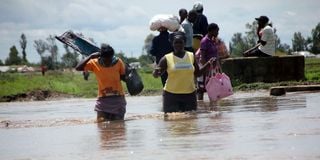
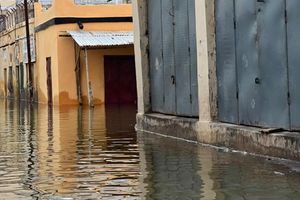
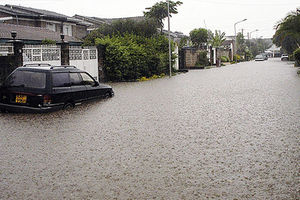
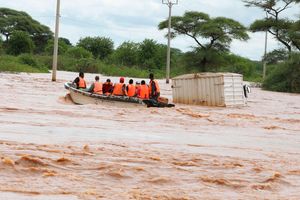
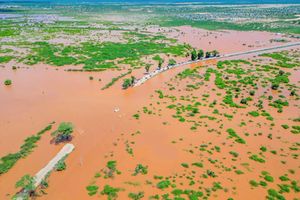
Kenya is staring at a potential humanitarian crisis as deepening global aid cuts threaten the country's ability to prepare for a forecast El Niño season expected to bring severe floods later this year.
Humanitarian agencies warn that shrinking donor support is already straining efforts to tackle hunger, support refugees and prepare for climate-related disasters, raising fears that millions of vulnerable Kenyans could be left exposed if heavy rains strike as forecast.
The Kenya Red Cross Society says a sharp decline in international humanitarian funding has created a significant financing gap just as the country braces for one of its biggest weather-related risks this year.
Kenya Red Cross Secretary General Ahmed Idris said funding from the United States alone has fallen by about 40 per cent. The US has traditionally contributed between $350 million (Sh45.2 billion) and $400 million (Sh51.6 billion) annually to support humanitarian programmes in Kenya.
The funding squeeze comes as the Kenya Meteorological Services Authority (KMSA) warns that the October-November-December (OND) rainy season is likely to be intensified by El Niño, increasing the risk of widespread flooding.
Dr Idris said the humanitarian challenge extends beyond floods as Kenya is already experiencing a prolonged dry spell that is expected to reduce food production before heavy rains arrive later in the year.
According to him, the dry conditions between June and August are likely to reduce food production, while the October to December rains could trigger severe flooding. The rapid shift from drought to floods will make it difficult for communities to maintain a stable food supply.
“We need to mobilise the right partnerships between the private sector, the international community, the donor community, the government and humanitarian organisations so that we put in place certain measures early enough to ensure no Kenyan is affected by the reduced food availability or by the effect of high levels of water that we expect,” he said.
The crisis in Kenya is part of a broader continental emergency. More than 270 million people across Africa are currently food insecure, according to data from the International Federation of Red Cross and Red Crescent Societies (IFRC), with nearly 175 million facing acute food crises.
In Kenya alone, more than 3.3 million people living in arid and semi-arid areas are projected to experience acute food insecurity this year. Refugees are among the hardest hit, with food rations already being reduced because of funding shortages.
Dr Idris spoke in Taita Taveta during the visit of His Majesty King Letsie III of Lesotho, who is the International Red Cross Food Security and Nutrition Ambassador at the African Union. His visit aimed to draw global attention to the impact of climate change on food production.
IFRC Secretary General Jagan Chapagain warned that humanitarian organisations can no longer rely on previous funding levels as global donor priorities shift.
"We are seeing weakening global solidarity. The money available for humanitarian and development work is not what it was five years ago.If we continue responding in the same way with fewer resources, we will not succeed,” he said.
Similar concerns were raised by Immigration and Citizen Services Principal Secretary Belio Kipsang, who warned that dwindling donor support could leave thousands of refugees without life-saving assistance.
Speaking in Mombasa while receiving 10,000 metric tonnes of rice donated by South Korea to the World Food Programme (WFP), Dr Kipsang said many traditional donors had reduced humanitarian funding, forcing aid agencies to cut already inadequate food rations.
He noted that the United States, through the former USAID programme, contributed $390 million (Sh50.3 billion) to WFP's emergency drought response in Kenya in 2022 and 2023, making it the agency's largest single donor.
WFP Kenya Country Director Betty Ka said the rice donation would support nearly half a million refugees over the coming months.
She added that savings made through faster cargo clearance at the Port of Mombasa would be redirected towards pre-positioning emergency food supplies ahead of the expected El Niño season.
Climate experts say the current El Niño has an 81 per cent probability of becoming a very strong event and a 97 per cent chance of persisting into early 2027.
The government has established an ad hoc Cabinet committee chaired by Deputy President Kithure Kindiki to coordinate preparedness measures, including flood mitigation, evacuation planning, protection of critical infrastructure and pre-positioning of emergency supplies.
However, despite the heightened risk, the 2026/27 national Budget contains no standalone allocation for El Niño preparedness, meaning the government is expected to rely on existing disaster management, climate resilience and contingency funds.
Flooding on the Elgon View State Lodge road in Eldoret City, Uasin Gishu County, after the River Sosiani burst its banks following heavy rainfall on March 23, 2026.
Photo credit: Jared Nyataya | Nation
According to climate experts, El Niño, commonly misconstrued as heavy rainfall, is the warm phase of the three phases of a natural climate pattern which is known as El Niño Southern Oscillation (ENSO). The other two phases are Neutral (normal phase) and La Nina (cool phase).
The Head of Public Weather Services at KMSA, Ms Hannah Kimani, explained that ENSO changes the global atmospheric circulation which in turn influences temperature precipitation across the globe.
“In Kenya, we know that El Niño tends to lead to enhanced rainfall while La Nina tends to lead to drought, depressed rainfall and particularly during the O-N-D season. Both events last about a year or so, but it can be shorter or much longer,” she said last Friday, during a presentation on the evolution, forecast and potential impacts of the 2026 El Niño in Kenya.
Ms Kimani said during an El Niño event, the normal weather pattern weakens. The warm ocean waters that are usually concentrated in the western Pacific spread eastwards into the central and eastern Pacific Ocean.
As a result, the western Pacific becomes cooler than normal, while the central and eastern Pacific become warmer than average.
This shift in ocean temperatures also changes atmospheric circulation. The zone of deep convection, where warm, moist air rises to form rain clouds, moves eastwards.
During El Niño, that convection extends closer to East Africa, including the Kenyan coast. This is why Kenya is more likely to experience above-average rainfall and an increased risk of flooding during the October to December season. Last month, the government established an Ad Hoc Cabinet Committee on El Niño Preparedness and Response, chaired by Deputy President Kithure Kindiki.
It was directed to immediately implement a National El Niño Contingency Plan focusing on flood mitigation, evacuation and shelter, drainage clearance, protection of vulnerable roads and bridges, pre-positioning of emergency supplies, farmer advisories, and a contingency fund for relief, recovery and rehabilitation.
Speaking in Nairobi last week, Prof Kindiki assured the public that the government will go out of its way to ensure that the situation will not affect the country’s food security.
“We have agreed to continue meeting every week to make sure that there is enough preparedness for any eventuality,” he said.
He added that the government is also looking at modalities of using part of the crop that failed for processing and making of animal feeds, and preparing interventions for harvesting, drying and storing mature crops. Other interventions will focus on assisting farmers with farm inputs and farm preparation so as to subsidise production in the next planting season.
Public Service Cabinet Secretary Geoffrey Ruku said the government also intends to map all regions prone to landslides so that early warning systems are activated to prevent tragedies.
However, the FY 2026/27 national budget does not include a standalone allocation for El Niño preparedness or response, with the government expected to rely on existing disaster management, climate resilience and contingency funds.