Kenya is emerging as a centre of a widening African debate over the climate crisis as governments push for tougher climate commitments and methane-reduction targets.
This comes amid a growing resistance from pastoralist communities who say they are being unfairly blamed for a crisis they did not create.
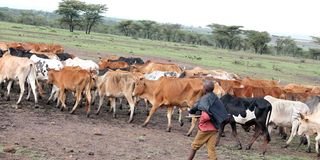
Across Africa’s rangelands, especially among the Maasai community, concerns are rising that global climate policies, carbon credit schemes and conservation programmes could gradually restrict grazing land, reduce livestock mobility and threaten a centuries-old way of life.
Speaking during the African Parliaments for Climate Action forum on Friday, May 15, 2026, Nairobi, Narok Senator, Ledama Ole Kina challenged the direction of global climate policy.
“I care more about the implementation of the emissions policy rather than the policy itself,” he said.
The Senator argued that climate action must not come at the expense of pastoralist survival. He insisted that climate justice must be grounded in the lived realities of local communities.
“I represent a community that depends on cows. If you tell me to reduce from 100 to 2, you must explain how I feed my family,” Ole Kina explained.
For Ole Kina, he describes the matter as a widening disconnect between global climate ambition and pastoralist realities.
He warned that emerging framework, particularly carbon markets and land based climate interventions, risk restricting grazing routes and undermining traditional livelihoods, especially among the Maasai.
“This whole business of carbon credit is now restricting our access to our forests, where we used to graze during drought,” he said. “Do not be lured by developed nations to adopt policies that destroy our way of life.”
Narok Senator Ledama Ole Kina.
Photo credit: Dennis Onsongo | Nation Media Group
There is growing concern among pastoralist communities that, while climate solutions are grounded in science, their implementation may be reshaping land tenure systems, restricting mobility, and altering food systems in arid and semi-arid regions.
According to experts, methane remains one of the most potent greenhouse gases, responsible for roughly 30 per cent of current global warming, yet it persists in the atmosphere for only about 12 years.
Yet Africa is stated to contribute a relatively small share of global emissions of less than 4 per cent of total greenhouse gases but accounts for an estimated seven to nine per cent of global methane emissions, largely from agriculture and livestock systems.
It is this livestock connection that has placed pastoralists at the centre of a global policy debate they did not design. However, experts caution against simplifying the issue.
Dr George Wamukoya, team Leader at African Group of Negotiators Experts Support (AGNES) urged lawmakers to focus less on political rhetoric and more on the architecture of international climate obligations already binding African states under agreements such as the Paris Agreement, the Kyoto Protocol and the UN Framework Convention on Climate Change (UNFCCC)
“The executive gets to negotiates, but parliaments ratify and oversee implementation,” Wamukoya said, “All countries are required to submit nationally determined contributions every five years.”
However, according to Wamukoya, fewer than 30 African countries have submitted their latest climate commitments, known as Nationally Determined Contributions (NDCs). He further claimed that fewer than 20 have standalone climate change laws to translate those commitments into enforceable domestic action.
“The question is not only what we promised internationally,” he said, “but whether we have the legal framework to implement it at home.”
His intervention reframed the debate, not as a clash between tradition and modernity, but as a governance gap in which policies exist on paper yet struggle to reach the communities most affected by them.
Still, for pastoralist communities, the concern is not only institutional capacity, but historical memory.
In recent weeks, activist discussions across social media platforms and grassroots forums have amplified a narrative of “carbon colonialism.”
They argue that carbon credit projects and conservation leases are reproducing older patterns of land dispossession, this time framed through environmental science rather than imperial policy.
They point to restrictions on grazing in forest areas, long-term conservation agreements and land-use contracts marketed as climate solutions.
In these accounts, pastoralists describe being asked to reduce herd sizes or alter mobility patterns in exchange for climate funding or conservation benefits.
Supporters of carbon markets argue these projects provide essential financing for conservation, water access and community infrastructure.
However, according to activists, the economic value extracted from land often far exceeds the compensation received locally, raising questions about fairness, consent, and long-term sovereignty.
“I want policies that target oil and gas industries, the biggest emitters,” he said. “Not policies that undermine communities that contribute the least.”
At the centre of the dispute is a fundamental tension in global climate governance: how to balance emissions reduction with social protection in vulnerable regions.
Africa’s pastoral systems, often cited as both climate-vulnerable and climate-adaptive, are now being re-evaluated through methane accounting frameworks that quantify livestock emissions in ways critics say risk oversimplification.
According to Wamukoya, he acknowledged the sensitivity of the issue, noting that African negotiators have consistently resisted global pressure to impose uniform livestock-reduction targets.
“We cannot be held responsible for global warming we contributed very little to,” he said, referencing past negotiations where Africa pushed back against proposals that could undermine pastoral economies.
He also emphasised that livestock emissions management through improved feed, manure systems and rangeland practices remains part of the broader mitigation toolkit rather than a call for herd reduction.
The policy divide, therefore, is not simply about science. It is about interpretation, implementation, and power.
The fear for pastoralist leaders is that implementation will arrive faster than safeguards. For policymakers, the risk is that without implementation, climate commitments remain empty promises.
The question raised in Nairobi remains unresolved: can global climate policy be implemented in a way that reduces emissions without eroding the cultural and economic foundations of pastoral life?
For Senator Ole Kina, the answer depends on whose voice shapes the rules.
“If we are to move forward as Africa,” he said, “then our policies must not destroy the very people they claim to protect.”