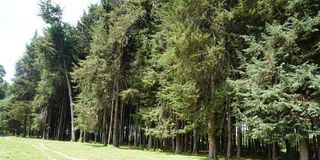
Leaving Nairobi and heading toward the escarpments of the Rift Valley, the urban landscape gradually gives way to open countryside as traffic thins and high-rise buildings disappear from view.
About 73 kilometres from Nairobi, dense stands of trees begin to line both sides of the road. This transition forms a continuous stretch of green, marking the approach to Kinale Forest.
It neither lies hidden beyond miles of rough terrain nor demands hours of planning or a journey off the beaten path, as many of Kenya’s forests do. Instead, Kinale Forest introduces itself immediately, especially to motorists, hikers and travellers.
However, the community remains concerned by how openly it is exposed to human activity, in a way that few ecosystems ever are, including through waste littering.
Daniel Njinu from Kinale Community Forest Association (CFA) shows some of the seedlings at the Kinale Forest Service tree nursery on March 31, 2026.
Photo credit: Kimani Mwangi | Nation
Speaking to Climate Action , Daniel Njinu, the secretary of the Kinale Community Forest Association (CFA), said the forest is increasingly facing pressure from human activities along its edges, raising fears about long-term degradation if protection efforts are not strengthened.
“From Nairobi to where you are going now, this is the first forest you get that cuts across the road,” said Njinu. “It is on both sides. So you get dumping, you get people interfering with it.”
What appears serene from the roadside masks a constant negotiation between conservation and pressure.
Cars slow down to admire it and sometimes to exploit it. Waste is discarded. Water is poured into its soils. Expanding towns nearby drive demand for timber and fuelwood.
Yet within this exposure lies a deeper ecological wealth. Kinale Forest holds over 120 species of medicinal plants. Some of its indigenous trees, like Prunus africana (locally known as Mwiri), Olea africana (Mutamayu) and Dombeya africana (Mukeu), are over a century old.
They are repositories of traditional medicine, biodiversity and ecological memory.
“Some of them you will not find anywhere else,” Njinu said
However, the forest has faced relentless degradation for years. Illegal logging, charcoal burning and weak enforcement have hollowed out sections of its landscape.
Beverlyne Lugano, a resident who has lived near the forest for over 15 years, remembers a different Kinale.
“When I first visited Kinale Forest, it was not good,” Lugano said. “People were coming inside the forest to cut trees irresponsibly. It was being destroyed.”
That destruction was not just environmental , it was also social. Communities living around the forest were often seen as part of the problem rather than part of the solution.
This began to change with policy shifts, particularly after the introduction of the Forest Act and the formalisation of Community Forest Associations, where local communities were no longer excluded but allowed to become co-managers.
“The CFA is formed by people who live within five kilometres of the forest,” Njinu explains. “We sign agreements with the Kenya Forest Service (KFS) and manage together.”
This co-management system allowed communities to legally access forest resources in what are termed user rights. The user rights include activities such as grazing, water access, beekeeping, firewood collection, eco-tourism and the shamba system.
The shamba system is a controlled arrangement where community members cultivate crops in cleared plantation areas while helping to establish new trees.
“We prepare the land, plant and maintain the trees,” Njinu explains. “At the same time, we grow crops. It supports our livelihoods.”
Robert Ngotho told Climate Action that when he arrived as Kinale’s forest manager, he inherited more than trees, he inherited conflict.
“One of the challenges I noticed was disputes within the community leadership,” Ngotho said. “There were disagreements that were affecting how the forest was managed.”
The conflict, largely within the CFA leadership, had stalled progress and weakened coordination. Some leaders resisted leaving office, while political interests complicated decision-making.
According to him, he first started by listening to the grievances tabled by local residents, an approach considered unconventional.
“I went to understand their interests, their passions,” Ngotho explained, “and then I brought all the groups together, including the villages and the chiefs, and we talked.”
Slowly, the tensions eased. Dialogue replaced confrontation. Community structures began to function again.
Njinu believes that this was critical, because without community alignment, conservation efforts in Kinale cannot succeed.
“This forest will only survive if the community takes responsibility,” Njinu noted.
Mercy Rop, the Assistant Forest Manager, Kinale Forest, holds a tree seedling on March 31, 2026.
Photo credit: Kimani Mwangi | Nation
President William Ruto’s 15-billion-tree planting agenda is at the centre of Kinale’s restoration efforts, with the forest playing a key role in advancing this national ambition. At the heart of this work is a tree nursery programme that supports ongoing reforestation within the area.
Originally, such a nursery in Kenya was expected to produce about two million seedlings. But Kinale quickly outgrew that target.
“Initially, we targeted two million seedlings,” Ngotho said. “We have shifted from two million to eight million to fourteen million.”
The expansion required difficult trade-offs. Nearly 20 hectares of plantation forest were cleared to create space for seedling production.
“It is better to lose a small plantation,” he explained, “to raise seedlings that can restore forests across many counties.”
He further explained that the success of any tree depends on various key factors such as water availability, space, accessibility, security and community support.
However, water remains a challenge.
“There is water here, but not enough,” Ngotho noted.
Over 100 local residents have been employed in its operations, providing income and strengthening community ownership.
In addition, eco-tourism has introduced an increasingly important dimension to the forest’s transformation, creating new opportunities that link conservation efforts with local livelihoods and sustainable economic growth.
Stephen Ng’ang’a, a community conservationist demonstrating the how to handle tree seedlings that have been transferred from the nursery to the open farm field on Tuesday, March 31, 2026.
Photo credit: Kimani Mwangi | Nation
Each weekend, according to Njinu, between 100 and 200 visitors come to hike through Kinale’s trails. Young people from the community have been trained as guides, earning income while promoting conservation.
“We used to see people go to other forests such as Karura and Ngong,” Njinu says. “Now they are coming here in Kinale.”
However, one major concern remains: equitable benefit-sharing from timber sales between the KFS and Kinale’s CFA.
“We, the community, get to plant, maintain and prune,” Njinu said. “However, we don’t get to benefit when KFS sells.”
Forests are vital ecological systems that support biodiversity, regulate climate and sustain livelihoods for surrounding communities. They act as carbon sinks, helping to mitigate climate change while also protecting water catchments and preventing soil erosion.
Despite their importance, many forests continue to face pressure from human activities such as settlement expansion, logging and agriculture, which gradually degrade their integrity.
Speaking to Climate Action , Akshay Vishwanath, the Executive Director of Public Interest Litigation and Advocacy for the Environment (PILAE), emphasized that there is an urgent need for stronger protection and accountability in forest management.
“Legal and policy frameworks must be matched with real enforcement on the ground if we are to protect these ecosystems from gradual degradation,” Vishwanath said.
Even as these challenges persist, a new force is reshaping Kinale’s future: youth.
Karen Wanjiru, a 13-year-old environmental champion, has emerged as a remarkable voice in conservation, with a vision that has successfully brought together corporates, communities and conservationists in support of environmental restoration efforts.
On April 10, 2026, her foundation, the Karen Forte Foundation, launched a major restoration initiative in Kinale, targeting 50 acres of degraded forest.
“We are not just planting trees; we are saving our future because our lives depend on this,” Wanjiru said. “We are responsible for protecting the future. That future is us, the children.” The project, supported by partners including Nation Media Group (NMG), Sasini Plc, CKL Africa Limited and Absa Bank Kenya, aims to plant and nurture 22,000 trees over three years.
NMG’s Managing Director and CEO, Geoffrey Odundo, said the media house sees environmental storytelling as a critical tool in driving awareness and accountability.
“This is a very relatable event for us because climate action is one of the things that we champion,” Odundo said.
He pointed to the contradiction between tree-planting efforts and ongoing environmental destruction.
“It’s very sad that we are planting trees while others are burning them. That is an abuse of what we have been given,” he added.
Odundo said NMG will continue to support climate-focused initiatives through its platforms, including dedicated programmes such as EarthWise and Climate Action, and by amplifying voices like Wanjiru’s.
Wanjiru urged institutions and individuals to join the effort.